Clear Sky Science · en
Reduced carbon outflow from a Floridian mangrove estuary up to two years after a hurricane
Why this coastal story matters
Mangrove forests fringe many tropical shorelines and quietly help protect people from storms, support fisheries, and lock away huge amounts of carbon. This study looks at what happens to that hidden carbon pipeline when a major hurricane slams into the largest mangrove forest in the continental United States, in Florida’s Everglades National Park. By tracking carbon flowing from the forest to the sea over five years, including Hurricane Irma in 2017, the researchers uncover an unexpected, long‑lasting drop in carbon outflow that could subtly reshape coastal waters and their ability to buffer ocean acidification.
A coastal forest that feeds the sea
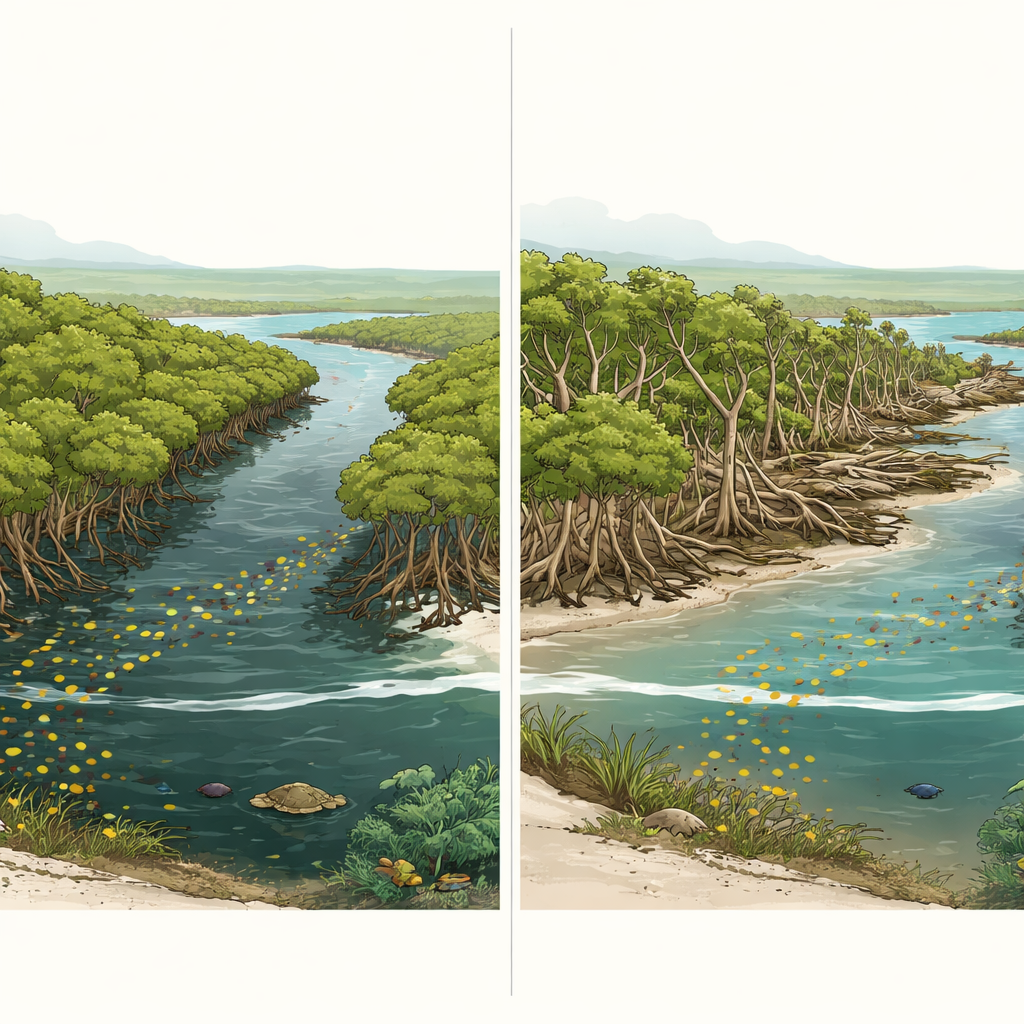
Mangroves are often called “blue carbon” powerhouses because they can store more than three times as much carbon per hectare as most land forests. Part of that carbon is buried in mud, but a large share leaves the forest dissolved in the water as it flows toward the ocean. In the Everglades, the Shark River and nearby channels act like conveyor belts, carrying dissolved organic carbon (from decaying leaves and other plant matter) and dissolved inorganic carbon (a mix of carbon dioxide–related forms in water) from inland marshes and mangrove roots out to the Gulf of Mexico. Once this inorganic carbon reaches the open ocean, it can stay there for centuries or longer, so measuring how much escapes from mangroves is key to understanding the global carbon budget.
Watching a living pipeline over five stormy years
The team continuously monitored water in Shark River from 2014 to 2019 at two points: one farther inland within dense mangroves and one closer to the Gulf. Using instruments that record water chemistry, temperature, and salinity, they reconstructed how much dissolved carbon flowed seaward day by day. They also pulled in data on river flow, tides, and wind. Over typical years, they found that carbon outflow pulses with the seasons. During the wet summer months, heavy rains and higher river discharge push more dissolved carbon toward the sea, while in the drier months, slower flow and longer water residence times favor the build‑up of inorganic carbon formed from the breakdown of organic matter in the sediments.
When the hurricane hit and what happened after
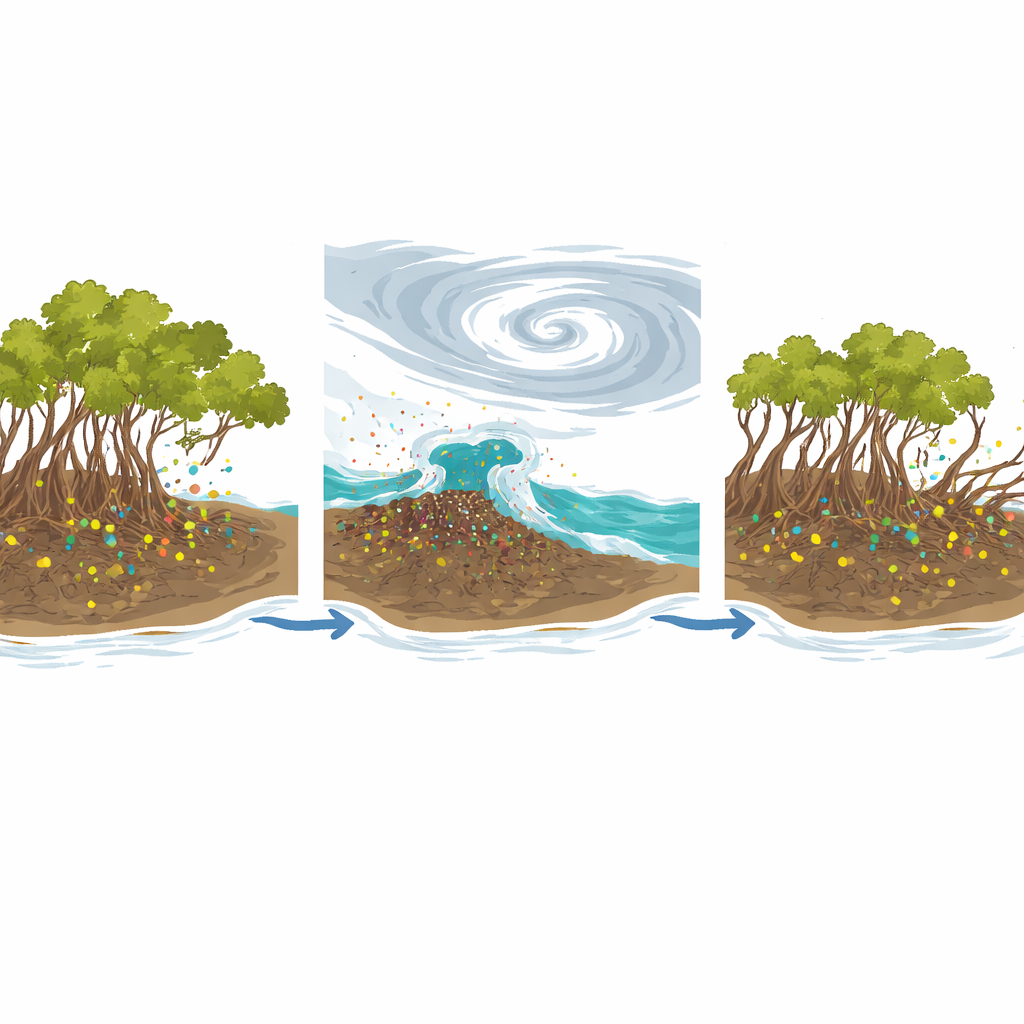
Hurricane Irma, a category 4 storm, struck the Everglades in September 2017, flattening or damaging a large fraction of the mangrove canopy. The storm radically disturbed water levels and river flow for several days, and the scientists expected a surge of carbon outflow as sediments were churned up. Instead, they saw something more subtle but more enduring: beginning just after Irma, both organic and inorganic dissolved carbon fluxes dropped by about half at the inland station and stayed depressed. Short‑term patterns partly recovered within days to months as river discharge went back to normal, yet even two years later, carbon outflow remained significantly below pre‑storm values, especially during the dry season.
Shifting roles of forest and marsh
By separating carbon coming from upstream marshes and from within the mangrove estuary itself, the researchers found that Irma changed who was doing the work. Before the hurricane, nearly half of the exported inorganic carbon at the inland station came from processes within the mangrove zone—such as root respiration, breakdown of buried organic matter, and carbonate dissolution in the sediments. After the storm, the estuary’s share shrank, and more of the carbon that did reach the sea came from landward marshes instead. The scientists link this shift to massive tree mortality and damage, which likely cut root activity and altered sediment conditions even as storm‑mobilized debris and microbes increased oxygen demand in the water. In effect, the mangrove engine that had been steadily feeding carbon to coastal waters began running in a lower gear.
What this means for coasts and climate
The main takeaway is that big hurricanes do not just topple trees; they can also throttle back the long‑term flow of dissolved carbon from mangrove forests to the ocean. Because this export helps shape coastal water chemistry and provides a pathway for carbon to be stored offshore for millennia, a sustained reduction could weaken the ability of mangrove‑lined coasts to buffer local ocean acidification. As climate change is expected to make powerful storms like Irma more common, this study suggests that current global estimates of mangrove carbon export may be too high if they overlook storm damage and slow recovery. Long‑term measurements, though difficult in such harsh environments, are therefore crucial to capture both the immediate and delayed effects of extreme events on the coastal carbon cycle.
Citation: Stegehuis, A.I., Ho, D.T., Bopp, L. et al. Reduced carbon outflow from a Floridian mangrove estuary up to two years after a hurricane. Commun Earth Environ 7, 395 (2026). https://doi.org/10.1038/s43247-026-03249-w
Keywords: mangroves, hurricanes, carbon cycle, Everglades, coastal ocean acidification