Clear Sky Science · en
Magnetic clusters in the paramagnetic phase of a high-temperature ferromagnetic metal–organic framework
Magnets Built from Sponges of Atoms
Magnets usually bring to mind heavy metal bars or sleek headphone drivers, not airy, sponge like crystals. This study explores a new type of magnet made from a metal–organic framework, a highly porous material better known for trapping gases. The work reveals how such a lightweight, chemically tunable crystal can behave like a near room temperature magnet while also hosting subtle, cluster like magnetic behavior usually seen in dense metal oxides.
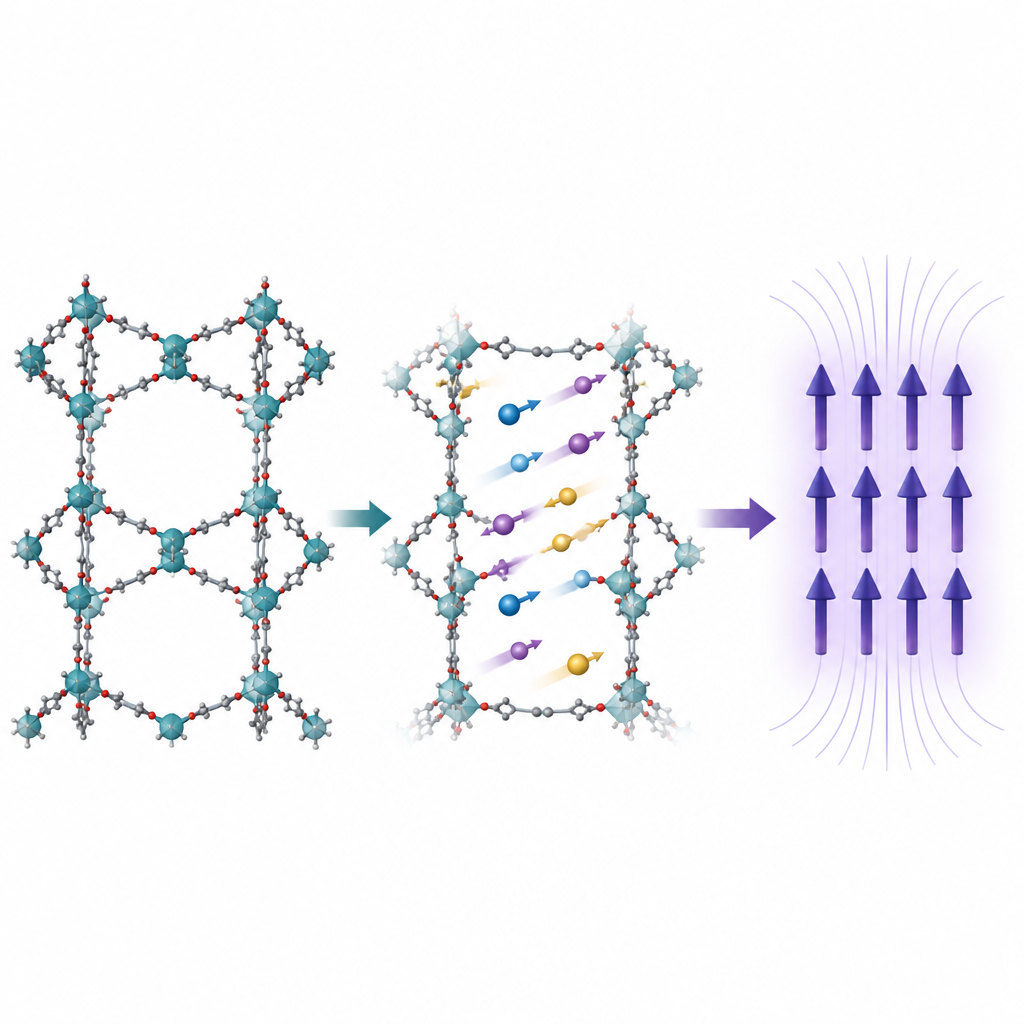
Why Porous Crystals Can Become Magnets
Metal–organic frameworks are built from metal atoms joined by organic linkers, forming open networks shot through with tiny cavities. Their structure and chemistry can be tuned almost at will, which has made them popular for gas storage, separation, and catalysis. Turning them into strong magnets, however, is difficult because the metals are spaced apart by nonmagnetic molecules, which usually weakens the interaction between magnetic moments and forces the ordering temperature down to the realm of liquid helium.
A Special Chromium Framework with Strong Magnetism
The material at the center of this work is a chromium based framework called Cr(tri)2(CF3SO3)0.33, where triazole groups link chromium ions into a three dimensional network with large pores. Inside each pore sit disordered triflate units that balance electric charge and place chromium in a mixed valence state, containing both Cr2+ and Cr3+. That mixture allows electrons to hop between sites and align neighboring spins through a process known as double exchange, giving rise to a ferromagnetic state that sets in just below room temperature and produces a sizable change in electrical resistance.
Watching Local Magnetic Motion with Nuclear Probes
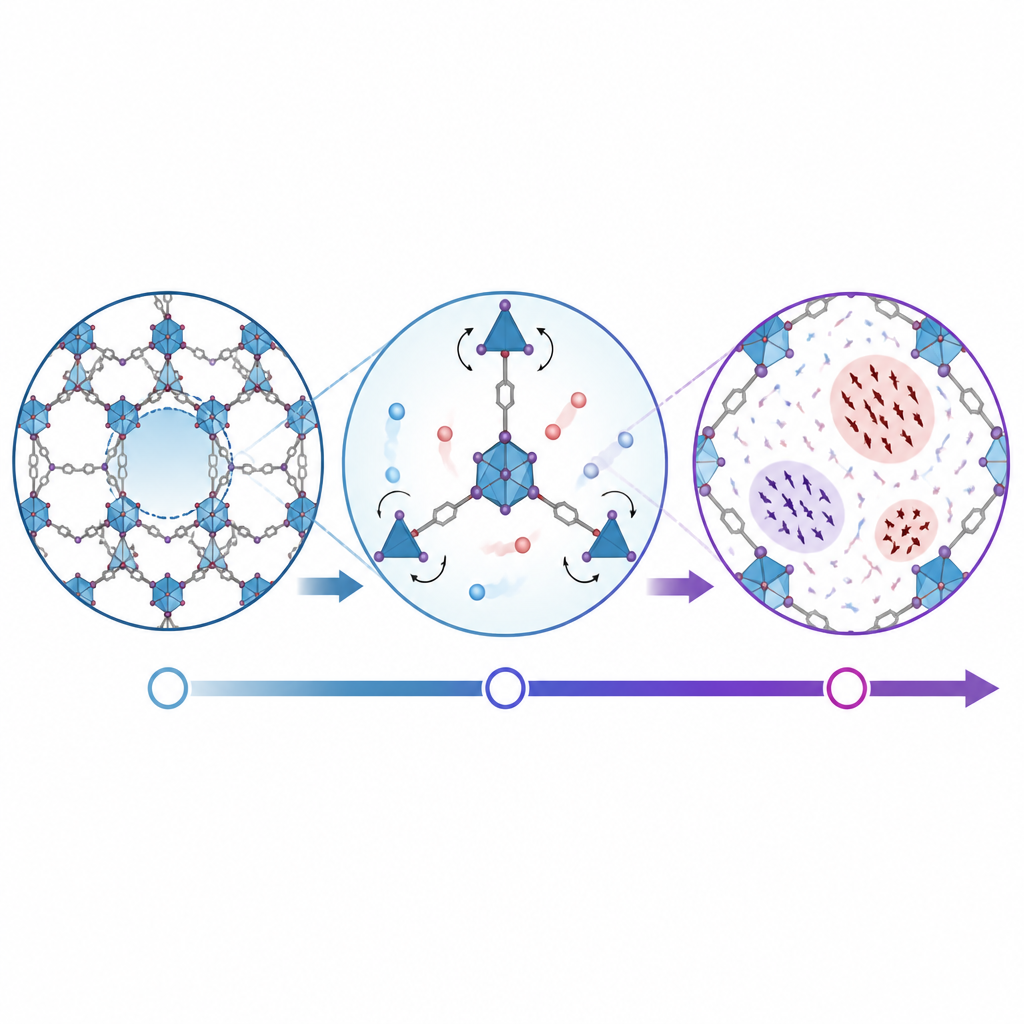
To look inside this unusual magnet, the researchers combined bulk magnetic measurements with two spectroscopic tools that sense tiny local fields: nuclear magnetic resonance and ferromagnetic resonance. Hydrogen nuclei on the triazole linkers and fluorine nuclei on the triflate groups act as built in probes of their surroundings. As the sample is cooled, both types of nuclei see their signals broaden, showing that internal magnetic fields are growing throughout the structure. By tracking how quickly the nuclear magnetization relaxes back to equilibrium, the team identified several temperature dependent processes that slow down or speed up the local magnetic fluctuations.
Hidden Charge Motion and Moving Molecular Groups
The relaxation data reveal three main ingredients in the magnetic dynamics. At lower temperatures, around 110 kelvin, the rate points to slowing electron hops, consistent with charges gradually becoming more localized as the material turns less conductive. Around 170 to 190 kelvin, both hydrogen and fluorine nuclei show a broad peak that matches the expected motion of the triflate groups rotating inside the pores. Similar behavior is known from polymers that contain the same chemical group, but here the surrounding magnetic lattice makes the effect much stronger, demonstrating how molecular motion and magnetism can intertwine inside a single crystalline material.
Magnetic Clusters Above the Ordering Point
Perhaps the most intriguing feature appears at higher temperatures, between about 230 and 250 kelvin, where the hydrogen nuclei sense another activated process even though the bulk crystal is still in its nominally disordered, paramagnetic state. The critical behavior of the magnetization, extracted from scaling analyses, also looks unusual and suggests that regions of the material start to behave as tiny ferromagnetic clusters before the whole sample orders. This kind of clustered state, in which islands of magnetically aligned regions coexist with a more disordered background, echoes the behavior seen in manganese and cobalt oxides that display colossal magnetoresistance, although here it does not exactly match the textbook picture known as a Griffiths phase.
What This Means for Future Magnetic Materials
In plain terms, this work shows that a lightweight, highly porous crystal can host rich and complex magnetic behavior usually reserved for dense inorganic oxides. The chromium framework not only becomes ferromagnetic at relatively high temperature but also forms magnetic clusters and supports internal molecular motion that couples to its spins. These findings position magnetic metal–organic frameworks as promising playgrounds for exploring correlated electron physics in materials whose structure and composition can be finely adjusted, opening paths toward tailor made magnets and devices based on low density, tunable solids.
Citation: Prando, G., Costarella, B., Dickson, M.S. et al. Magnetic clusters in the paramagnetic phase of a high-temperature ferromagnetic metal–organic framework. Commun Mater 7, 132 (2026). https://doi.org/10.1038/s43246-026-01142-9
Keywords: metal organic framework magnetism, ferromagnetic clusters, chromium framework, nuclear magnetic resonance, colossal magnetoresistance analogs