Clear Sky Science · en
Collapse of Jahn-Teller phonons in La1−xSrxMnO3 with weak magnetoresistance
Why tiny changes in crystals can switch electricity
Some metal oxides can dramatically change how easily they conduct electricity when exposed to a magnetic field, a phenomenon called colossal magnetoresistance. These materials are promising for future data storage and sensing technologies, but the microscopic dance between their atoms, electrons, and magnetic moments is still debated. This paper looks inside one such family of crystals and finds that a subtle kind of atomic vibration behaves in a surprisingly extreme way, even when the overall electrical effect is relatively modest.
The strange behavior of a well-known material family
The study focuses on perovskite manganites, crystals built from manganese and oxygen octahedra with lanthanum and strontium atoms in between. These compounds can show colossal magnetoresistance, where their electrical resistance can change by factors of hundreds or more in magnetic fields. Earlier theories tied this behavior to a mechanism in which electrons hop between manganese atoms while tugging strongly on the surrounding oxygen cage, creating special distortions known as Jahn–Teller distortions. The prevailing view has been that the stronger this electron–lattice coupling, the larger the magnetoresistance.
Probing atomic vibrations with neutron beams
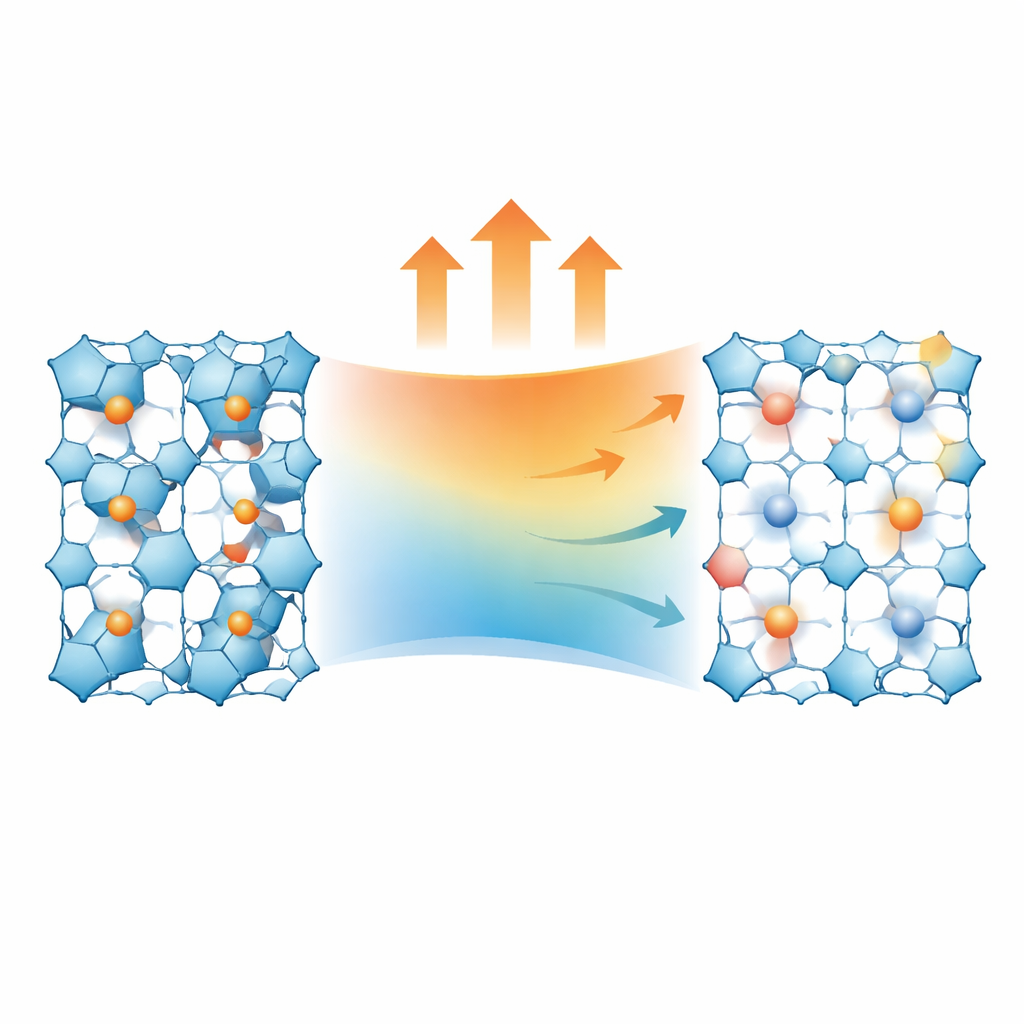
To test this picture, the authors used high-resolution neutron scattering, a technique that maps both magnetic excitations (spin waves) and atomic vibrations (phonons) throughout the crystal. They studied two compositions, La0.7Sr0.3MnO3 and La0.8Sr0.2MnO3, which become ferromagnetic below about 350 K and 305 K, respectively, but show only modest magnetoresistance compared with classic colossal systems. At low temperature, the measurements revealed textbook-like behavior: the magnetic excitations followed simple sinusoidal patterns that could be described by a basic Heisenberg model, and most phonons matched detailed computer calculations based on density functional theory. This indicated that, in the ordered magnetic state, both the spins and the atomic lattice act in a conventional, well-understood manner.
When magnetism melts, a key vibration vanishes
As the crystals were heated above their Curie temperatures, where ferromagnetism disappears, an unexpected transformation took place. A whole family of oxygen vibrations involving stretching of the manganese–oxygen bonds and carrying Jahn–Teller character abruptly lost its inelastic signal along the edge of the Brillouin zone, a region describing collective motions across many unit cells. Rather than just softening or broadening slightly with temperature, these modes essentially collapsed: they were strong and clear at low temperature but gone at high temperature. Careful analysis ruled out mundane explanations such as a change in crystal symmetry, twinning of domains, or strong mixing between spin waves and phonons. Theoretical phonon calculations for both known structural phases still predicted these modes should be present, pointing to a genuinely anomalous effect tied to how electrons interact with the lattice.
From sharp vibrations to diffusive distortions
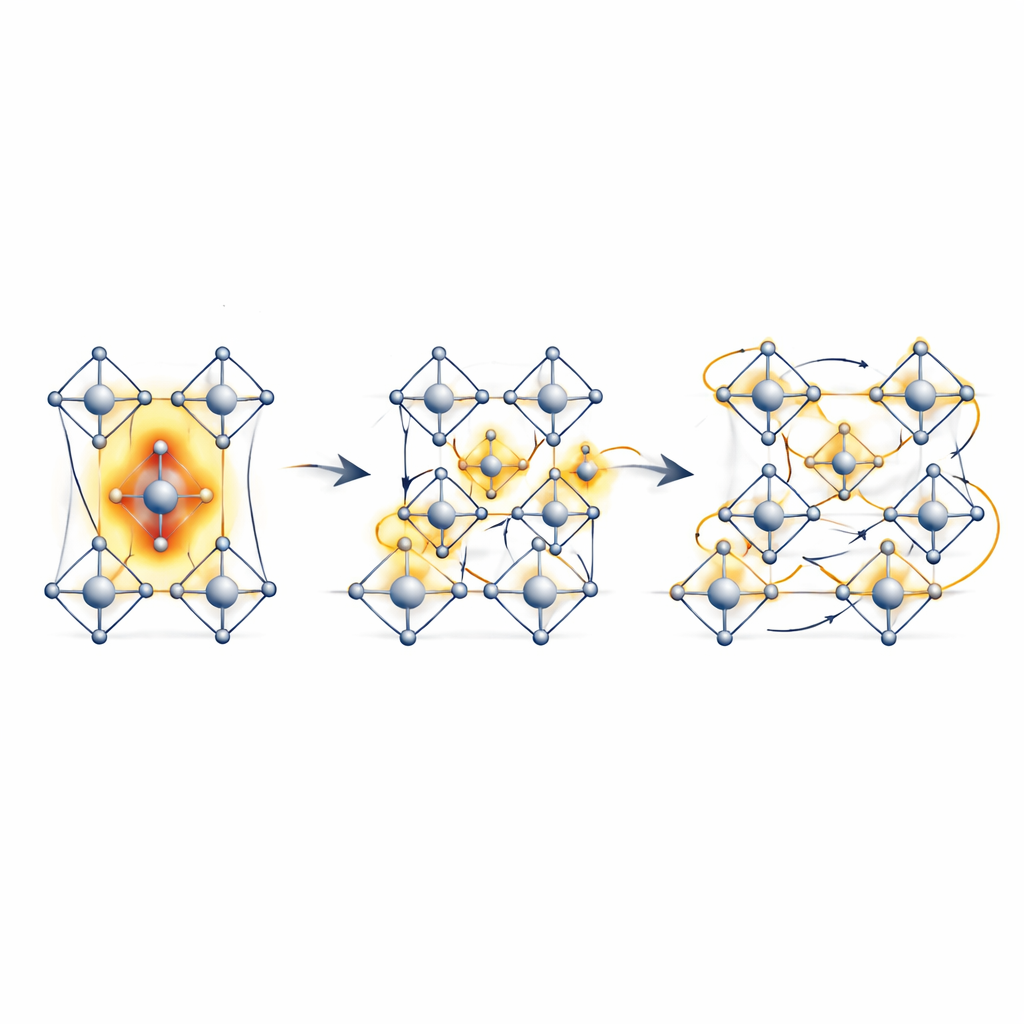
Because the total scattering intensity must be conserved, the missing vibrational weight must reappear elsewhere. The authors found that it does not simply move into lower-energy phonon peaks. Instead, above the magnetic transition temperature, they observed enhanced quasielastic scattering: a broad signal centered near zero energy that indicates very slow, almost frozen fluctuations. This signal appears at large momentum transfers where magnetic contributions are negligible, so it must come from the lattice. The picture that emerges is that the Jahn–Teller bond-stretching modes do not vanish; they transform from well-defined travelling waves into slowly moving, charge-trapping distortions of the oxygen sublattice that diffuse through the crystal. In other words, the lattice distortions associated with the electrons become more like wandering, short-lived local deformations than clean, extended vibrations.
Rethinking what controls colossal magnetoresistance
Perhaps the most surprising aspect is that this extreme “collapse” of Jahn–Teller vibrations appears in compounds that show only weak magnetoresistance, not just in those with colossal effects. Other experiments have also shown that the size of the oxygen displacements in these weaker compounds is comparable to that in classic colossal systems. Taken together, these results challenge the simple idea that the magnitude of magnetoresistance is set mainly by how strongly electrons couple to Jahn–Teller distortions. The authors propose instead that the crucial factor is how fast these distortions move. In materials with huge magnetoresistance, the distortions are slow or nearly static, strongly pinning charge carriers; in those with weaker effects, the distortions diffuse more rapidly, allowing charges to move more easily. This shift in emphasis from distortion strength to distortion mobility calls for new theoretical models and could guide the design of future oxide electronics that harness, or deliberately suppress, colossal magnetoresistance.
Citation: Sterling, T.C., Savici, A.T., Kajimoto, R. et al. Collapse of Jahn-Teller phonons in La1−xSrxMnO3 with weak magnetoresistance. Commun Mater 7, 121 (2026). https://doi.org/10.1038/s43246-026-01139-4
Keywords: colossal magnetoresistance, electron phonon coupling, Jahn-Teller distortions, perovskite manganites, neutron scattering