Clear Sky Science · en
Characterising a stress-sensitive default mode network (DMN) deficit in major psychiatric disorders
Why early stress and thinking problems matter
Many people who live through difficult experiences as children later struggle with depression, psychosis, addiction or eating disorders. They also often find it harder to concentrate, remember things, or make decisions. This study asks whether a specific brain network that is active when we daydream or think about ourselves might help explain how early stress relates to these thinking problems across several different mental health conditions.
A quiet-time brain network under stress
When we are not focused on a task, certain brain regions work together in what scientists call the "default mode" network. It supports inner thoughts, memories, and understanding other people. In this study, young adults with major depression, alcohol use disorder, psychosis, eating disorders or ADHD took part in brain scans while they watched faces showing anger or neutral expressions. Researchers focused on four key hubs in this network and checked how strongly they talked to the rest of the brain during this social task.
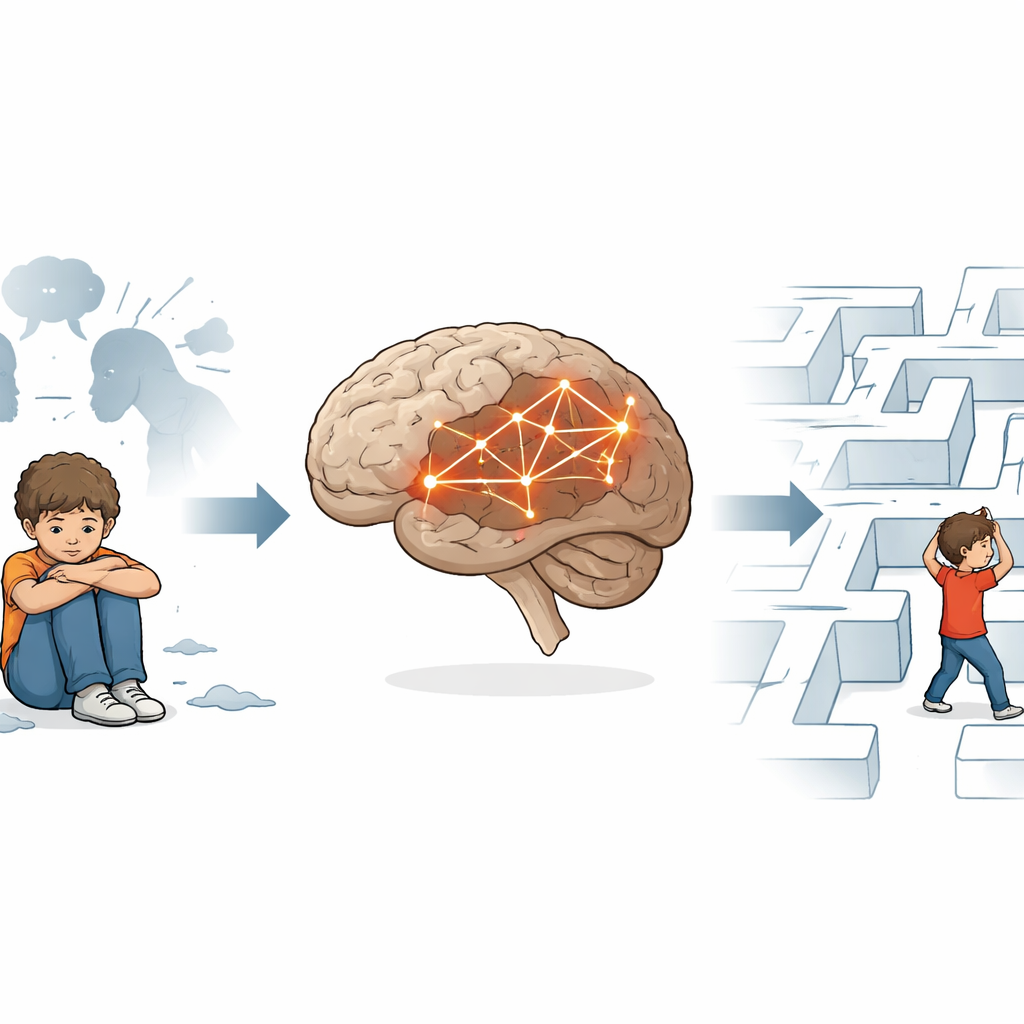
Linking childhood hardship, brain wiring and memory
The same volunteers completed detailed questionnaires about childhood trauma, including emotional and physical neglect or abuse, and sexual abuse. They also performed computer-based thinking tests that measure how well people can hold locations in mind, shift attention, and make decisions under risk. Across more than 1800 participants, those who reported higher levels of childhood trauma tended to perform worse on a spatial working memory task, which requires keeping track of where items have already been found.
Weakened brain connections across diagnoses
Compared with healthy peers, patients from all diagnostic groups showed weaker connections within the default mode network while viewing faces. In particular, links between frontal and parietal regions and a key area called the precuneus were reduced. Some subgroups, such as people with depression or alcohol use disorder, showed stronger activity in certain connections, hinting at a more complex pattern rather than a simple on-off problem. Overall, though, the common theme was that this inner-thought network was less well coordinated during a task that requires reading social cues.
How disrupted wiring may pass on the impact of trauma
Next, the team tested whether these altered brain connections helped to explain the bridge from childhood trauma to poorer thinking skills. Using statistical models, they found that reduced connectivity between parts of the parietal cortex and the precuneus acted as a go-between: higher trauma scores were linked to weaker connections, which in turn were linked to more errors and less efficient strategies on the spatial working memory task. This pattern was especially strong in people with depression, suggesting that trauma-related changes to this network may be particularly important in that group.
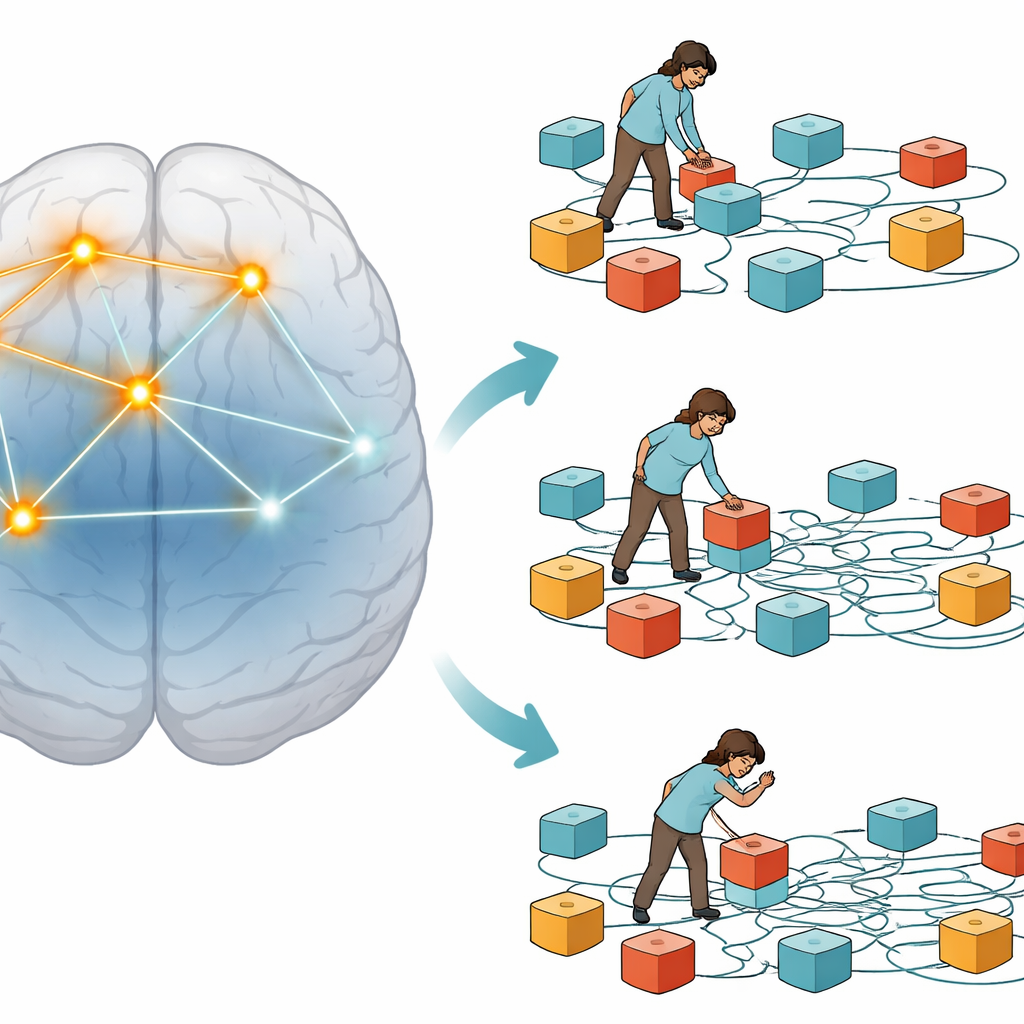
What this means for mental health care
To a layperson, the findings suggest that early life stress may leave a lasting mark on how certain brain regions communicate when we process emotions, and that this disrupted wiring is tied to later difficulties with everyday thinking and memory. While the study cannot prove cause and effect, it points to a shared brain pathway that cuts across traditional diagnoses. In the future, treatments that support healthier patterns in this quiet-time network, or that directly target thinking skills, may help reduce the long-term cognitive burden of childhood trauma.
Citation: King, S., Zhang, Z., Robinson, L. et al. Characterising a stress-sensitive default mode network (DMN) deficit in major psychiatric disorders. Commun Biol 9, 603 (2026). https://doi.org/10.1038/s42003-025-09400-1
Keywords: childhood trauma, default mode network, working memory, psychiatric disorders, brain connectivity