Clear Sky Science · en
CancerLLM: a large language model in cancer domain
Why this matters for patients and doctors
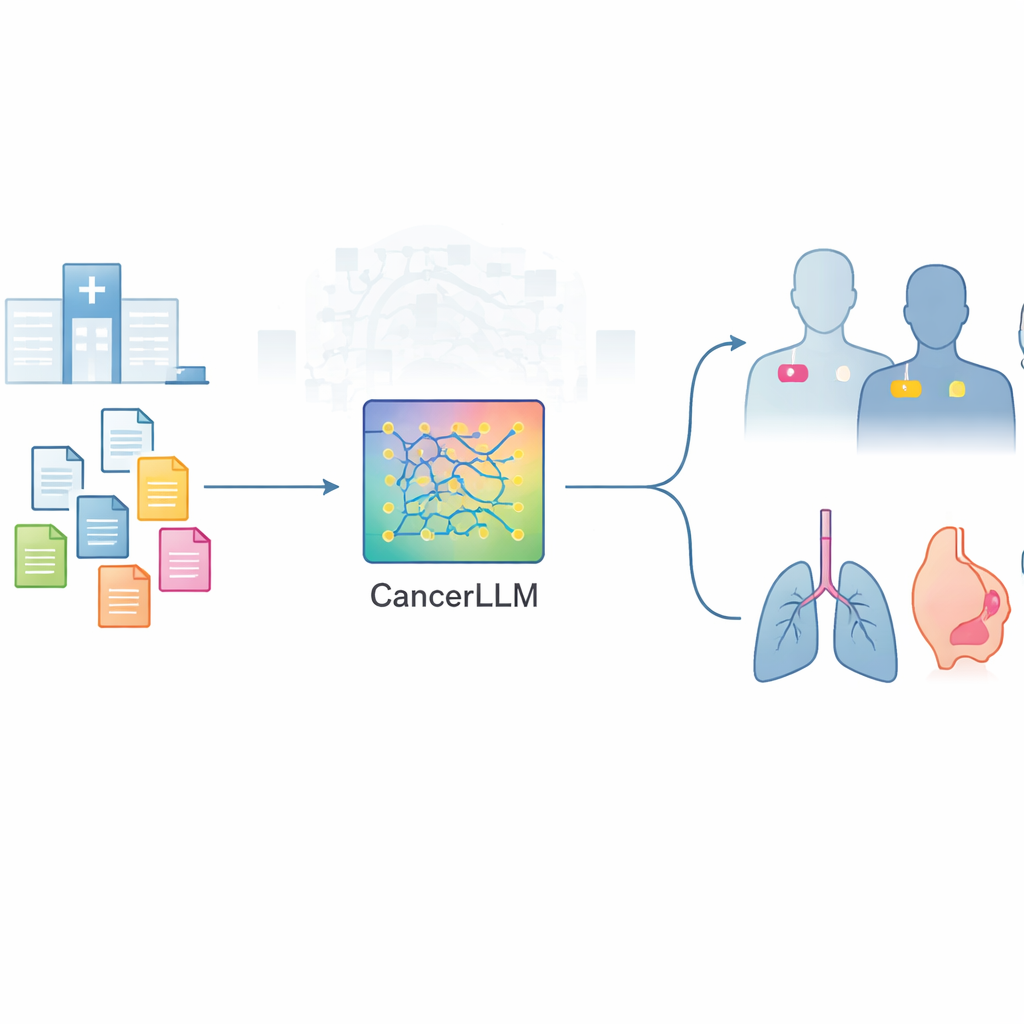
Cancer care depends on making sense of huge volumes of text — from doctors’ notes to lab reports. Most artificial intelligence systems that read this text are generalists, not cancer experts, and they are often enormous, expensive, and hard for hospitals to run. This paper introduces CancerLLM, a smaller language model trained specifically on cancer records that promises more accurate help with understanding a patient’s cancer and doing so with far fewer computing resources.
A new digital assistant focused on cancer
The researchers set out to build a language model that “thinks” in the language of oncology. Instead of scraping the open web, they trained CancerLLM on 2.7 million cancer clinical notes and over half a million pathology reports from more than 30,000 patients across 17 types of cancer, including breast, lung, colorectal, and leukemia. They started from an existing 7‑billion‑parameter model architecture and then continued training it on this cancer‑rich material, followed by a second phase where the model was taught to follow task‑style instructions similar to how a doctor might query a digital assistant.
Helping pull key details out of complex reports
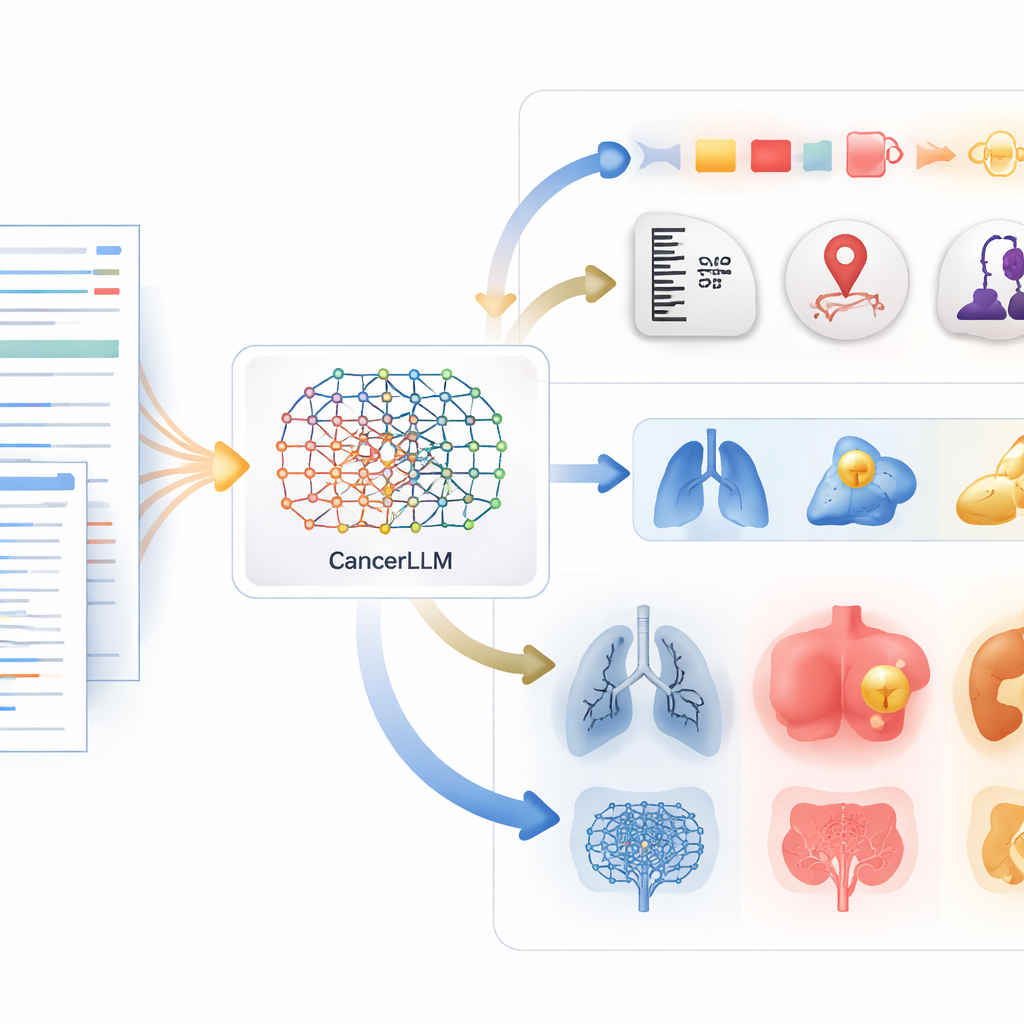
One major job for CancerLLM is “phenotype extraction”: pulling out specific cancer features from free‑text reports. These features include where the tumor is, how big it is, its grade and stage, and the status of hormone receptors that guide treatment. Traditional systems treat this as a token‑by‑token labeling problem, but the authors instead turned it into a question‑answering task. For each report sentence, the model is asked simple questions such as “What is the tumor size?” or “What is the stage of cancer?” and must respond with the relevant phrase or reply that the question is not relevant. On this task, CancerLLM matched or beat many larger general medical models, achieving very high accuracy while remaining compact enough for practical clinical use.
From scattered notes to a clear diagnosis
The second key task is diagnosis generation. Here the model receives a realistic slice of a cancer visit: reasons for coming to clinic, treatment site, symptoms, nurse observations, physical findings, and test results. It must then produce the correct cancer diagnosis, such as lung cancer or non‑Hodgkin lymphoma. Across a large benchmark, CancerLLM substantially outperformed well‑known medical models with up to ten times as many parameters, boosting a combined accuracy score by over nine percentage points on average. In a separate test on an independent group of 2,000 patients it had never “seen” before, CancerLLM again came out on top, suggesting it can generalize to new patients rather than simply memorizing earlier cases.
Testing toughness in messy real‑world data
Real clinical records are not clean: they contain typos, abbreviations, and even occasional labeling errors. The team built two special testbeds to probe how fragile or sturdy the model is under such noise. In one, they deliberately mixed in wrong answers during training to mimic mis‑labeled data and found that CancerLLM held up as well as or better than comparable models, especially when the error rate was very high. In another, they added spelling mistakes like “cnacer” instead of “cancer” at different rates. Both CancerLLM and a strong comparison model showed performance drops as errors mounted, underscoring that even advanced AI is sensitive to messy text and that careful data entry and preprocessing remain crucial.
Speed, efficiency, and current limits
Because hardware budgets in hospitals are tight, the researchers also compared computing time and memory use. Large 70‑billion‑parameter models could squeeze out slightly better performance on some extraction tasks but required several times more memory and much longer processing times. CancerLLM, by contrast, delivered leading or near‑leading accuracy for both extraction and diagnosis while running on a single high‑end graphics card with modest memory needs. Error analysis revealed that the model still struggles with very fine‑grained distinctions, such as subtle cancer subtypes, complete staging details, and heavy use of shorthand or misspellings in notes, pointing to areas where more data cleaning and future model refinement will be needed.
What this means for the future of cancer AI
In everyday terms, CancerLLM is like a compact, cancer‑savvy text reader that can rapidly distill critical details from medical records and suggest likely cancer diagnoses, all while being realistic for hospitals to run. It does not replace oncologists, but it could save them time, support research studies, and reduce missed details in complex charts. By releasing both the model framework and synthetic datasets, the authors aim to spur further work on trustworthy, efficient AI tools that are tuned to specific medical domains rather than one‑size‑fits‑all systems.
Citation: Li, M., Zhan, Z., Huang, J. et al. CancerLLM: a large language model in cancer domain. npj Digit. Med. 9, 266 (2026). https://doi.org/10.1038/s41746-026-02441-8
Keywords: cancer AI, clinical text mining, diagnosis support, medical language models, oncology informatics