Clear Sky Science · en
Illuminating the black box of reservoir computing
Peeking Inside a Clever Type of Neural Network
Many modern AI systems are impressive but mysterious, especially when they deal with information that unfolds over time, such as speech, gestures, or changing weather. This study looks inside one such approach, called reservoir computing, to find out how simple these systems can be while still working well, and which design choices really matter when they are used for different kinds of tasks.
How a Reservoir Computer Handles Information
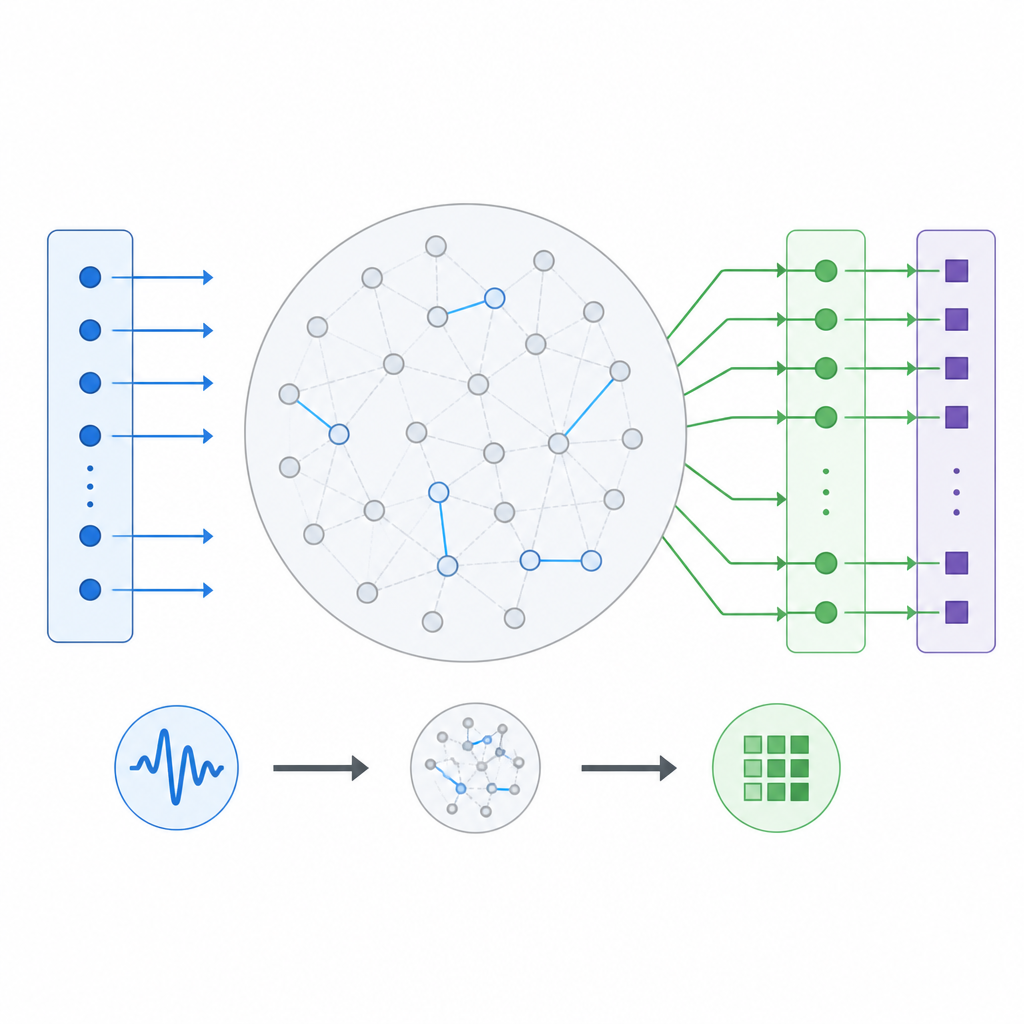
In a reservoir computer, incoming signals first pass through a fixed web of interconnected units, the reservoir, and then into a trainable output layer that produces the final answer. The twist is that only the last layer is trained, while the internal connections are mostly random and left untouched. The authors treat this setup as a machine that turns an input sequence into an output sequence, and they systematically vary how many units are in the reservoir, how strongly they influence one another, and how sharply each unit responds to its input. They also experiment with different shapes of the response curve, including smooth curves, simple straight lines, and switch-like on–off behavior, as well as different ways of wiring the inputs into the reservoir.
Simple Dynamics Can Still Remember the Past
One set of tests asks the system to remember and later reproduce short random sequences of numbers. For this “sequence memorization” task, the reservoir must keep fading traces of earlier inputs without letting them be completely overwritten by new ones. The researchers find that there is a sweet spot: if the internal connections are too weak, signals never spread beyond a few units and memory fails; if they are too strong, the activity becomes irregular and chaotic, and useful traces are lost in the noise. Good performance occurs in a calm regime where activity quickly settles after each input, and where the units behave almost linearly. Surprisingly, in this memory-focused task, using purely linear units, without any built-in nonlinearity, can work even better than the standard squashing curve.
When Curved Decision Boundaries Are Needed
Another task focuses on classification rather than memory. Here the system sees single points in a two-dimensional plane and must assign them to one of two classes arranged in a checkerboard of small square regions. This demands curved decision boundaries, because straight lines cannot carve the plane into such a patchwork. In this non-temporal setting, the recurrent wiring of the reservoir barely matters at all, and the system behaves like a feedforward network with a fixed hidden layer. What turns out to be crucial is the shape and steepness of the units’ response curves. Smooth nonlinear responses, scaled to an intermediate steepness, allow the output layer to draw boundaries that closely follow the checkerboard pattern, while simple linear or hard switch-like responses perform poorly.
Learning the Rules of a Digital World
The authors then challenge the system with a tougher non-temporal problem: predicting the next state of a small cellular automaton, a simple digital universe where each cell turns on or off according to the pattern of its neighbors. To succeed, the reservoir computer must infer the hidden update rule from examples and apply it to new patterns it has never seen. Here, both the recurrent structure and smooth nonlinearity are important, and larger reservoirs help a lot. With enough units and well-chosen response steepness, the system can reach perfect accuracy for complex rules, effectively reproducing the automaton’s behavior step by step.
Generating Sequences on Demand
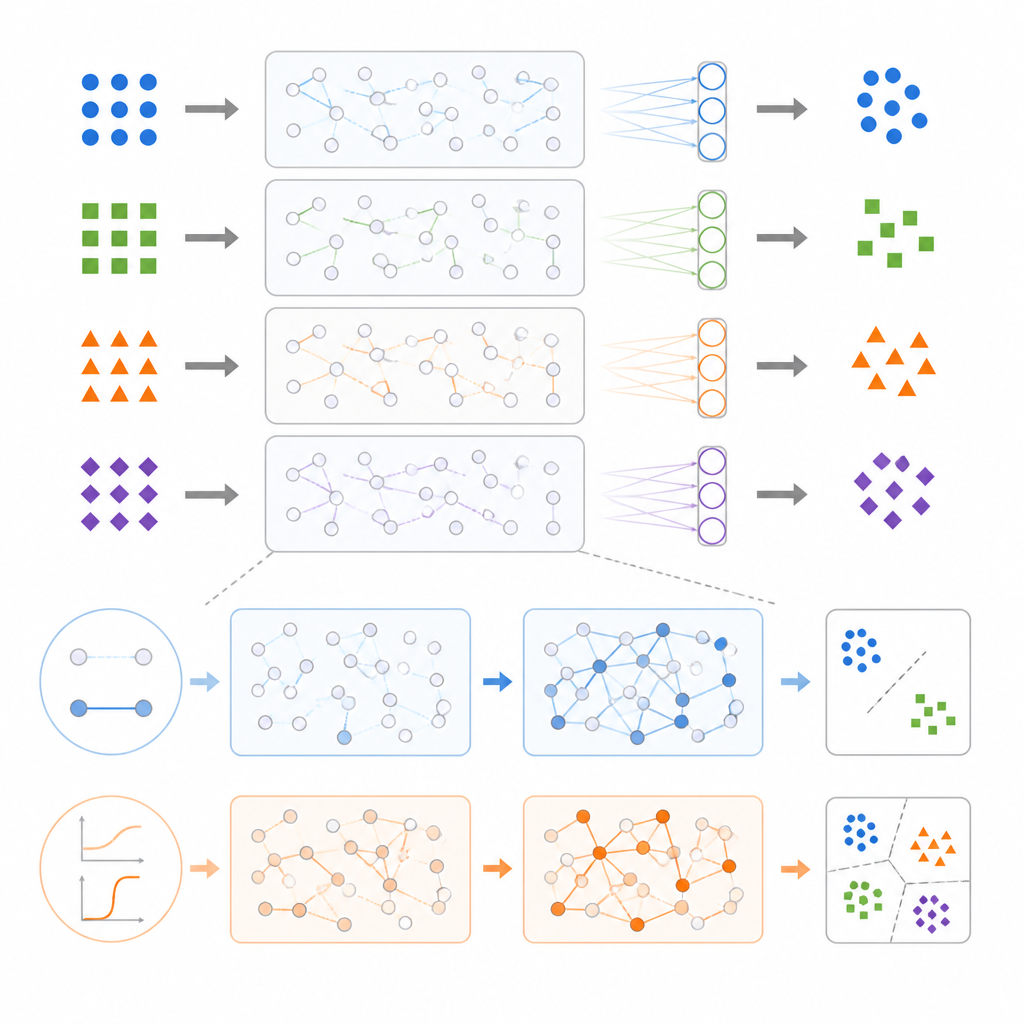
In a final group of experiments, the system is asked not just to recognize or predict, but to generate entire sequences. A brief input indicating one of several classes should trigger the reservoir to follow a class-specific path through its internal states, which the output layer turns into a target sequence of numbers. Again, there is an optimal middle ground: some internal coupling and nonlinearity are needed to create rich trajectories that last for many steps, but overly strong coupling pushes the system into chaotic behavior that blurs the differences between classes and confuses the output layer.
What This Means for Designing Smarter Systems
Overall, the study shows that there is no single recipe for building a good reservoir computer. Depending on the job, the heavy lifting can be done by the input wiring, by the reservoir’s dynamics, or by the simple linear output layer. Many tasks work well with weakly connected, barely nonlinear reservoirs, as long as their states are rich enough for the output layer to decode. Other tasks demand stronger nonlinearity to bend decision boundaries or to emulate complex digital rules. For a lay reader, the key message is that useful “memory” and flexible behavior do not require wildly chaotic internal activity. Instead, carefully tuned simplicity, together with a smart output layer, can be enough to illuminate the inner workings of these once black-box systems.
Citation: Metzner, C., Kinfe, T., Maier, A. et al. Illuminating the black box of reservoir computing. Sci Rep 16, 15500 (2026). https://doi.org/10.1038/s41598-026-53098-y
Keywords: reservoir computing, recurrent neural networks, sequence memory, nonlinear dynamics, cellular automaton prediction