Clear Sky Science · en
Experience and personality modulate pupillary responses during real-time processing of within-language accent shifts
Why accents quietly tax the brain
Most of us glide through everyday conversations without noticing how hard our brains work to understand different ways of speaking. This study peeks under the hood by tracking tiny changes in people’s pupils as they listen to a dialogue that switches between standard and regional German accents. The results reveal that accent shifts briefly make listening more effortful, that this extra effort fades as we adapt, and that life experience and personality shape how easily we handle these changes.
Following a two-accent conversation
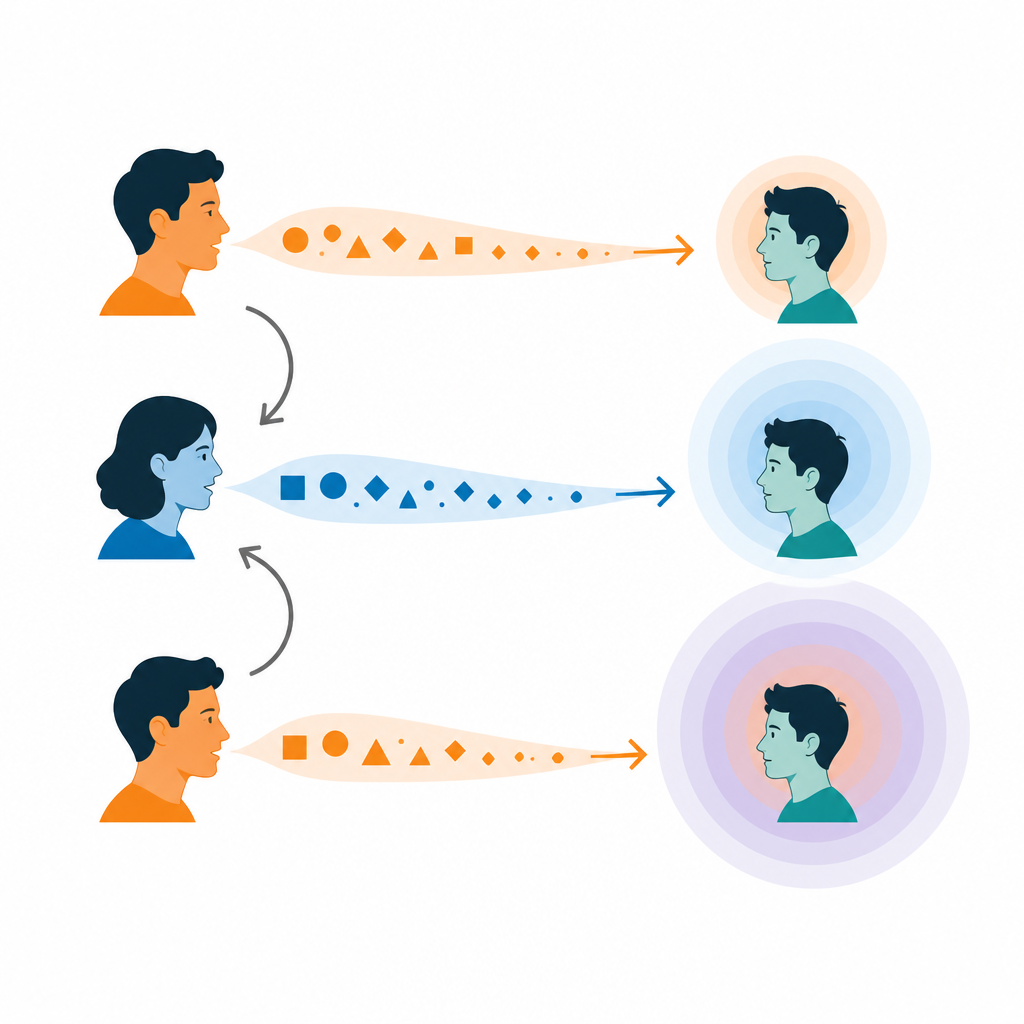
The researchers asked native speakers of German to listen to a recorded conversation between two voices. One voice used Standard German, which most participants heard often in daily life. The other voice spoke a regional Alemannic variety, a less familiar accent for these listeners. The dialogue unfolded much like a real chat, with turns of different lengths and many switches between the two voices. While participants listened, they judged whether each sentence sounded grammatically acceptable, and a sensitive eye tracker measured how their pupils changed from moment to moment as each utterance ended.
Pupil size as a window into listening effort
Pupil dilation is a well established sign that the brain is working harder. By modeling how pupil size rose and fell after each sentence, the team could capture the time course of effort as listeners dealt with accent changes. Overall, trials where the speaker changed produced larger pupil dilations than trials where the same speaker continued. Sentences in the regional accent also produced somewhat larger dilations than those in Standard German. The largest effects appeared when the dialogue switched from the familiar standard accent into the less familiar regional one, suggesting that these transitions were especially demanding.
Adapting to a new accent over time
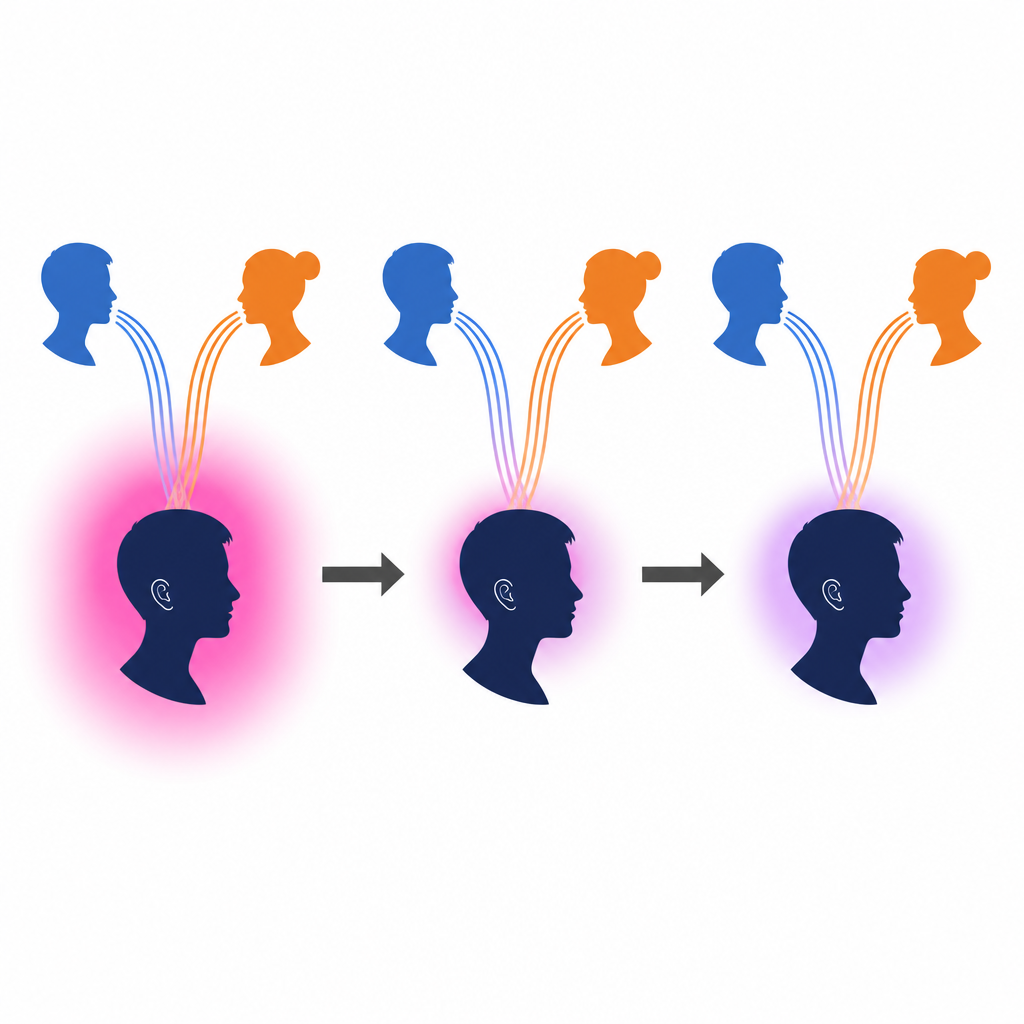
To see whether these costs stayed the same or shifted with experience, the researchers examined pupil responses across the entire dialogue. They found that the basic cost of any speaker switch remained stable from beginning to end, pointing to a steady need to redirect attention whenever the voice changed. In contrast, the extra burden of switching into the regional accent was strongest early on and became smaller later in the conversation. At the same time, the overall difference between regional and standard accent trials gradually shrank. These patterns are consistent with rapid adaptation: as listeners accumulate exposure to the regional accent, they refine their expectations about its sounds and need less effort to handle those shifts.
Different listeners, different strategies
The study also explored why some people might adapt more smoothly than others. Using cluster analysis, the authors identified two broad listener profiles. One group was younger, reported more exposure to Standard German, scored lower on the personality trait of openness, and rated the standard speaker as clearer and more pleasant. This group showed larger asymmetries, finding switches into the regional accent especially effortful. The second group, slightly older and more open, reported more varied language input and showed smaller differences in how they evaluated the two speakers. These listeners displayed much weaker asymmetry, suggesting a more flexible way of dealing with accent changes.
What this means for everyday talk
Taken together, the findings suggest that our brains manage accent variation through at least two partially separate processes. One is a constant attentional cost whenever speakers change, regardless of how familiar their accents are. The other reflects a temporary adjustment to less familiar sound patterns, which is most intense at first and wanes as we get used to a new way of speaking. Experience with different varieties of language and personality traits such as openness influence how strongly people feel this second type of cost. In everyday life, this means that frequent contact with diverse accents and a flexible attitude can make it easier to follow conversations that weave together different ways of speaking.
Citation: Hanulíková, A., Gastmann, F. & Schimke, S. Experience and personality modulate pupillary responses during real-time processing of within-language accent shifts. Sci Rep 16, 15987 (2026). https://doi.org/10.1038/s41598-026-53089-z
Keywords: accent adaptation, speech perception, listening effort, pupillometry, individual differences