Clear Sky Science · en
Carbon dioxide stunning of pigs induces the expression of fear-associated genes in the amygdala
Why this matters for how we treat animals
Most people who eat pork rarely think about what happens in the final minutes of a pig’s life. Yet the way pigs are rendered unconscious before slaughter has a major impact on their welfare. This study asks a deceptively simple question: do different stunning gases make pigs feel more or less afraid, deep inside the part of the brain that processes emotions? By peering into the activity of thousands of genes in the pigs’ amygdala, the researchers provide new biological evidence that some common practices likely cause more fear than others.
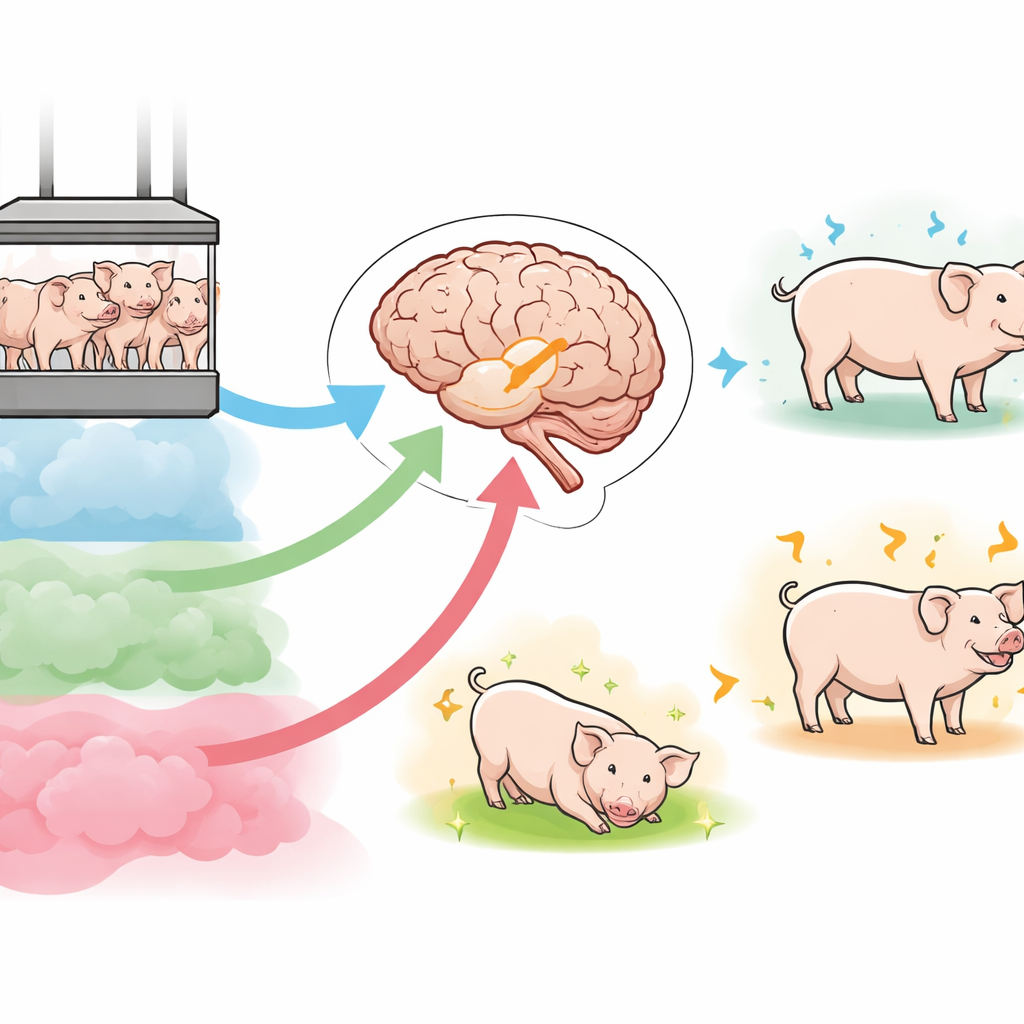
Different gases, different paths to unconsciousness
In modern slaughterhouses, pigs must be made unconscious before they are killed, either with electricity applied to the head or by breathing special gas mixtures. High-concentration carbon dioxide (CO2) is widely used because it is reliable and allows groups of pigs to be stunned together. However, pigs exposed to CO2 often gasp, hyperventilate, and try to escape, suggesting that they find the experience highly unpleasant. As an alternative, some researchers and companies are testing so-called “inert gases” such as argon and nitrogen. These gases do not directly trigger the body’s sensors for rising CO2 levels, and pigs appear calmer when breathing them, even though they still lose consciousness from lack of oxygen. This study set out to see whether those behavioral signs of distress are mirrored by changes in brain gene activity linked to fear and anxiety.
Listening to the emotional center of the brain
The scientists focused on the amygdala, a small but crucial brain region that helps detect danger and generate fear. They worked with 27 pigs from the same farm that were stunned in a commercial slaughterhouse using one of three gas conditions: almost pure argon, a nitrogen–argon mixture, or very high CO2. About half an hour after slaughter, the researchers removed a small piece of the amygdala from each brain. From this tissue they extracted RNA, the molecule that reflects which genes were actively being used by the cells at the time. Using high-throughput sequencing, they read out the activity of thousands of genes and compared patterns between pigs stunned with CO2 and those stunned with inert gases.
What the genes revealed about fear
CO2 had the strongest impact on gene activity in the amygdala. When the team compared CO2 with argon or nitrogen, they found hundreds of genes whose activity levels differed, whereas argon and nitrogen produced much more similar gene patterns to each other. Many of the genes altered by CO2 are linked in previous work to fear, anxiety, and mood disorders. In particular, genes encoding two serotonin receptors, often studied in human depression and anxiety (called 5-HT1A and 5-HT2A receptors in technical terms), were turned down in pigs stunned with CO2 compared with inert gases. Earlier animal and human studies have connected lower activity of these serotonin-related systems with stronger anxiety and panic-like responses.
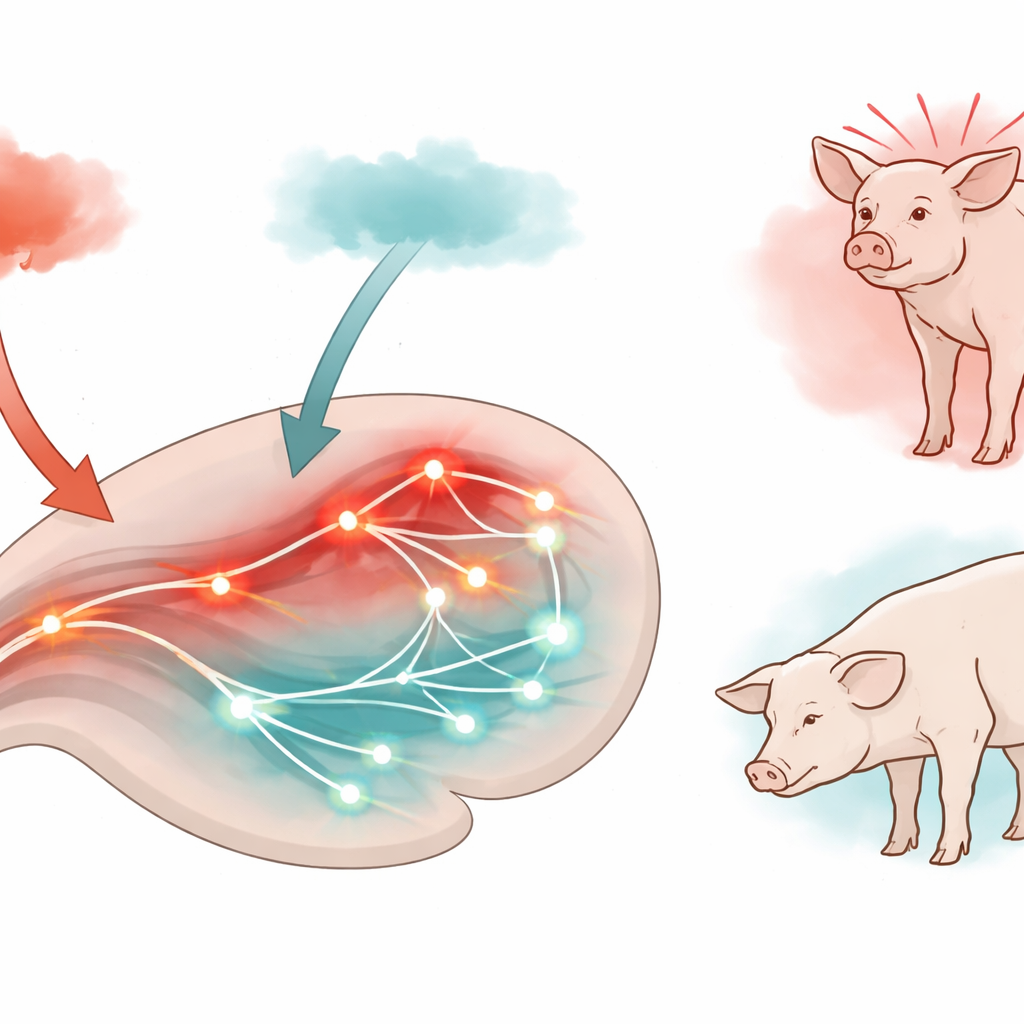
Subtle brain chemistry differences between gas types
Beyond individual genes, the researchers used statistical tools to see which broader biological pathways were affected. Only the comparisons involving CO2 showed enrichment of serotonin-related signaling, supporting the idea that CO2 exposure specifically taps into brain circuits that monitor acidity and CO2 levels as potential threats. They also found that several transporter proteins—molecules that shuttle signaling chemicals and nutrients across cell membranes—were more active after CO2 stunning, forming a tightly connected network of interacting proteins. In contrast, argon and nitrogen produced more muted changes, and one gene linked in earlier studies to reduced anxiety was more active in pigs stunned with argon than in those stunned with nitrogen or CO2. Together, these patterns point to CO2 driving a distinct, more fear-associated molecular “signature” in the amygdala.
What this means for animal welfare
The gene activity patterns cannot tell us exactly what each pig consciously felt during stunning, and they do not replace direct observation of behavior. But when taken together with previous work showing visible signs of distress under CO2, these molecular data strengthen the case that high CO2 stunning is more aversive than inert gas methods. This study is the first to map the full set of active genes in the pig amygdala under different gas mixtures and highlights specific genes that could serve as biological markers of fear. In practical terms, the findings support ongoing efforts to refine or replace CO2 stunning with gas mixtures that keep pigs calmer while still ensuring they lose consciousness quickly and humanely.
Citation: Gelhausen, J., Paul, NF., Knöll, J. et al. Carbon dioxide stunning of pigs induces the expression of fear-associated genes in the amygdala. Sci Rep 16, 14416 (2026). https://doi.org/10.1038/s41598-026-51710-9
Keywords: pig welfare, stunning gases, carbon dioxide, amygdala, fear and anxiety