Clear Sky Science · en
A d-dimer and ADAMTS8 based multi-marker score for the diagnosis of acute aortic dissection
Why this hidden heart emergency matters
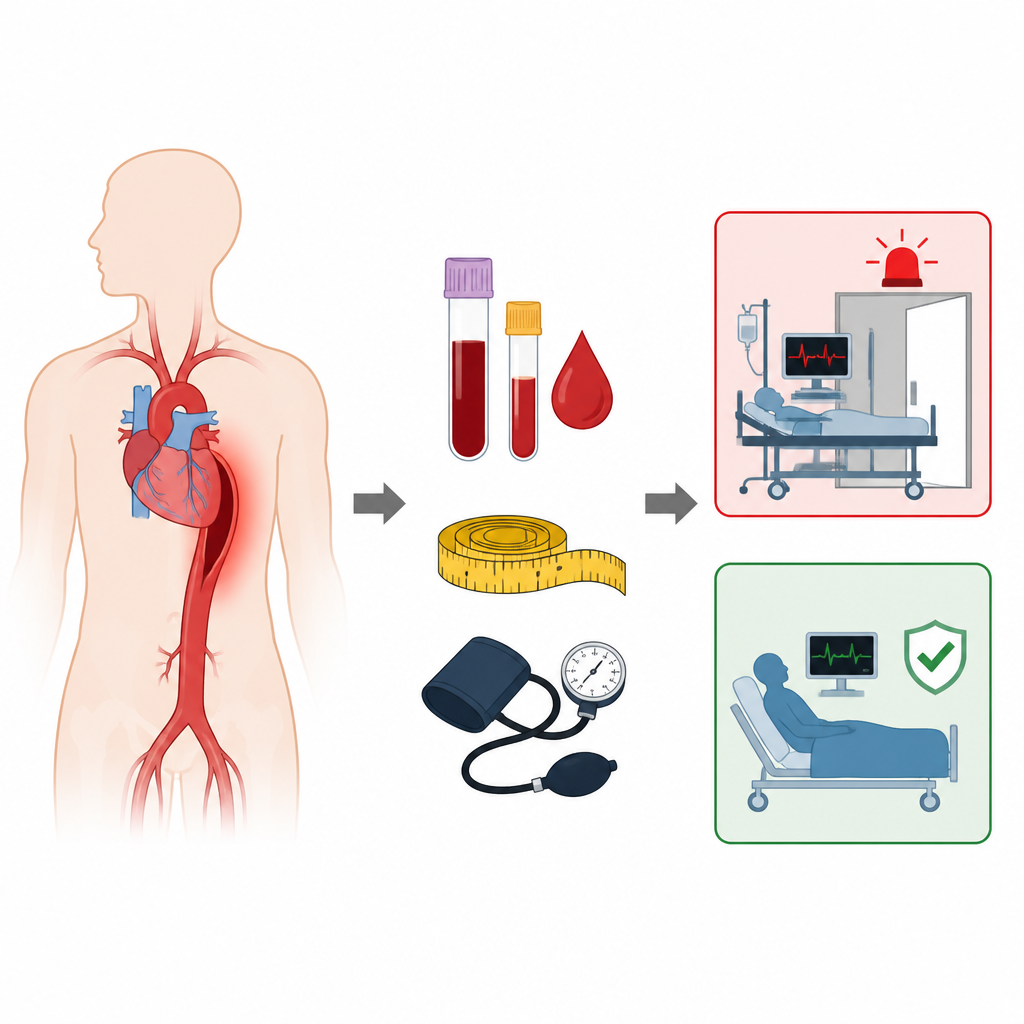
Acute aortic dissection is a sudden tear in the body’s main artery that can kill within hours, yet its early symptoms often mimic a heart attack or other chest problems. Doctors race the clock to tell these conditions apart, but current tools usually rely on advanced scans that are slow, costly, and not always available in the first critical minutes. This study explores whether a simple blood-based score, combined with a few basic measurements, can quickly flag people with this dangerous tear so they receive the right treatment in time.
The silent tear in the main artery
The aorta is the large vessel carrying blood from the heart to the rest of the body. In an acute aortic dissection, its inner lining suddenly splits, letting blood surge into the vessel wall. Mortality climbs hour by hour if the condition is missed. Today, diagnosis depends mostly on imaging tests such as CT or MRI scans. While accurate, these scans are not practical as broad screening tools in busy emergency rooms, and aortic dissection can be easily confused with heart attacks or lung clots. The researchers set out to find biological signals in blood that track the disease and could be measured rapidly at the bedside.
From artery tissue to blood signals
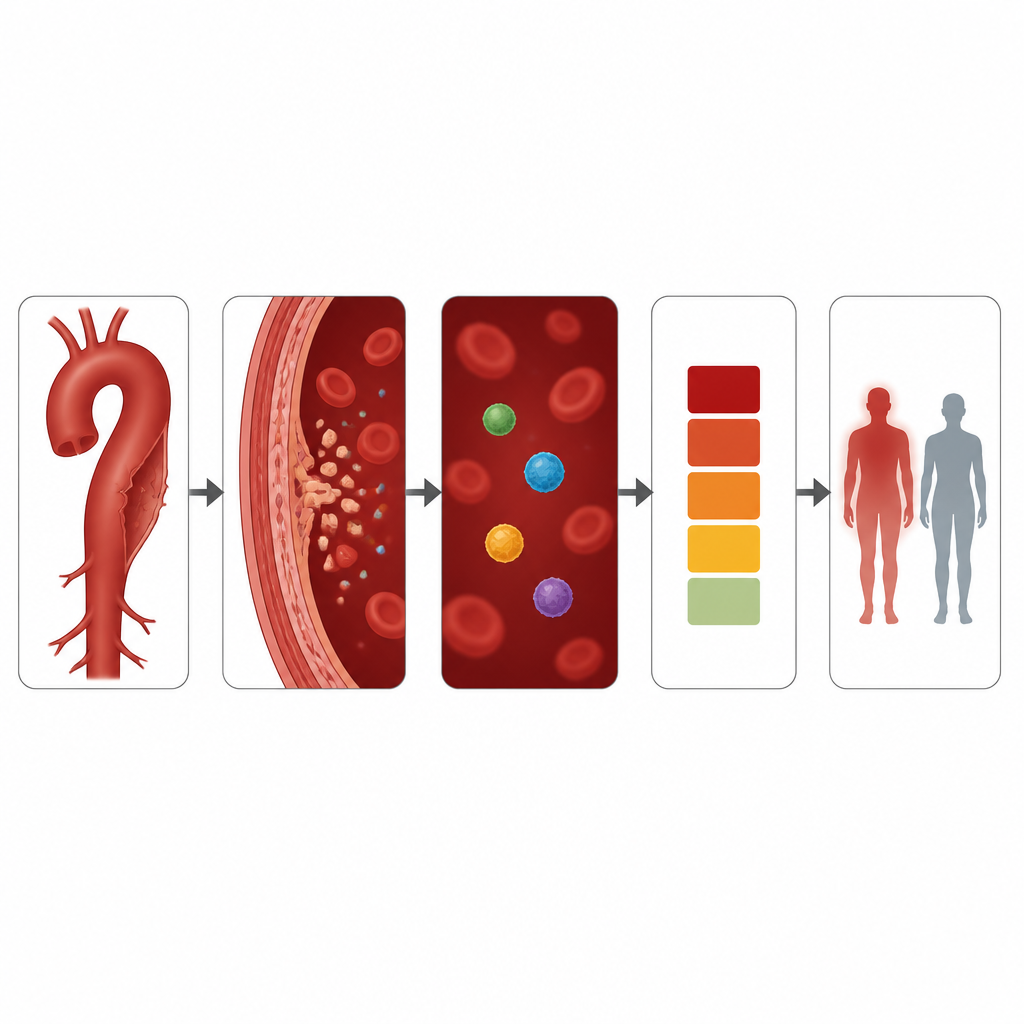
The team first examined pieces of aorta taken during surgery from patients with acute aortic dissection and from donors without the disease. Using a technique that maps gene activity across thin tissue slices, they searched for genes that were unusually active in diseased areas and that make proteins released into the bloodstream. They narrowed in on three little-known proteins, called PTMA, ADAMTS8, and CD36, which were strongly overproduced in the damaged aortic wall. Microscopy and protein tests confirmed that these molecules were much more abundant in dissection tissue than in healthy aortas, suggesting that they might leak into the circulation during the tearing process.
Finding risk clues in a simple blood draw
Next, the scientists measured these three proteins in blood samples from 173 patients with acute aortic dissection and 129 healthy people. All three proteins were clearly higher in patients with the tear. They then looked more broadly at which factors distinguished patients from controls. In addition to the protein ADAMTS8, they found that an established clotting fragment called d-dimer, taller body height, higher top blood pressure number, and a history of smoking were all linked to greater risk. After adjusting for many other lab values and medical conditions, raised ADAMTS8, CD36, and d-dimer still stood out as independent warning signs, while a type of “good” cholesterol appeared protective.
A practical multi-marker score
To turn these findings into a tool doctors might actually use, the researchers built a simple score that combines five items: d-dimer, ADAMTS8, blood pressure, height, and age. Each factor is given one point when it crosses a chosen cut-off, creating a total score from zero to five. In the initial group, people with confirmed aortic dissection scored much higher than healthy participants, and the score separated the two groups with high accuracy. The chance of having a dissection rose steeply once the score reached three points or more, suggesting that this threshold could prompt urgent imaging and specialist care in the emergency setting.
Putting the score to the test in real-world chest pain
Because many dangerous conditions can cause sudden chest pain, the team tested their score in a second, independent group of 393 people arriving at the emergency department. This group included patients with aortic dissection, heart attack, lung blood clots, and healthy volunteers. Again, ADAMTS8 levels and the combined score were higher in patients with aortic dissection. The multi-marker score reliably distinguished those with aortic dissection not only from healthy people but also from patients whose chest pain was due to heart attacks or lung clots. It consistently outperformed any single blood marker on its own.
What this means for patients and doctors
This work suggests that a straightforward score based on two blood proteins plus age, height, and blood pressure could help emergency teams quickly identify patients with aortic dissection and separate them from others with similar symptoms. The score is not meant to replace imaging, which remains the definitive test, but rather to act as an early warning system that guides who should be scanned first. Larger, multi-center studies are still needed, yet this approach points toward faster, more accessible diagnosis of a deadly but often overlooked arterial tear.
Citation: Tian, T., Zhao, L., Tian, X. et al. A d-dimer and ADAMTS8 based multi-marker score for the diagnosis of acute aortic dissection. Sci Rep 16, 14679 (2026). https://doi.org/10.1038/s41598-026-51121-w
Keywords: acute aortic dissection, blood biomarkers, emergency diagnosis, chest pain triage, risk scoring