Clear Sky Science · en
Material characterization of stone surfaces in the inner chambers of the Khufu (Cheops) Pyramid: towards informed conservation strategies
Why the Pyramid’s Hidden Rooms Still Need Care
Deep inside the Great Pyramid of Khufu, the Queen’s and King’s Chambers look timeless, carved from massive blocks of limestone and granite laid more than 4,500 years ago. Yet these stone walls are quietly changing today, as modern tourism and shifting indoor climate conditions encourage tiny salt crystals to grow, slowly weakening the rock. This study explores what is happening on the surfaces of these famous inner rooms and how gentle, non-destructive scientific tools can guide smarter conservation before visible damage becomes irreversible. 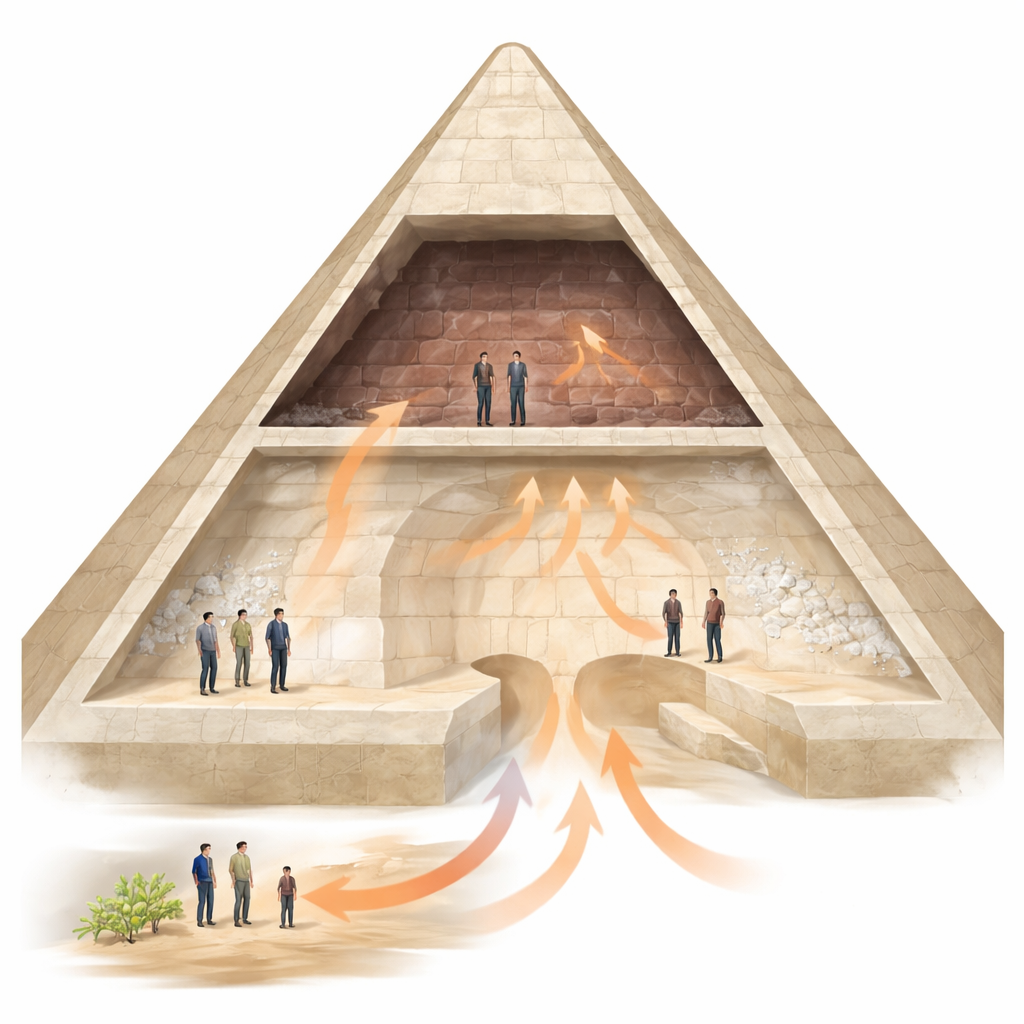
Ancient Rooms Under Modern Pressure
The Queen’s and King’s Chambers sit at the heart of the Great Pyramid, reachable only by steep, narrow passages that funnel thousands of visitors each year. Their breath, body heat, and moisture raise temperature, humidity, and carbon dioxide levels in spaces that were never designed for such traffic. Earlier reports had already warned that visitor-related moisture can trigger salt crystallization and fungal growth in other pyramids. In Khufu’s pyramid, new surveys between 2022 and 2024 showed that white crusts and whisker-like salt deposits are spreading on the limestone of the Queen’s Chamber, while crystalline blooms are appearing on the upper granite blocks of the King’s Chamber, especially near joints and ceilings where air is warmest and least disturbed.
Seeing Inside Stone Without Taking It Apart
Because the pyramid is protected by strict heritage laws, researchers must gather as much information as possible while touching the monument as little as possible. To do this, the team relied on portable X-ray fluorescence (XRF) instruments that can be brought into the chambers and aimed at the wall from a short distance, without removing material. In the limestone Queen’s Chamber, they recorded dozens of spot measurements, mapping how chemical elements such as sulfur and chlorine are distributed across the lower wall courses. In the granite King’s Chamber, they took both spot measurements and small-area XRF scans, building color-coded maps that distinguish different minerals—such as feldspars and dark micas—based purely on their elemental signals. This is the first time such detailed XRF imaging has been carried out in situ on Aswan granite inside the pyramid. 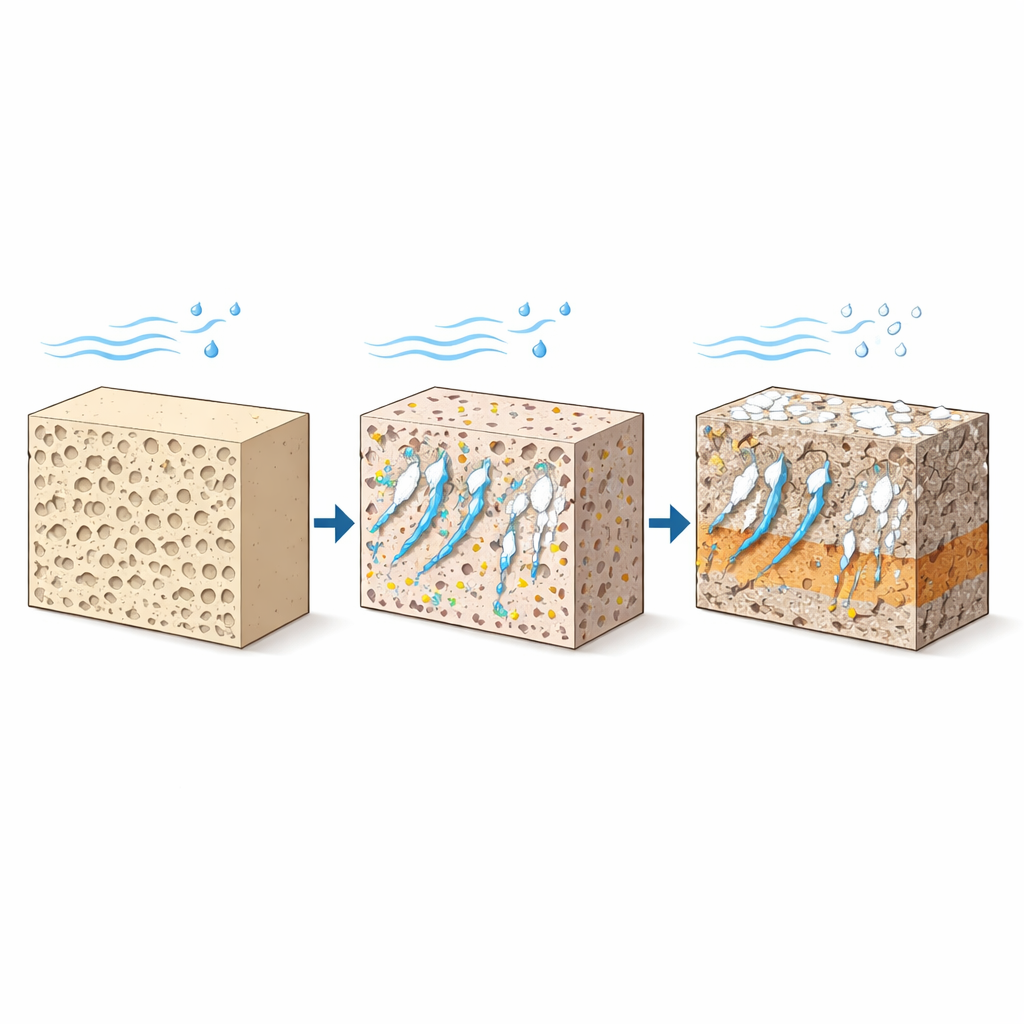
What the Salts Are and Where They Come From
To understand the crusts themselves, the researchers combined their non-contact measurements with a very small number of micro-samples, limited to salts and already detached fragments. Laboratory analyses using scanning electron microscopy and X-ray diffraction showed that the gleaming white efflorescence in the Queen’s Chamber is dominated by one mineral: halite, or common salt composed of sodium and chlorine. The same elements also appear within apparently sound fragments of limestone, indicating that this salt is not just a surface contaminant but is partly built into the stone from its ancient marine origins. As humidity rises and falls around the critical threshold at which halite takes up or releases water, the salt repeatedly dissolves and recrystallizes, growing needle-like crystals in the stone’s pores and on its surface. Over time, these cycles can pry grains apart and turn once-solid blocks into fragile powder.
Granite That Slowly Changes From Within
The King’s Chamber tells a different story. Here the stone is dense red Aswan granite rather than porous limestone, and the most visible salt growth occurs high on the walls and in the ceiling joints. XRF mapping and statistical analysis of the spectra (using a data-reduction technique known as principal component analysis) allowed the team to distinguish the various granite minerals and to relate the location of salts to specific components such as feldspars and dark micas. The authors suggest that a long-term alteration process called kaolinization is at work: under warm, humid, carbon-dioxide-rich conditions, feldspar minerals gradually break down into a clay-like phase, increasing the stone’s micro-porosity. This new network of tiny pores makes it easier for moisture and dissolved salts to migrate and crystallize in the upper blocks, especially in a chamber where daily visitor loads drive sharp swings in temperature, humidity, and CO₂.
Guiding Future Protection of the Great Pyramid
By pinpointing halite as the main damaging salt in the limestone chamber and linking granite salt efflorescence to internal mineral alteration in the King’s Chamber, the study provides a scientific basis for future conservation planning. The authors argue that any cleaning and salt removal must be combined with better control of the microclimate—especially stabilizing humidity and improving air circulation—so that dissolution and crystallization cycles are minimized. Their work also demonstrates that portable, non-destructive tools like XRF, together with careful data analysis, can track early warning signs of change over large wall areas without needing to carve out fresh samples. In this way, modern science can help ensure that visitors continue to experience the inner rooms of the Great Pyramid while keeping the stone itself as close as possible to the condition in which ancient builders left it.
Citation: Sessa, C., Deraz, R., Popovych, O. et al. Material characterization of stone surfaces in the inner chambers of the Khufu (Cheops) Pyramid: towards informed conservation strategies. Sci Rep 16, 12586 (2026). https://doi.org/10.1038/s41598-026-48805-8
Keywords: Khufu Pyramid, stone conservation, salt efflorescence, Aswan granite, heritage microclimate