Clear Sky Science · en
Influence of the cutting speed in turning and force in diamond smoothing on the surface properties of pure nickel
Smoother Metal for Tough Jobs
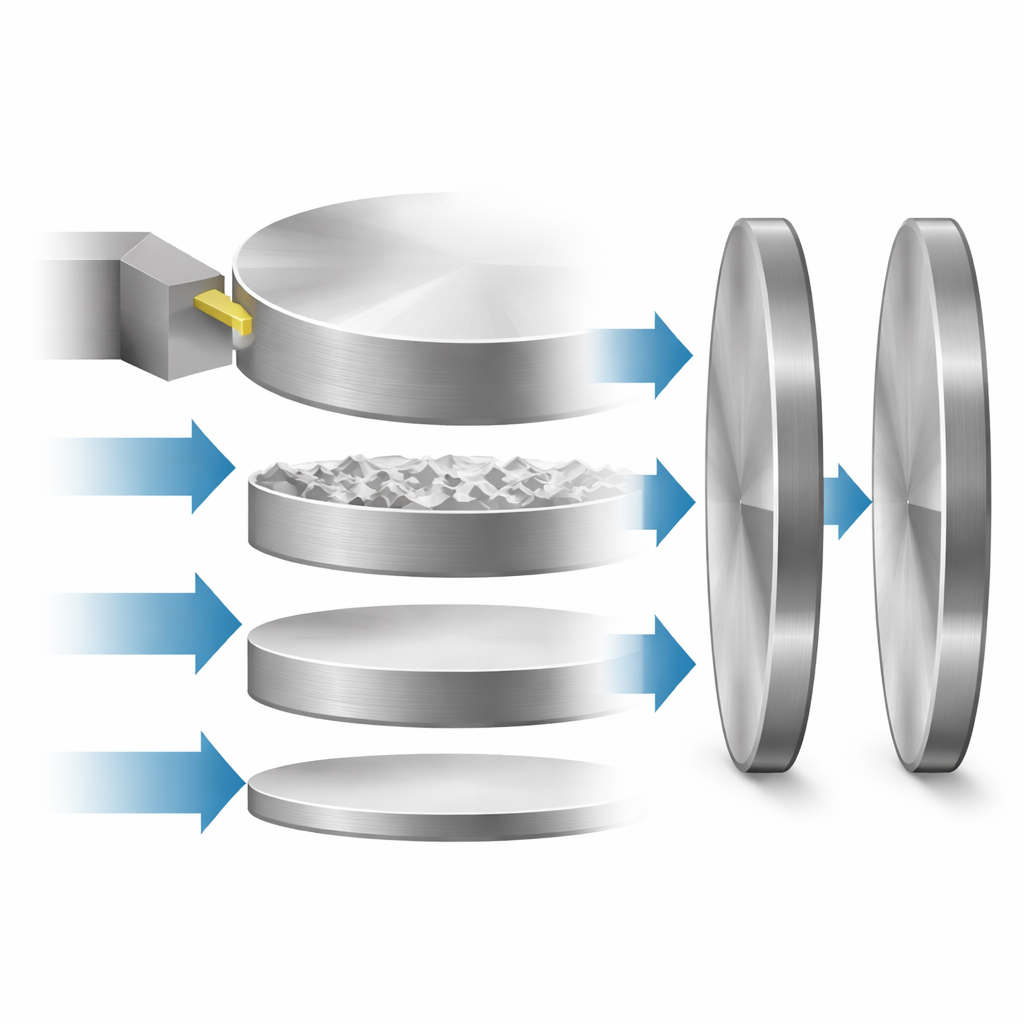
From jet engines to chemical plants, many critical machines rely on nickel parts that must endure extreme heat, pressure, and corrosion. How the surface of these parts is prepared at the microscopic level can make the difference between a reliable bond and an early failure. This study explores how two common manufacturing steps—cutting on a lathe and a follow‑up "ironing" step with a hard diamond tip—change the very top layer of pure nickel, and how those changes may help future components stick together more strongly through a process called diffusion bonding.
Why the Skin of Nickel Parts Matters
Nickel is valued because it stays strong and resists attack even at high temperatures, but those same traits make it hard to machine cleanly. In tiny devices such as microreactors, traditional welding is difficult, so manufacturers turn to diffusion bonding, which joins parts by pressing very clean, flat surfaces together at high temperature. In that situation, the "skin" of the metal becomes crucial: if it is too rough, full of small cracks, or locked into the wrong kind of internal stress, gaps can remain between parts and the joint may weaken. The researchers therefore set out to understand how the cutting speed during turning, and the pushing force during diamond smoothing, together shape surface roughness, hardness, internal stresses, and crystal structure in pure nickel.
Turning the Dials on Cutting Speed
The team machined disk‑shaped samples of pure nickel on a precision lathe, varying how fast the cutting edge swept across the surface—from relatively slow to very fast—while keeping other settings constant. At low cutting speeds, the cutting and feed forces were highest, and the machined surface showed pronounced grooves and raised ridges, far rougher than what simple tool geometry would predict. Inside the top layer, the metal became harder, its tiny crystals were strongly broken down into smaller regions, and the locked‑in stresses tended toward compressive in one direction but tensile in another. As cutting speed increased, the forces dropped, the feed‑direction roughness shrank to about a third of its original level, and the metal softened slightly near the surface as heat effects began to dominate. At the highest speeds, the surface became smoother but the internal stresses shifted more clearly into tension, especially along the cutting direction.
Ironing with Diamond to Calm the Surface
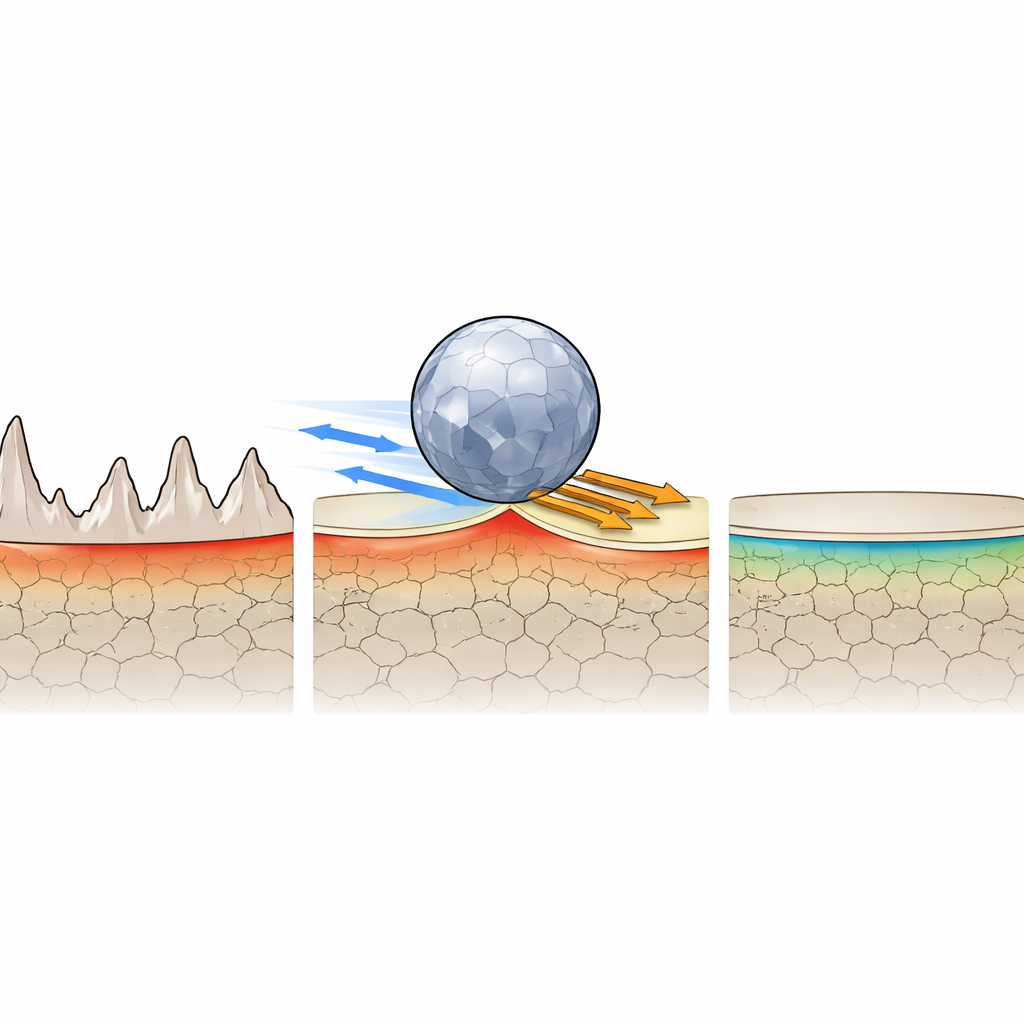
Next, the researchers took nickel disks cut at a mid‑range speed and passed a smooth spherical diamond tip over the surface under different forces, a process similar to rolling a hard marble over soft metal. At moderate forces, this step dramatically reduced the height of surface peaks left by turning, creating much flatter surfaces in the feed direction while only slightly increasing roughness along the smoothing path. Microscopic images showed that the diamond pass wiped away many imperfections without tearing the surface. Inside the material, this treatment increased hardness, shrank the metal’s crystallites further, and, crucially, converted the previously tensile stress state into strong compressive stress near the surface—often considered beneficial because it helps resist crack growth. When the force became too high, however, the surface started to flake in thin scales, roughness increased again, and some of the compressive stress relaxed, showing that more pressure is not always better.
Linking Surface Shape and Hidden Structure
By comparing the different tests, the study revealed clear links between what can be seen on the surface and what happens in the thin layer beneath. Rougher surfaces produced at low cutting speeds coincided with stronger work hardening, finer crystal fragments, higher microstrain, and more compressive stresses in one direction, all signs of severe mechanical deformation. Smoother surfaces produced at higher cutting speeds showed reduced deformation and a shift toward tensile stress, reflecting the growing role of heat in shaping the surface. Diamond smoothing at carefully chosen forces combined the best of both worlds: it flattened the geometry while also packing the near‑surface layer into a hardened, fine‑grained state under compression. Pushing the diamond too hard tipped the balance, damaging the top layer and undoing some of the beneficial stresses.
What This Means for Real‑World Joints
For engineers aiming to diffusion‑bond nickel parts, these findings offer a practical recipe. Turning at sufficiently high speeds can deliver a reasonably smooth starting surface, but may leave behind tensile stresses that are not ideal. A follow‑up diamond smoothing step, applied with moderate force, can then create a much flatter, harder, and compressively stressed skin, which should help surfaces press together more completely and resist crack formation. While the study did not directly measure bond strength, it lays out how machining knobs—cutting speed and smoothing force—translate into surface texture and hidden structure. With that roadmap, future work can fine‑tune these steps to produce nickel components whose joined surfaces are as robust and reliable as the harsh environments they must withstand.
Citation: Ghorbanalipour, S., Liborius, H., Martini, J. et al. Influence of the cutting speed in turning and force in diamond smoothing on the surface properties of pure nickel. Sci Rep 16, 12179 (2026). https://doi.org/10.1038/s41598-026-48553-9
Keywords: nickel machining, surface roughness, diamond smoothing, residual stress, diffusion bonding