Clear Sky Science · en
A lightweight hybrid attention network with multi-scale feature integration for intelligent recognition of underwater acoustic targets
Listening to Ships Beneath the Waves
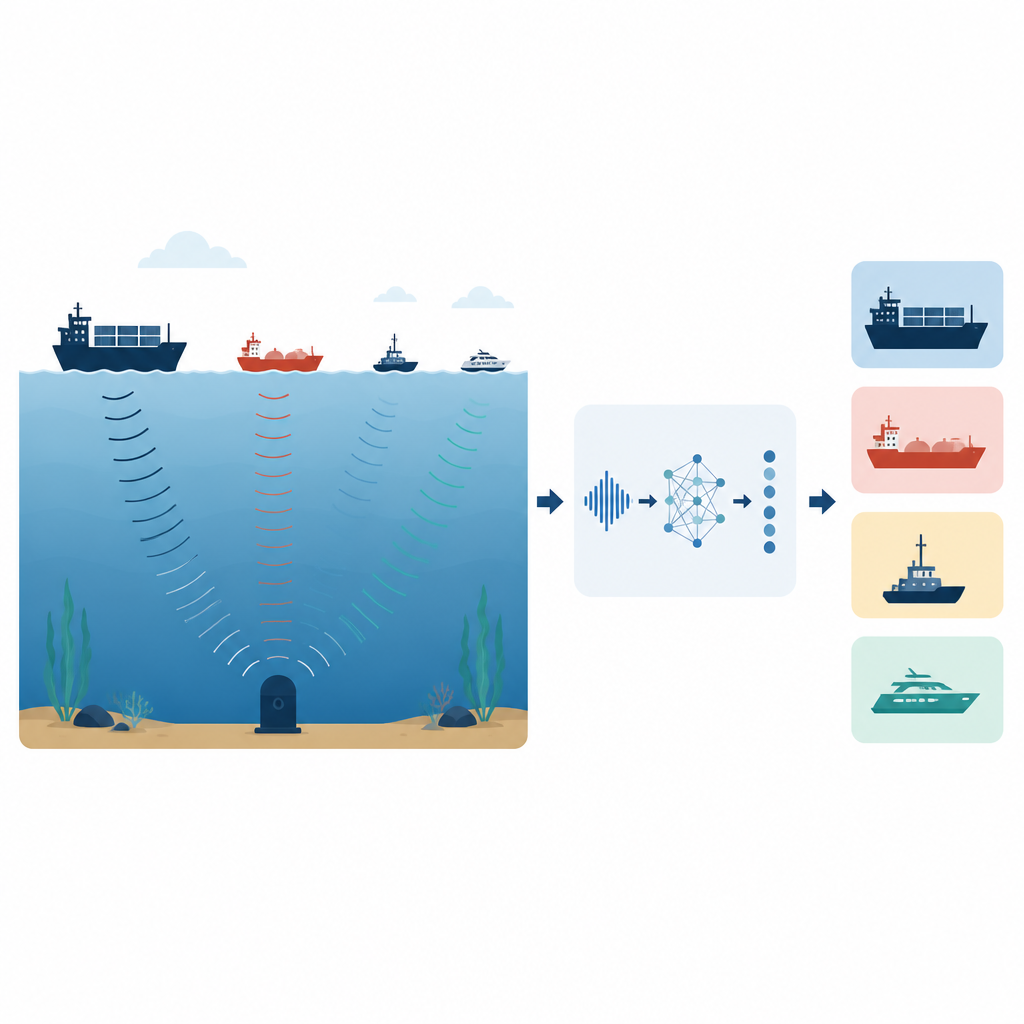
Oceans are filled with sounds from ships, animals, and natural forces, and sorting out who is making which noise is vital for safety, defense, and protecting marine life. This study presents a smart yet compact listening system that can tell different types of ships apart using only their underwater sound signatures. By carefully shaping how the computer hears and processes these signals, the authors show that it is possible to recognize ships with very high accuracy while using surprisingly little computing power, opening the door to widespread, low cost underwater monitoring.
Why Ship Sounds Matter
Modern oceans are busy highways, and the low rumble of engines and propellers travels for long distances underwater. Being able to recognize which ship is where helps with navigation, search and rescue, and surveillance, and it also lets scientists track how human noise affects whales, fish, and fragile habitats. Traditional sonar systems struggle because underwater sound is easily distorted by waves, currents, and echoes, and the signals are mixed with natural background noise. Older recognition methods also relied heavily on human experts or on hand tuned rules, which are slow to adapt and do not scale to the huge volumes of data that sensors now collect.
Teaching Machines to Hear Underwater
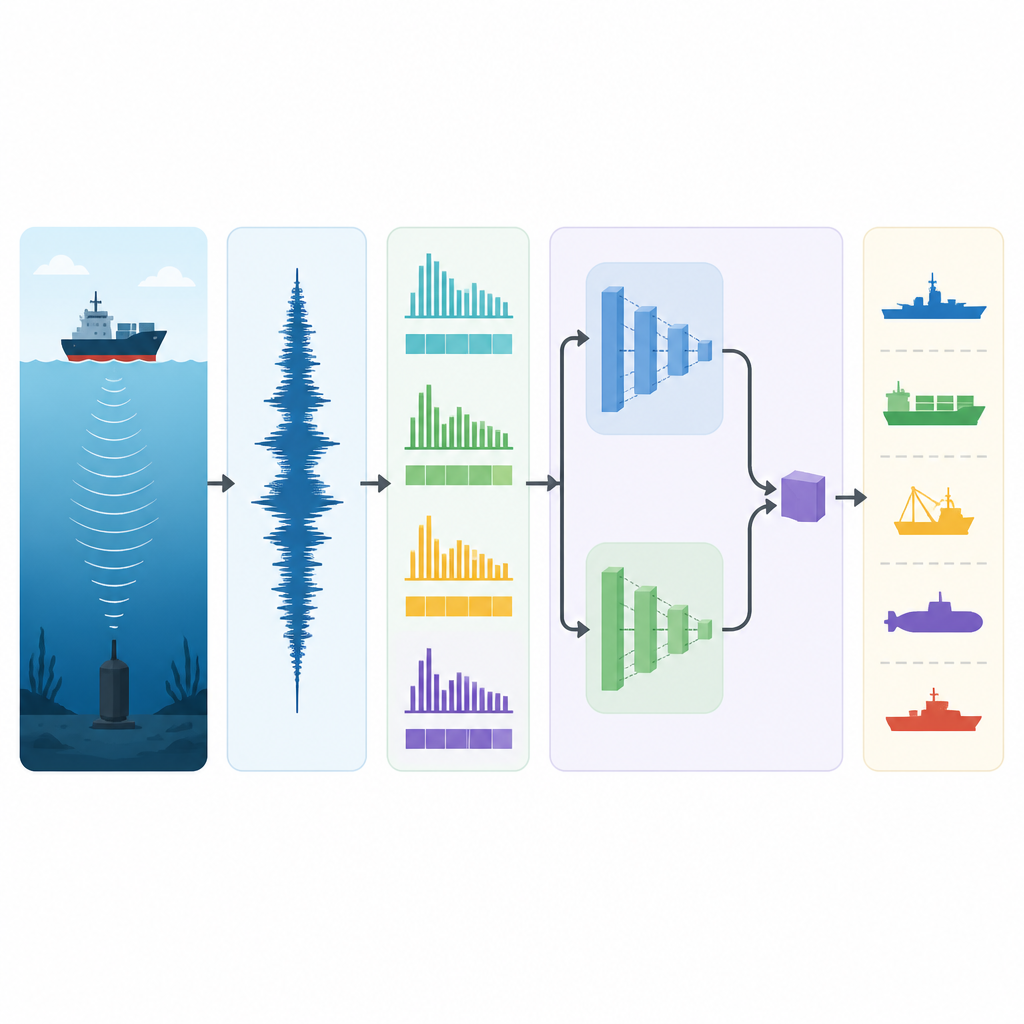
To tackle these challenges the researchers built a listening pipeline that reshapes raw sound into a compact description before it ever reaches the main learning engine. First, recordings from two real world ship noise archives are all resampled to a common rate and cut into five second clips. Each clip is then copied and gently altered three ways: its pitch is shifted within a narrow range to mimic Doppler effects, its speed is stretched or squeezed to imitate changes in ship motion, and a realistic colored noise pattern is added to emulate ocean background hum. These steps triple the amount of training data and expose the system to many plausible versions of the same ship, making it less sensitive to small changes in how the sound was recorded. From every segment the system extracts simple, fast features that capture how strong, how rough, and how tonal the sound is, including how often it crosses zero, its overall energy, how its spectrum resembles human hearing scales, and how its tones are distributed across pitch classes, ending in a fixed length numeric fingerprint.
A Compact Brain for Sound
The heart of the method is a model called the Depthwise Separable Convolutional Adaptive Transformer, designed to be both accurate and lightweight. It starts with special convolution blocks that act like many tiny filters listening for short term patterns in the feature sequence, such as rhythmic pulses from propellers or repeating engine cycles, while keeping the number of calculations low. On top of this, the model runs two transformer branches in parallel, each looking at long stretches of the sound fingerprint but with different levels of detail. These branches use attention mechanisms to decide which parts of the sequence matter most, and then distill their findings through pooling operations that summarize the overall behavior. An adaptive fusion stage learns to weigh the two branches differently for each input, favoring one when fine local details are key and the other when long range structure carries more information, before passing a compact summary to a final classifier that outputs the most likely ship class.
Putting the System to the Test
The authors evaluated their design on two well known underwater ship noise collections, one long term dataset recorded off Canada and another from coastal Spain. In both cases the model saw only five second clips and had to assign them to broad ship categories such as cargo, passenger, tanker, tug, or size based groups. The system achieved about 98.8 percent accuracy on the first dataset and 99.2 percent on the second, while using only about half a million trainable parameters and a few million basic operations per prediction. That makes it much smaller and faster than many current deep learning models, yet it still matched or surpassed them in accuracy. Visual analyses of the model’s internal representations showed that clips from different ship types form well separated clusters, and standard measures like precision, recall, and receiver operating curves all confirmed that the system rarely confuses one class for another.
What This Means for Oceans
In plain terms, this work shows that a small, carefully designed listening system can reliably tell ship types apart in noisy, real ocean settings, and can do so quickly enough for near real time use. By pairing simple but informative sound features with a hybrid model that balances local details against long term patterns, the authors provide a practical blueprint for future underwater monitors that could run on buoys, robots, or dockside stations. Such tools could help manage shipping lanes, support environmental studies of noise pollution, and improve autonomous sonar systems, all while keeping computing demands low enough to fit on modest hardware.
Citation: Mahmud, NA., Zhang, T., Iqbal, Y. et al. A lightweight hybrid attention network with multi-scale feature integration for intelligent recognition of underwater acoustic targets. Sci Rep 16, 16388 (2026). https://doi.org/10.1038/s41598-026-47540-4
Keywords: underwater acoustics, ship noise, sonar recognition, deep learning, marine monitoring