Clear Sky Science · en
Green recovery of vanadium from spent vanadium catalyst from sulfuric acid production
Turning Industrial Waste into a Resource
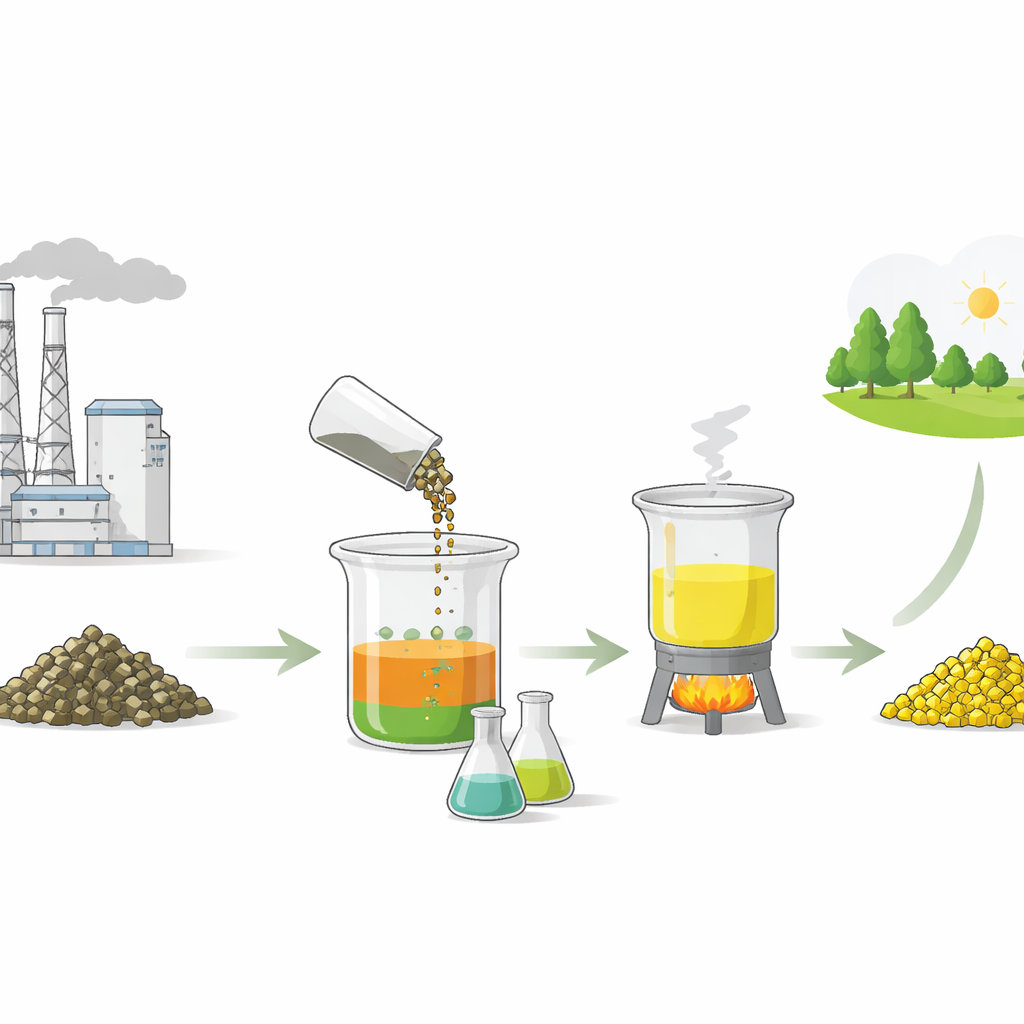
Each year, factories that make sulfuric acid throw away thousands of tons of used catalyst—solid pellets that once helped drive the chemical reactions inside their towers. These discarded materials are rich in the metal vanadium, which is valuable for industry but harmful when it escapes into air, soil, and water. This study explores a way to rescue vanadium from that waste using a relatively mild, plant-derived acid, turning a hazardous by‑product into a useful raw material while easing pressure on the environment.
Why Vanadium and Sulfuric Acid Matter
Sulfuric acid is one of the world’s most widely produced chemicals, used in fertilizers, fuel refining, explosives, dyes, and car batteries. Making it involves converting sulfur dioxide gas into sulfur trioxide with the help of a vanadium-based catalyst. Over time, the catalyst grains lose their effectiveness and are replaced, generating about 40,000 tons of spent material worldwide every year. These piles still contain vanadium pentoxide, a compound prized for its electronic and catalytic properties but also known to irritate lungs, harm plants, and contaminate ecosystems if left uncontrolled.
Finding a Gentler Way to Extract a Useful Metal
Recovering vanadium from waste is not new, but many existing methods rely on strong mineral acids or harsh alkaline treatments. These can be costly, corrosive, and environmentally burdensome. The authors set out to test whether simple organic acids—similar to those found in fruit or vinegar—could do the job instead. They ground the spent catalyst pellets into fine particles and exposed them to four different acids: citric, oxalic, tartaric, and acetic. By carefully adjusting how much acid they used, how long the mixture was stirred, the temperature, and the ratio of solid to liquid, they measured how much vanadium could be drawn out into solution.
Citric Acid Steps Up as a Green Helper
Among the four options, citric acid stood out. At room temperature and equal strength, it pulled far more vanadium into solution than the others. The team then explored what conditions made citric acid work best. Increasing its concentration up to one mole per liter steadily improved the extraction, after which the gain leveled off. Allowing the mixture to react for about two hours was enough; longer times brought little extra benefit. Keeping the solid-to-liquid ratio low helped the acid reach all surfaces of the particles, and gently warming the mixture to 70 °C raised the recovery even further. Under the optimal recipe—1 molar citric acid, 2 percent solid loading, 70 °C, slightly acidic conditions, and a two‑hour leach—the process recovered an impressive 95 percent of the vanadium present.
Peering Inside the Chemistry
To understand what was happening at a deeper level, the researchers used tools that probe the structure and composition of materials. X‑ray measurements showed that, after treatment, the solid residue lost the signals associated with vanadium compounds, confirming that nearly all the metal had moved into the liquid. Infrared spectroscopy revealed new vibration patterns in the citric acid solution once it had contacted the catalyst, consistent with vanadium atoms forming stable complexes with citrate molecules. In simple terms, the citric acid not only loosens vanadium from the solid by supplying hydrogen ions but also wraps it in a molecular "hold," keeping it dissolved and available for later recovery.
From Liquid Back to a Valuable Solid
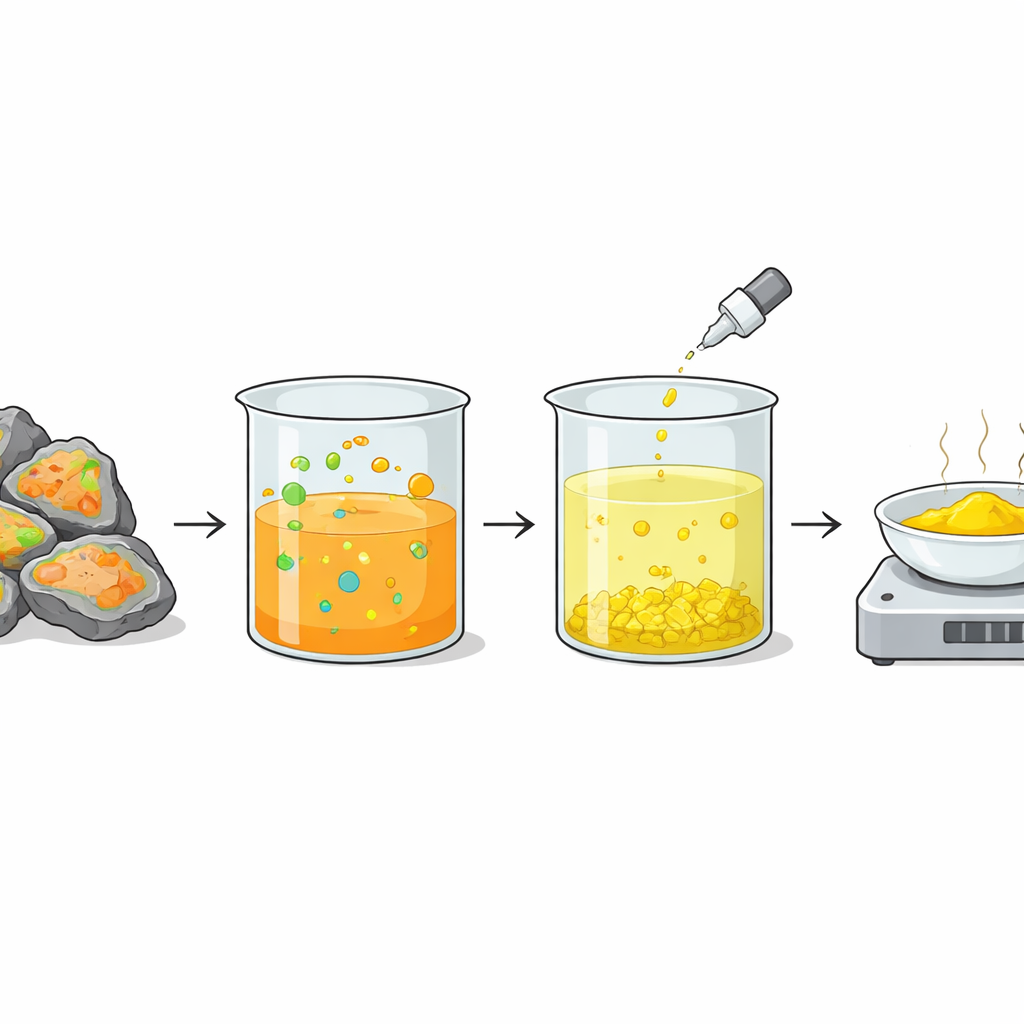
Once the vanadium was safely captured in solution, the team still needed to turn it into a useful product. They did this by adding a common salt containing ammonium ions and adjusting the mixture to be strongly basic. Under these conditions, vanadium settled out as a solid ammonium compound. Heating this solid in air at high temperature transformed it into vanadium pentoxide—the bright yellow powder that industry demands. This final step closes the loop: a hazardous waste from sulfuric acid production is converted into a high‑value material ready for reuse in batteries, catalysts, or other technologies.
A Cleaner Path for Heavy-Metal Waste
In everyday terms, this work shows that a relatively gentle, citrus‑like acid can help strip a dangerous but valuable metal from industrial leftovers with very high efficiency. By replacing harsher chemicals and capturing up to 95 percent of the vanadium, the method offers a way to shrink waste piles, reduce pollution, and recover a strategic resource that would otherwise be thrown away. If scaled up, similar "green" recovery schemes could help many chemical plants treat their spent materials not as garbage, but as a secondary mine sitting right outside the factory gate.
Citation: Shaltout, A.A., El-Hallag, R.S.F. & Razek, T.M.A. Green recovery of vanadium from spent vanadium catalyst from sulfuric acid production. Sci Rep 16, 12869 (2026). https://doi.org/10.1038/s41598-026-47112-6
Keywords: vanadium recovery, spent catalyst recycling, citric acid leaching, sulfuric acid industry, green metallurgy