Clear Sky Science · en
Assessing three altruism facets by economic games and self-report: a multitrait-multimethod investigation
Why this matters for everyday kindness and fairness
From climate action to calling out bullying, people constantly face choices between looking out for themselves and helping others. This study asks a deceptively simple question: when people say they would help, punish wrongdoers, or stand up to unfair authority, do their actions in carefully designed decision games actually match their words? By comparing questionnaire answers with behavior in classic economic games, the researchers probe how well we can measure different kinds of altruism that shape real-life cooperation.
Different faces of doing good
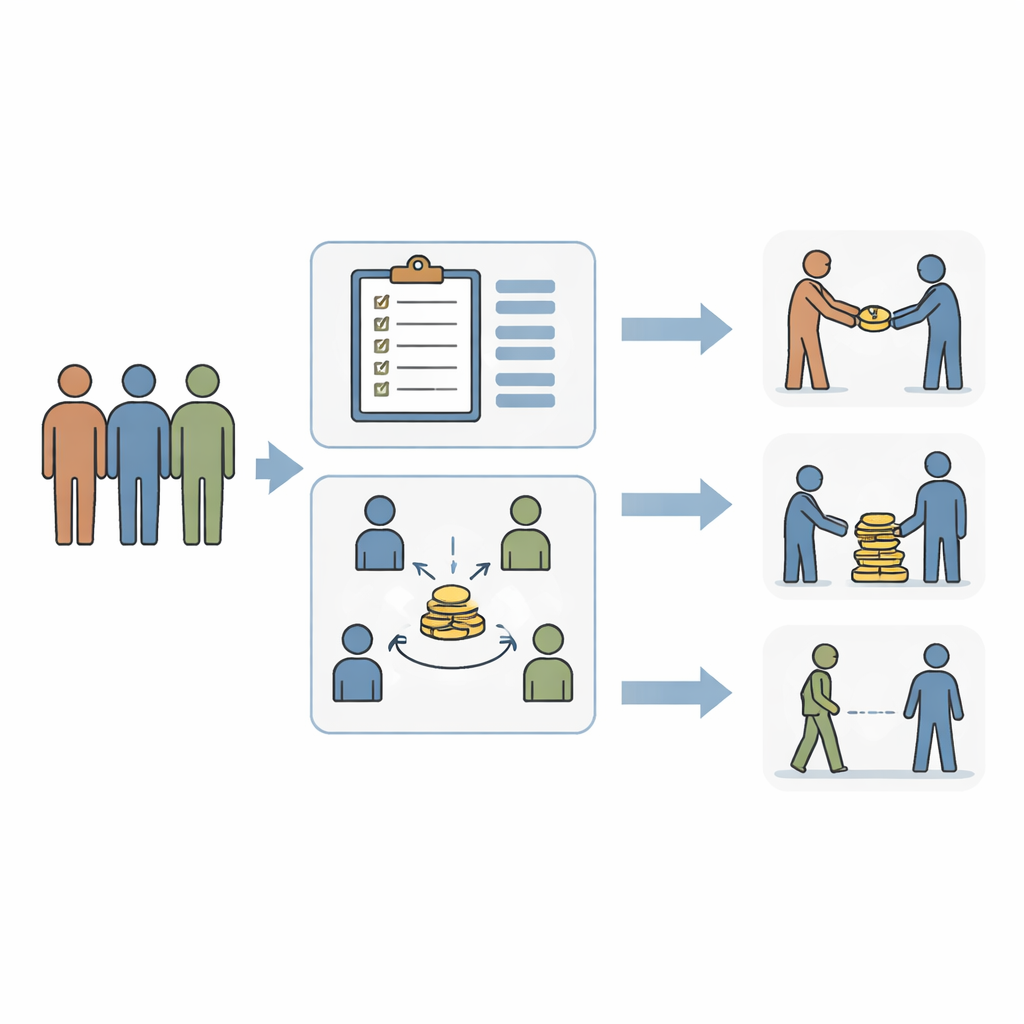
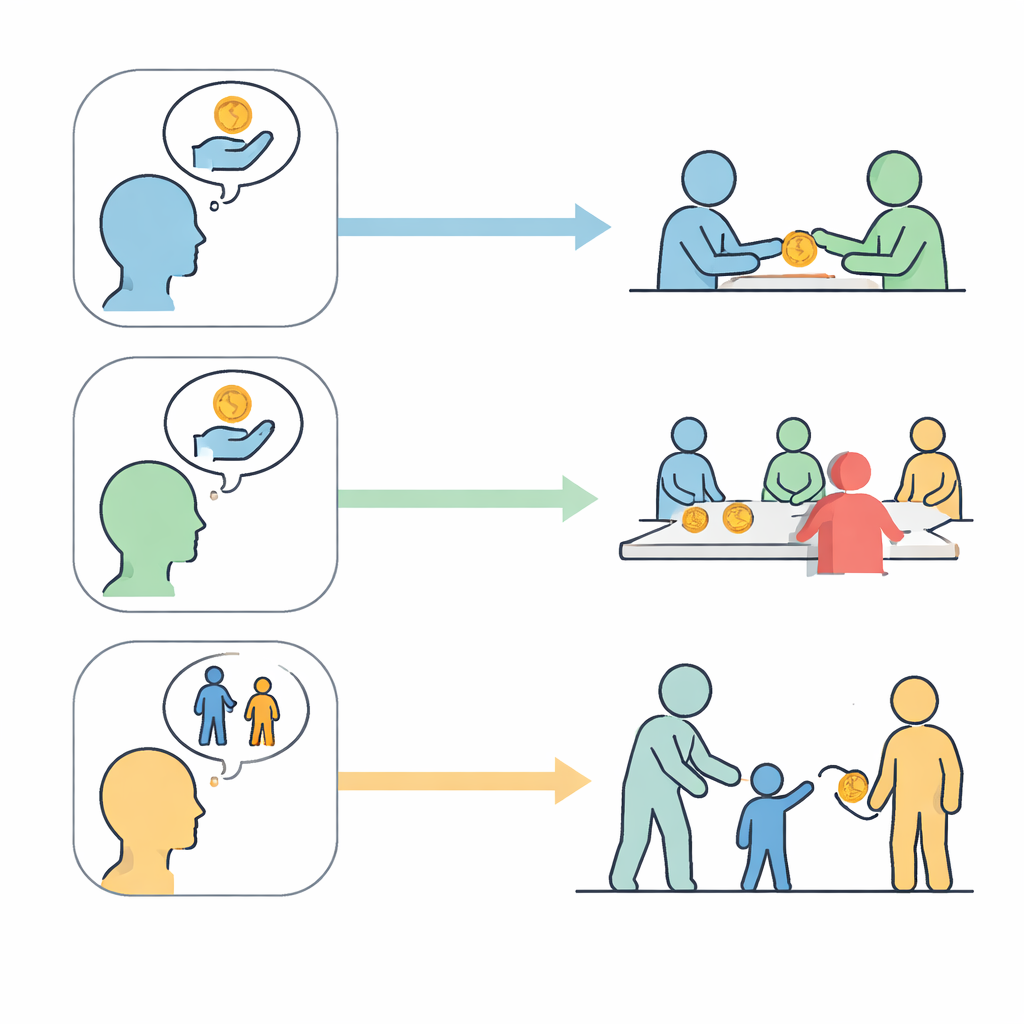
The authors focus on three everyday forms of acting for others. The first is help giving, such as sharing money, time, or information with someone in need without expecting anything back. The second is peer punishment, where group members spend their own resources to sanction someone who abuses the group’s trust, like a free rider who benefits without contributing. The third is moral courage, when someone risks social costs by confronting a powerful person who behaves unfairly, for example questioning a boss’s unjust decision. These three “faces of altruism” are captured in a self-report questionnaire called the Facets of Altruistic Behaviors (FAB) scale, which asks about concrete behaviors rather than feelings or attitudes.
Putting generosity and courage to the test
To see how these self-descriptions relate to actual choices, the researchers analyzed data from 5,806 U.S. and German participants across 22 online studies. A large subgroup of 1,843 people also played well-established economic games. In the Dictator Game, a player decides whether and how much of a windfall to share with an anonymous other, modeling pure giving. In a Public Goods Game with a punishment option, players can spend their own money to reduce the payoff of a group member who has contributed too little, modeling peer punishment. In the Ultimatum Game, a responder can reject an unfair offer so that both parties earn nothing, again interpreted as punishment of unfairness. Finally, a newly developed Third-Party Intervention scenario stages a powerful actor who behaves blatantly unfairly; participants can choose to send a critical message at personal risk, capturing moral courage.
Do self-portraits match game behavior?
Using statistical models that accounted for differences between studies, the authors asked how strongly each game behavior could be predicted from the three FAB traits. Help giving showed the clearest match: people who rated themselves higher on everyday helping were much more likely to share money in the Dictator Game, and when they did share, they gave noticeably larger amounts. Moral courage also translated into action. Higher scores on the moral courage scale were linked to a greater chance of intervening against the unfair, powerful player in the Third-Party Intervention scenario. Importantly, these links were trait-specific. Help giving predicted sharing, not punishment or intervention, while moral courage predicted intervention but not the other game behaviors, suggesting that the questionnaire scales do indeed tap partly distinct kinds of altruism.
The puzzle of punishment
The picture was murkier for peer punishment. People who claimed they would anonymously sanction free riders did not consistently punish more in the Public Goods Game, nor did they reject unfair offers more often in the Ultimatum Game. The one robust connection was that higher peer-punishment scores were tied to demanding slightly fairer minimum offers in the Ultimatum Game. There was also a modest sign that people who endorsed punishment tended to share a bit less in the Dictator Game when they did give at all. These weak and uneven links echo earlier findings that punishment in laboratory games may be driven by anger or other motives that are hard to compress into brief self-report items, and that real-world punishment may look quite different from the stylized choices offered in experiments.
Games, surveys, and the limits of measurement
Across all traits, correlations between games and questionnaires were modest at best, and measures tended to cluster more by method (all self-reports together, all games together) than by underlying facet of altruism. The authors also tested whether it mattered that some participants were deceived into believing they were playing against real partners, while others knew the interactions were simulated. Deception made a small difference only for how much people demanded as a minimum fair offer in the Ultimatum Game; otherwise, behavior was surprisingly stable. These results highlight both the promise and the limits of current tools: they capture broad tendencies, especially for helping and moral courage, but fall short of offering precise, interchangeable measures of “true” altruism.
What this means for understanding human goodness
For non-specialists, the takeaway is that altruism is not a single trait but a family of related yet distinct ways of acting for others: quietly helping, enforcing shared rules, and bravely confronting unfair power. Carefully crafted questionnaires and economic games each shed light on these behaviors, but they do so from different angles and are far from perfectly aligned. The study shows that self-reported helping and moral courage do predict generous and brave choices in controlled settings, while punishment-related altruism remains harder to pin down. Improving our understanding—and measurement—of these facets will be crucial for designing policies and interventions that encourage everyday kindness, fair rule enforcement, and the courage to challenge injustice.
Citation: Binder, L., Schultze, M., Chen, F.S. et al. Assessing three altruism facets by economic games and self-report: a multitrait-multimethod investigation. Sci Rep 16, 11600 (2026). https://doi.org/10.1038/s41598-026-46603-w
Keywords: altruism, economic games, prosocial behavior, moral courage, peer punishment