Clear Sky Science · en
Screening of five mulberry (Morus spp.) cultivars for safe utilization of arsenic-contaminated tailings
Turning Poisoned Land into Productive Fields
Old mine sites can leave behind soil laced with toxic metals, raising worries about food safety and local livelihoods. This study explores whether certain mulberry trees can grow on arsenic contaminated mine tailings while still safely feeding silkworms that produce silk, offering a way to clean up damaged land and support rural economies at the same time.
Why Mulberry Trees Matter
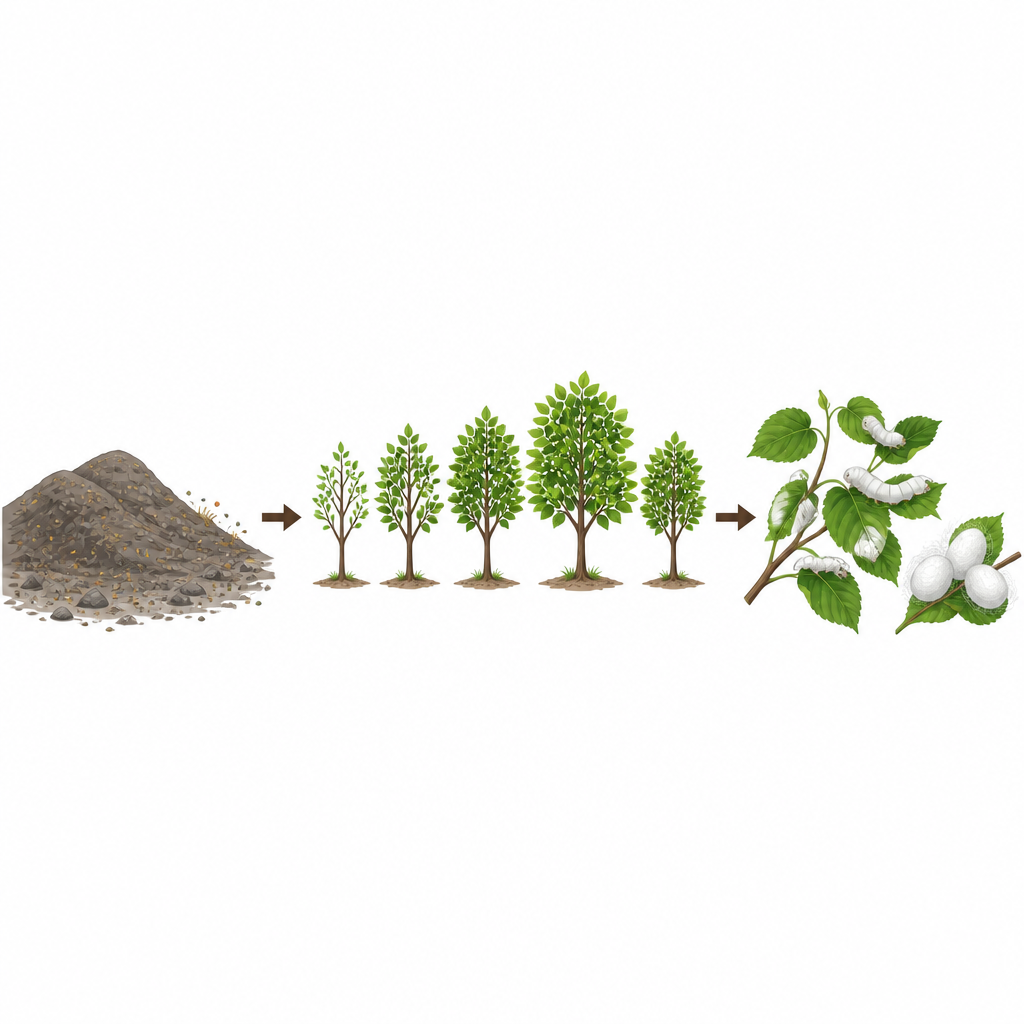
Mulberry trees are workhorses in many farming regions. Their deep roots and sturdy growth help hold loose soil in place and pull pollutants out of the ground, while their leaves are the sole food source for silkworms. Because arsenic is highly poisonous to people, animals, and plants, the team set out to test whether five common mulberry varieties could thrive in arsenic rich tailing soil and still provide safe leaves and cocoons for silk production.
Testing Trees on Toxic Ground
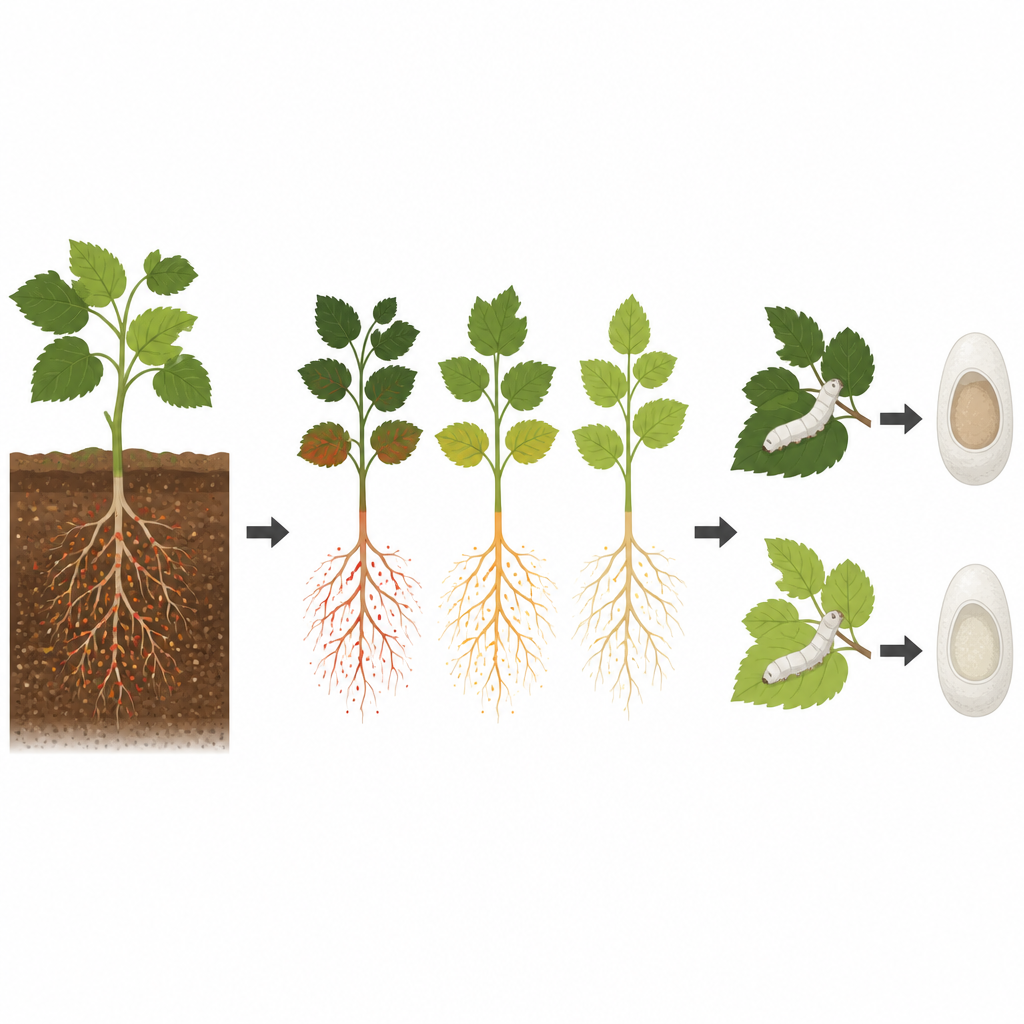
Researchers planted five mulberry cultivars in both clean soil and arsenic contaminated mine tailings in southern China and followed them for six months. All trees grew more poorly in the tainted soil, but one variety, called Y120, stayed relatively tall, kept its roots longer, and held onto its leaf numbers better than the others. Measurements showed that arsenic built up mainly in roots, then leaves, then stems. Two varieties, J and F, soaked up far more arsenic into their roots and leaves, while Y120 and G62 took up much less and kept arsenic in their above ground parts well below national safety limits for animal feed.
Cleaning Soil While Feeding Silkworms
Despite the stress, each mulberry type helped lower arsenic levels in the surrounding soil, with the F variety cutting arsenic by nearly two fifths in the topsoil. The same trees then supplied leaves to silkworms raised in the lab. Silkworms that ate arsenic exposed leaves ate more overall, especially in their final growth stage, a sign that their bodies may have been struggling to cope. Even so, survival differed sharply among leaf sources. Silkworms fed leaves from Y120 had the highest survival and cocooning rates, while those eating F leaves suffered heavy losses and produced many weak or abnormal pupae and adults.
Tracking Hidden Changes Inside the Worm
The team also looked inside the silkworm gut to see how their resident microbes responded to contaminated food. In some leaf groups, gut bacteria became less diverse, while in others, certain bacterial groups became more common, changes that may be linked to higher disease risk. When arsenic was measured in silkworm bodies, feces, pupae, and cocoons, a clear pattern emerged: most arsenic was shunted into feces, then pupae, then the rest of the body, and the least ended up in the cocoons. Even in the worst case, arsenic levels in feces, pupae, and cocoons stayed below Chinese safety standards for fertilizer, food or feed use, and eco friendly textiles.
Choosing the Safest Tree for Silk and Soil
To weigh all these factors together, from tree growth and soil cleanup to silkworm health and arsenic in cocoon silk, the researchers applied a scoring method that compared 26 different indicators. This overall assessment ranked the five mulberry cultivars from safest to riskiest as Y120, G62, G12, J, and F. In plain terms, Y120 turned out to be both tough enough to handle arsenic contaminated tailings and gentle enough on silkworms to keep their products within safety limits, making it a strong candidate for reclaiming polluted mine land through sustainable silk production.
Citation: Lu, F., Wu, C., Fan, W. et al. Screening of five mulberry (Morus spp.) cultivars for safe utilization of arsenic-contaminated tailings. Sci Rep 16, 15821 (2026). https://doi.org/10.1038/s41598-026-46408-x
Keywords: mulberry, silkworm, arsenic, mine tailings, phytoremediation