Clear Sky Science · en
Wavelet neural network based reduced-ripple DITC of switched reluctance motors in electric vehicles
Why smoother electric motors matter
Electric cars promise quiet, efficient travel, but the motors that drive their wheels can still produce unwanted shaking and noise. A popular motor type for future vehicles, the switched reluctance motor, is tough, cheap and avoids rare-earth magnets, yet it suffers from pronounced torque ripple, the tiny surges and dips in twisting force that cause vibration. This paper explores a smart control method that uses a specialized neural network to smooth out those ripples, making these rugged motors more pleasant and efficient for everyday driving. 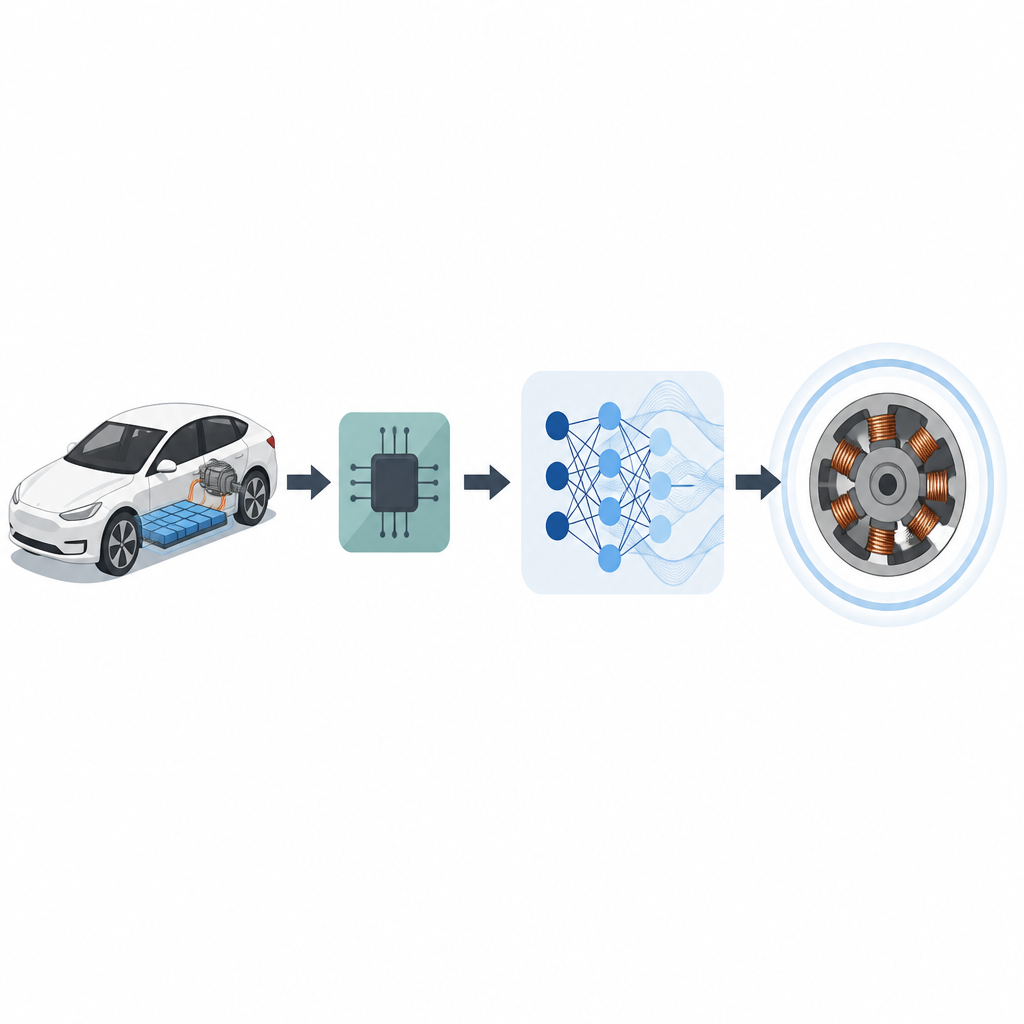
A tough motor with a rough ride
Switched reluctance motors are attractive for electric vehicles because they have a simple structure, are highly reliable, and do not depend on scarce magnetic materials. Their drawback comes from the way they generate force: as the rotor teeth line up with energized stator teeth, the torque naturally pulses. Traditional control schemes that regulate current in square waves are easy to implement but leave large torque variations. More advanced torque-based controls can react faster, yet they still struggle with the strongly nonlinear magnetic behavior of these machines, especially during the brief moments when multiple motor phases overlap and hand torque from one to another.
Teaching the controller to think ahead
The authors build on a strategy known as direct instantaneous torque control, where the controller directly compares the desired torque with the estimated actual torque and rapidly switches power electronics to correct any error. In its basic form, this approach still produces sizable ripples. The study adds a compact wavelet neural network between the speed controller and the torque controller. Instead of sending a fixed torque target, this smart module looks at both the torque error and how quickly it is changing, then subtly reshapes the reference torque in real time. Wavelets, which capture patterns in both time and scale, help the network learn the complex, position-dependent torque behavior of the motor using only two hidden neurons and seven tuned parameters.
Optimizing once, working everywhere
To avoid an unwieldy, constantly retrained model, the team uses an optimization algorithm called the Equilibrium Optimizer to tune the neural network just once at a carefully chosen operating point: slightly above rated speed and at rated load, where torque ripple is high but current remains well controlled. The algorithm searches for parameter values that jointly minimize torque ripple and overall torque error. The resulting set of seven parameters is then fixed and used for all speeds and loads. In parallel, the same optimizer is used to refine the angles at which each motor phase is switched on and off across a grid of speeds and torques, and the best values are stored in simple look-up tables inside the controller. 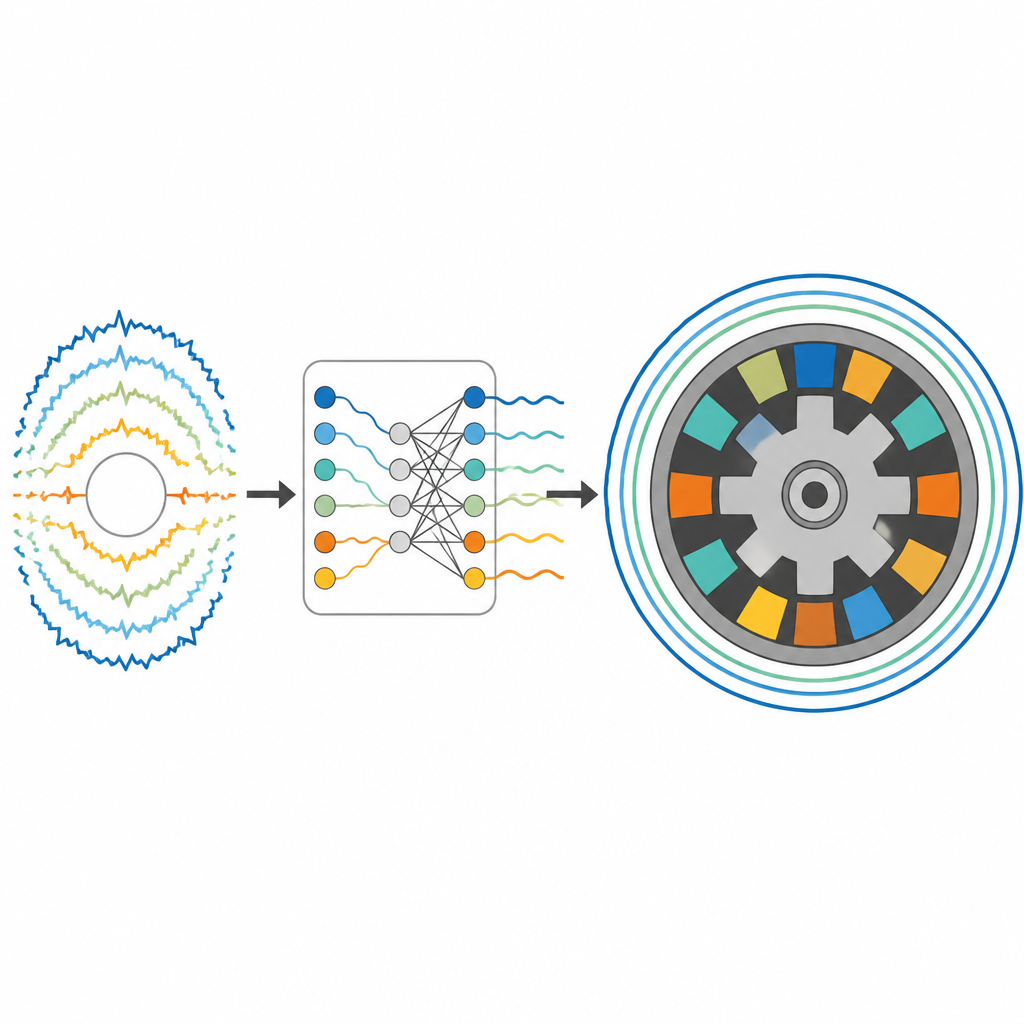
From computer model to test bench
Extensive simulations on a three-phase 12/8 switched reluctance motor show that the new controller delivers higher average torque, noticeably smoother torque profiles, and similar peak currents compared to the conventional scheme. The improvement appears across a broad range of speeds and both light and heavy loads. Experiments on a real motor setup confirm these findings. Under open-loop tests and realistic closed-loop driving scenarios with speed steps and sudden load changes, the proposed controller consistently cuts measured torque ripple by around 16 percent for light loads and nearly 29 percent for heavy loads. The price is a higher switching frequency and a modest increase in computation time, but both remain within common industrial limits.
What this means for future electric drives
In plain terms, the study shows that a small, well-trained neural network can act like a smart filter between a driver’s torque demand and the motor, reshaping the command to cancel much of the inherent pulsing inside a switched reluctance motor. Because the network is simple, trained only once, and paired with optimized switching angles, the overall control stays practical for real-time hardware. For electric vehicles and other demanding applications, this approach offers a path to using robust, magnet-free motors while reducing vibration and improving drive quality without redesigning the motor itself.
Citation: Saleh, A.L., Hamouda, M., Számel, L. et al. Wavelet neural network based reduced-ripple DITC of switched reluctance motors in electric vehicles. Sci Rep 16, 15564 (2026). https://doi.org/10.1038/s41598-026-46371-7
Keywords: switched reluctance motor, torque ripple, electric vehicle drive, neural network control, motor control optimization