Clear Sky Science · en
A novel deep intronic COL5A1 variant in an Ehlers-Danlos syndrome family: functional characterization by minigene assay
Hidden clues in stretchy skin
Why do some people bruise easily, scar deeply, and have unusually stretchy skin and flexible joints? For families living with Ehlers-Danlos syndrome, these day-to-day problems can be painful and confusing. This study follows one such family in China and shows how a single, well-hidden change in their DNA can weaken the body’s internal scaffolding, offering new insight into diagnosis and future treatment ideas for this rare condition.
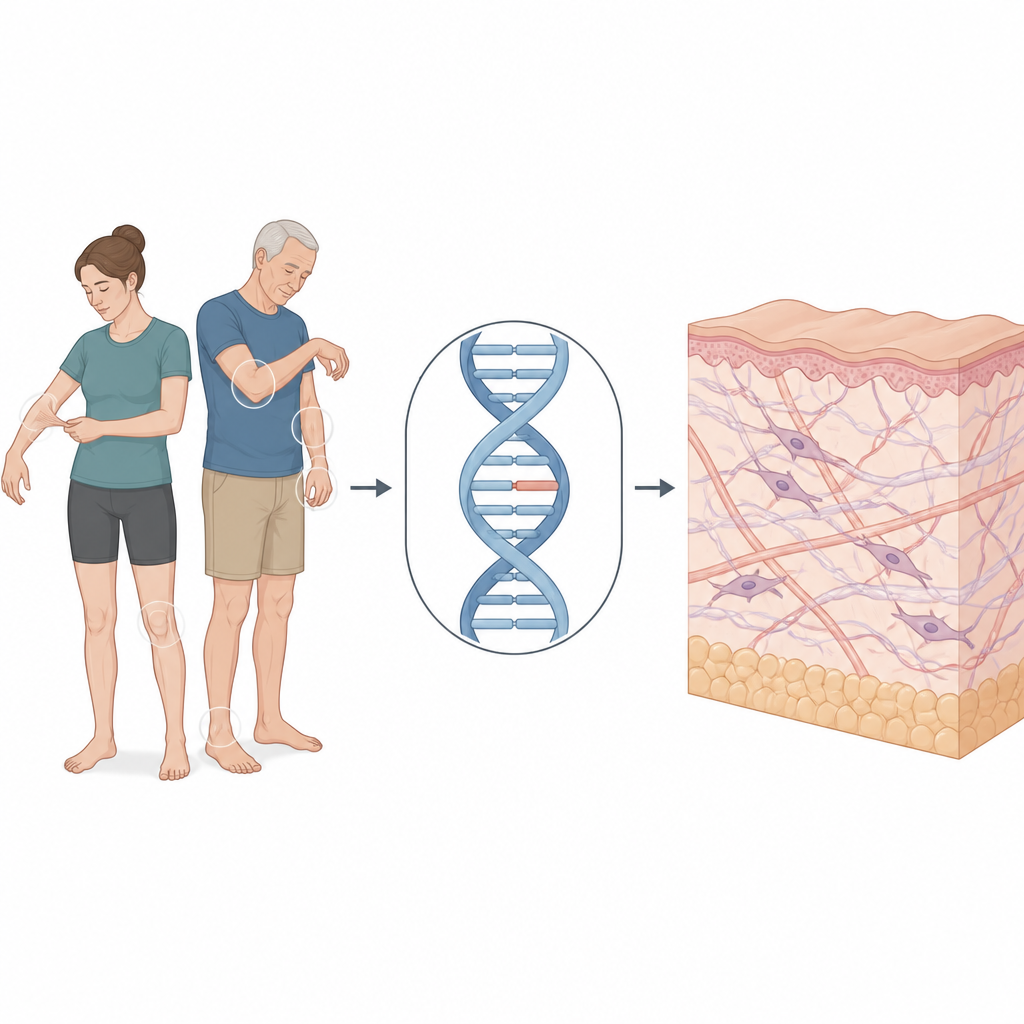
What this family was facing
The research centers on a 30-year-old woman who went to a dermatology clinic because of long-standing skin and joint problems. She had soft, velvety skin that could stretch more than usual, healed with thin, papery scars, and bruised with little effort. Her finger joints bent back further than normal. Her father showed loose skin and some facial features often seen in this condition, while her mother had no symptoms. Together, their signs pointed to the classical type of Ehlers-Danlos syndrome, a form that mainly affects the skin and joints but can also raise concern about blood vessels and other organs.
Looking for answers in the genes
Classical Ehlers-Danlos syndrome is usually linked to changes in genes that build collagen, the protein ropes that strengthen skin and many other tissues. The team used medical whole-exome sequencing, which scans thousands of disease-related genes, to search for suspicious changes in the patient and her parents. They found a subtle alteration in a gene called COL5A1, which helps make type V collagen. This change did not sit in the usual protein-coding stretch of the gene, but deep inside a noncoding segment. At first glance, such a hidden change was hard to classify, so the researchers needed to test whether it actually disturbed how the gene’s message was read.
A lab test that mimics gene reading
To probe the effect of this buried DNA change, the scientists used a tool known as a minigene assay. They built two miniature versions of the COL5A1 gene segment: one with the usual sequence and one carrying the family’s variant. These constructs were placed into human cells grown in the lab to see how the cell machinery would process them. The normal version produced the expected RNA message, while the altered version produced two messages. One looked normal, but the other contained an extra inserted piece, a so-called pseudoexon, spliced in from what should have been a silent stretch of genetic material.
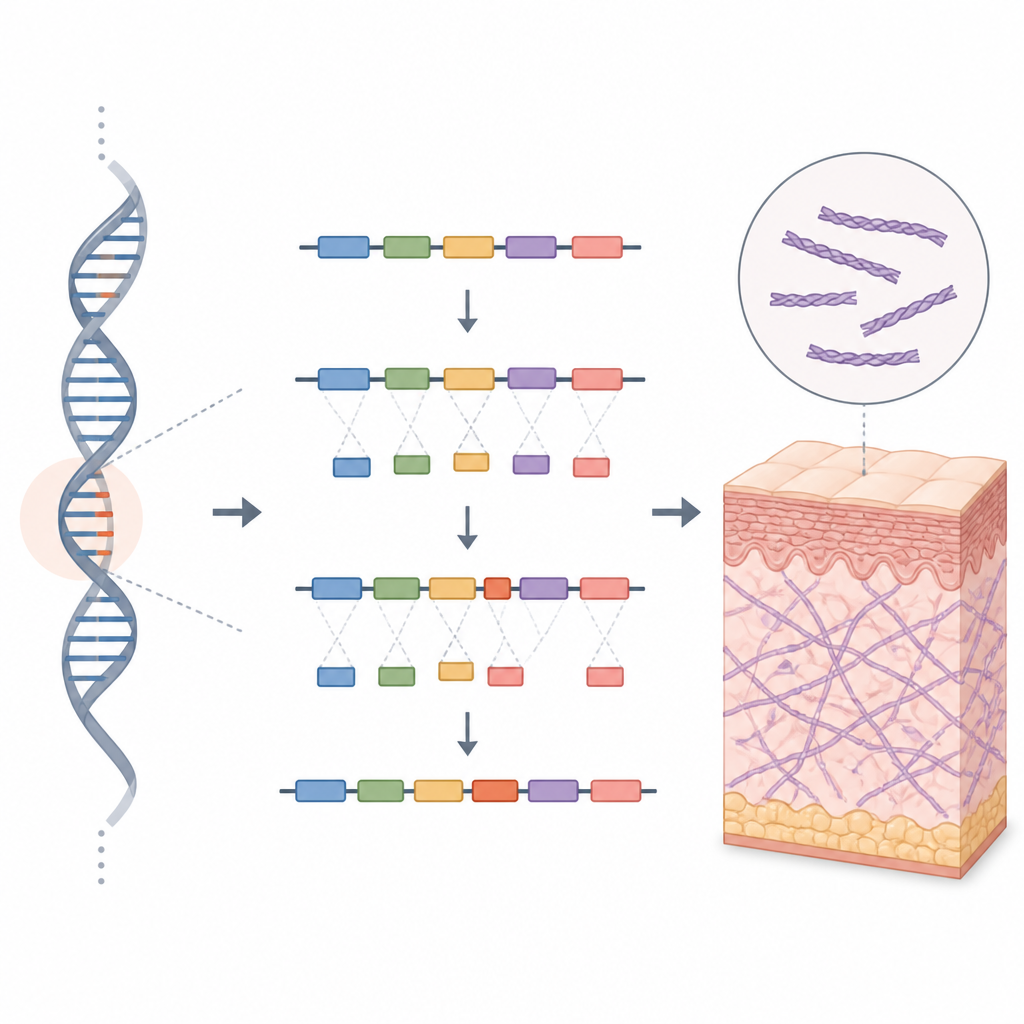
How a tiny extra piece causes fragile tissue
This extra inserted piece shifted the reading frame of the gene’s message, quickly introducing a stop signal that cut the protein short. The result is predicted to be either a truncated, nonworking fragment of the COL5A1 protein or no protein at all, because cells often destroy such faulty messages. Either way, the body would have too little functional type V collagen, weakening the collagen network that supports skin and joints. The pattern in the family, the absence of this variant from population databases, and the clear lab evidence of faulty splicing together led the authors to classify the change as likely disease-causing under current clinical genetics guidelines.
Why this hidden change matters
This work shows that important disease-causing changes can lurk far from the usual, easily scanned parts of genes, and that specialized RNA-level tests may be needed when routine genetic screens fail to explain a strong clinical picture. It also hints at future treatments that could, in principle, correct this kind of mistake by blocking the extra pseudoexon and restoring the normal message, using approaches such as antisense oligonucleotides. For people with classical Ehlers-Danlos syndrome, studies like this deepen understanding of why their tissues are fragile and may eventually open the door to more precise diagnosis and tailored therapies.
Citation: Zhao, J., Feng, J. A novel deep intronic COL5A1 variant in an Ehlers-Danlos syndrome family: functional characterization by minigene assay. Sci Rep 16, 15232 (2026). https://doi.org/10.1038/s41598-026-46346-8
Keywords: Ehlers-Danlos syndrome, COL5A1, intronic variant, aberrant splicing, connective tissue