Clear Sky Science · en
Hybrid expansion methods for fractional non-linear mathematical systems with Erdelyi-Kober derivative operators in theory of tsunami wave modeling
Waves With a Long Memory
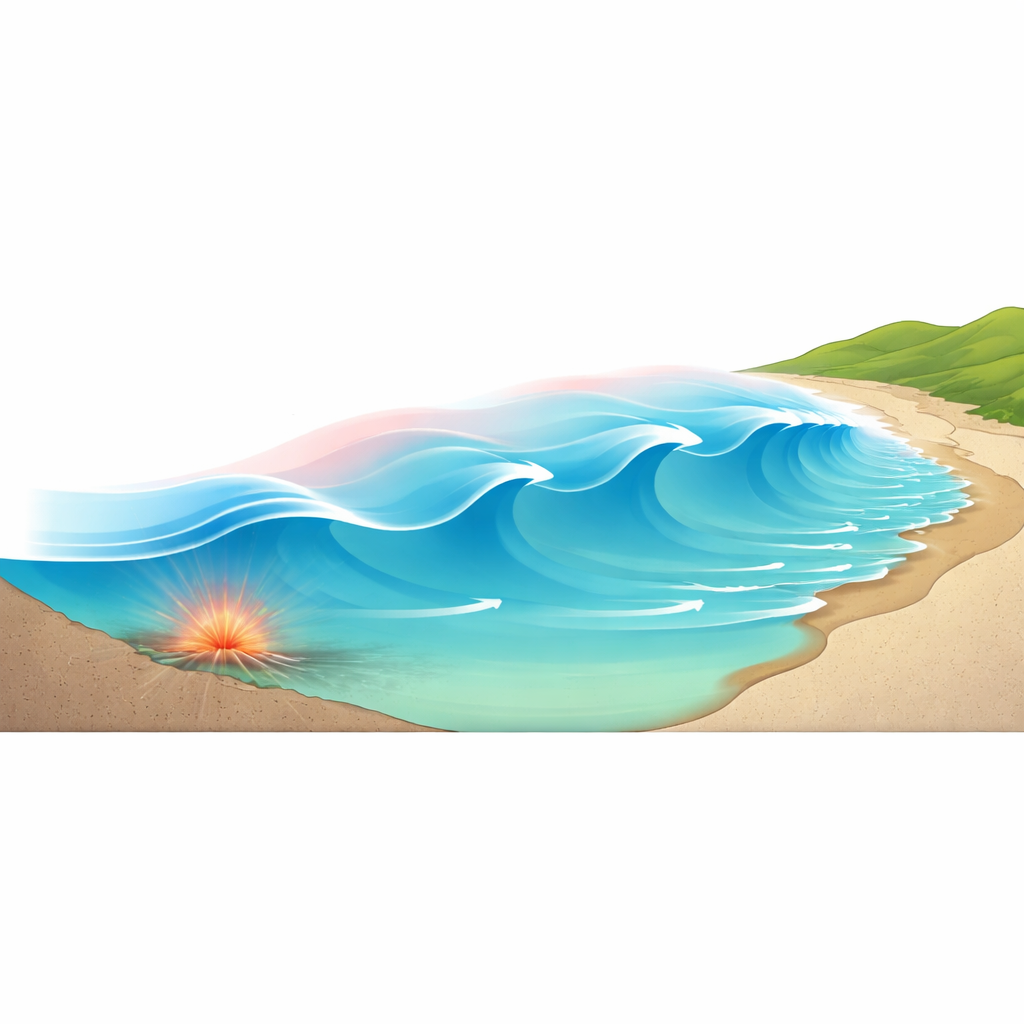
Huge ocean waves such as tsunamis do not just respond to what is happening right now; they also carry a kind of memory of what happened earlier on the seafloor and along their path. This paper explores how to capture that memory in mathematical models of shallow-water waves. By doing so, the authors aim to build tools that can describe how tsunami-like waves evolve more faithfully than traditional equations, without claiming to predict real disasters directly.
Why Ordinary Wave Equations Fall Short
Standard wave equations treat water like a system that reacts instantly and locally: what happens at one spot depends mainly on conditions right there and at that moment. Real oceans, however, are more subtle. Sediments, complex coastlines and long-lasting disturbances mean that the present motion of water is influenced by its past behavior and by what happens some distance away. Mathematicians refer to these effects as nonlocal interactions and memory. To address this, researchers use “fractional” calculus, which allows derivatives of non-integer order and naturally builds in history and long-range influence.
A New Kind of Calculus for the Sea
The authors focus on a particular family of tsunami-related equations known as the Whitham–Broer–Kaup (WBK) system, widely used as an idealized model for waves in shallow water. They replace the usual time derivative in these equations with an Erdelyi–Kober fractional derivative, a specialized operator that can encode both scaling and memory effects. In everyday terms, this modification lets the equations remember how the wave has evolved over time, rather than responding only to the most recent push. The result is a “fractional” WBK model in which a key parameter controls how strongly past events influence the present wave shape.
Hybrid Methods to Tame Tough Equations
These more realistic equations are also more difficult to solve. Instead of relying purely on brute-force computing, the authors construct two semi-analytical methods that blend the advantages of series expansions and iterative corrections. The first, called the expansion new iterative method (ENIM), builds the solution step-by-step, repeatedly improving an initial guess using the structure of the equations and the fractional operators. The second, the expansion homotopy perturbation method (EHPM), gradually transforms a simple problem into the full fractional system and tracks how the solution deforms along the way. In both cases, the wave profile and the horizontal water speed are represented as special fractional power series whose coefficients are computed using properties of the Erdelyi–Kober operators.
What the Calculations Reveal About Tsunami-Like Waves
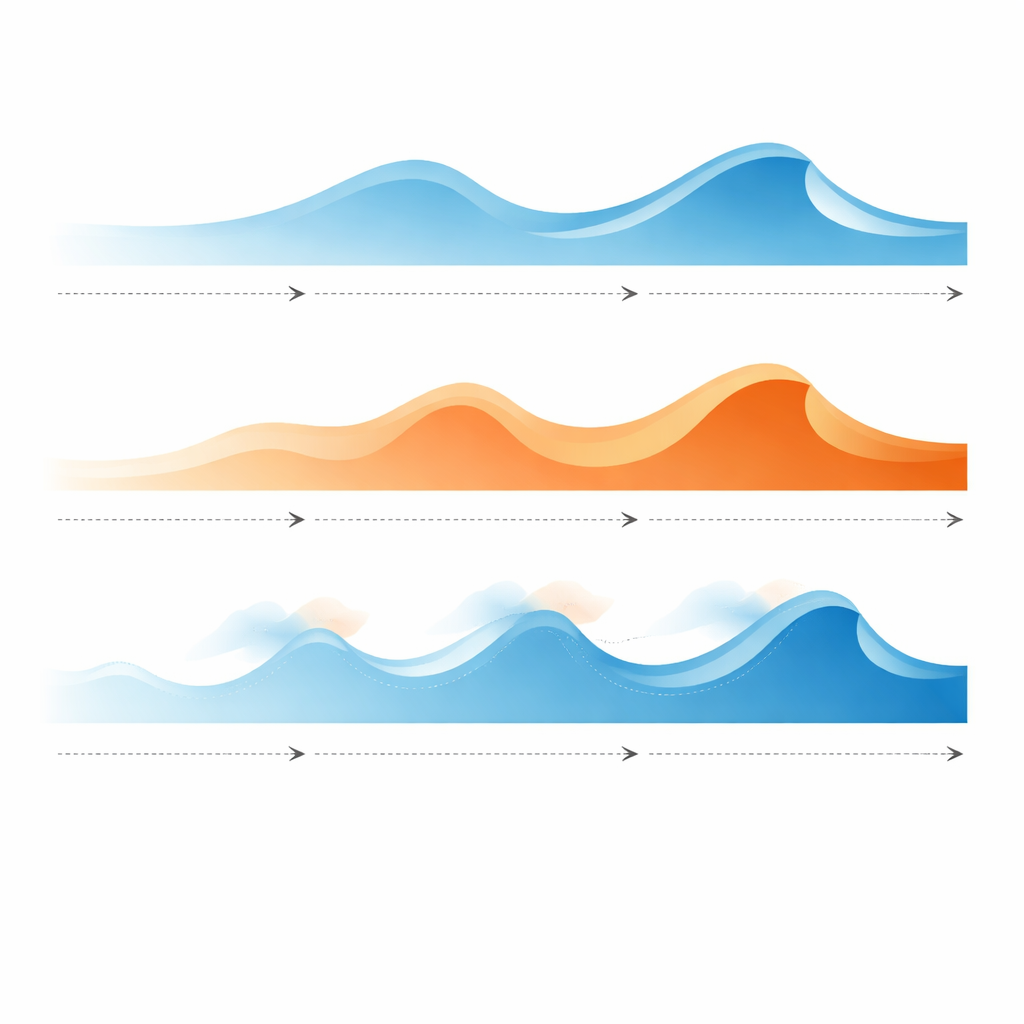
To test their methods, the authors apply ENIM and EHPM to a benchmark version of the fractional WBK system that represents shallow-water tsunami dynamics. When the fractional order is set to match the classical case (effectively turning memory off), both methods reproduce the known exact solution with high accuracy; EHPM consistently produces smaller errors than ENIM, often about half as large. When the fractional order is reduced below the classical value, the model waves change character: they become smoother and more diffused, with lower peaks and broader profiles, reflecting stronger memory and spreading effects. As the fractional order increases toward the classical value, the waves sharpen and behave more like familiar, sharply defined pulses racing toward shore.
Why This Matters for Future Wave Modeling
The study concludes that these hybrid expansion methods are stable, efficient and accurate tools for handling complex wave equations that include memory. While the results are not intended as direct forecasts of real tsunamis, they show how fractional models can smoothly bridge between diffusive, strongly history-dependent behavior and the sharper waves described by traditional equations. This makes them promising building blocks for future mathematical studies of tsunami-like phenomena and other systems where the past continues to shape the present.
Citation: Damag, F.H., Saif, A., Alshammari, M. et al. Hybrid expansion methods for fractional non-linear mathematical systems with Erdelyi-Kober derivative operators in theory of tsunami wave modeling. Sci Rep 16, 10551 (2026). https://doi.org/10.1038/s41598-026-46268-5
Keywords: tsunami modeling, fractional calculus, shallow water waves, semi-analytical methods, wave propagation