Clear Sky Science · en
A power–exponential secant modulus model for the compression and settlement behavior of compacted loess fill
Why hills made from soil can slowly sink
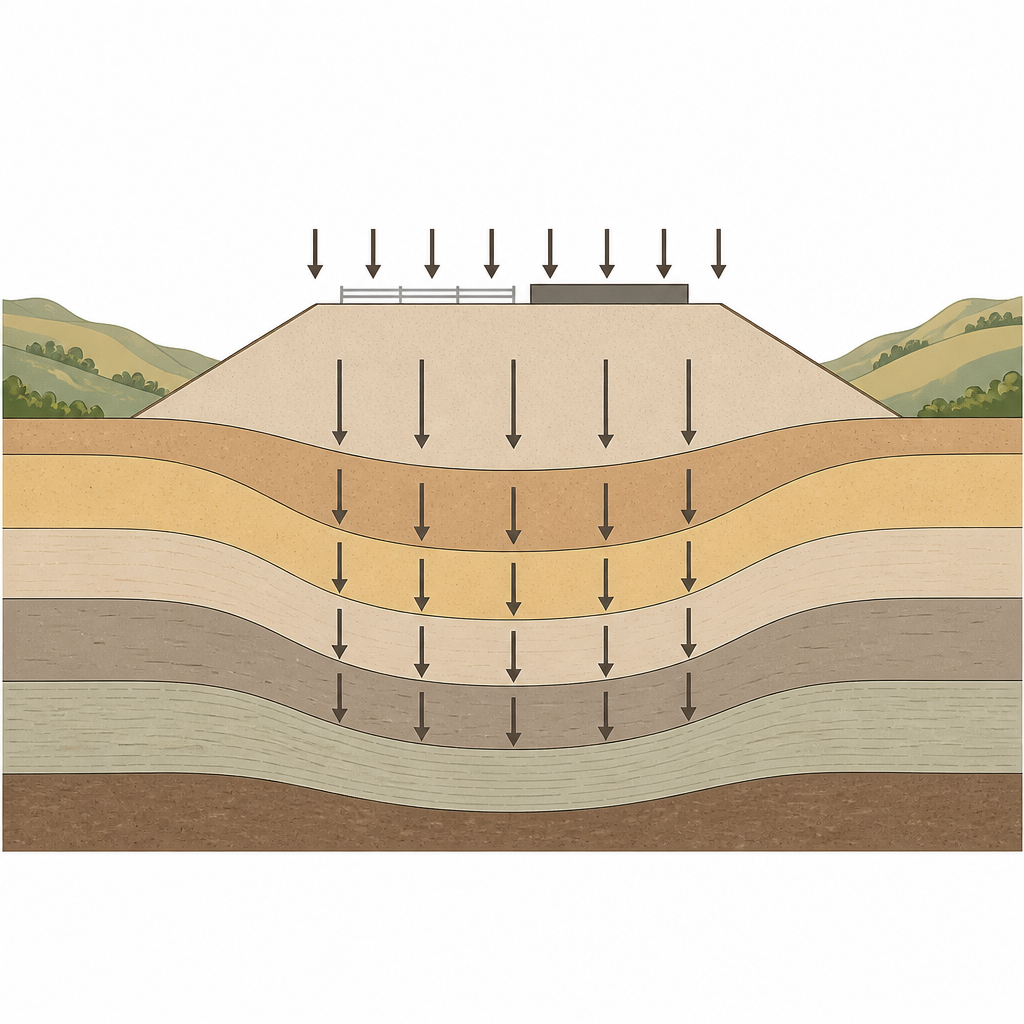
Across many hilly regions, cities are creating new flat land by filling deep gullies with thick layers of compacted soil. These man-made hills support roads, homes, and factories, so even small irregular sinking can crack buildings or damage pipelines. This study looks at a common soil called loess and asks a simple question that matters to engineers and nearby residents alike: how much will these giant soil fills squeeze and settle under their own weight and the weight of what we build on them, and can we predict that settlement more reliably?
Layered ground that is far from uniform
The researchers began by sampling a 40 meter deep high-fill site in a gully area on the Chinese Loess Plateau. Although all layers were made from loess, measurements of water content, dry density, and grain size showed strong changes with depth. Near the surface, the soil was loose and moist, reflecting recent reworking. Deeper layers that had received more compaction energy were denser and stiffer, while an intermediate transition zone at the contact with natural loess was relatively weak and wet. This vertical patchwork means that some horizons are more prone to squeezing than others, which helps explain why settlement can be uneven across a large fill.
Watching soil pores close under pressure
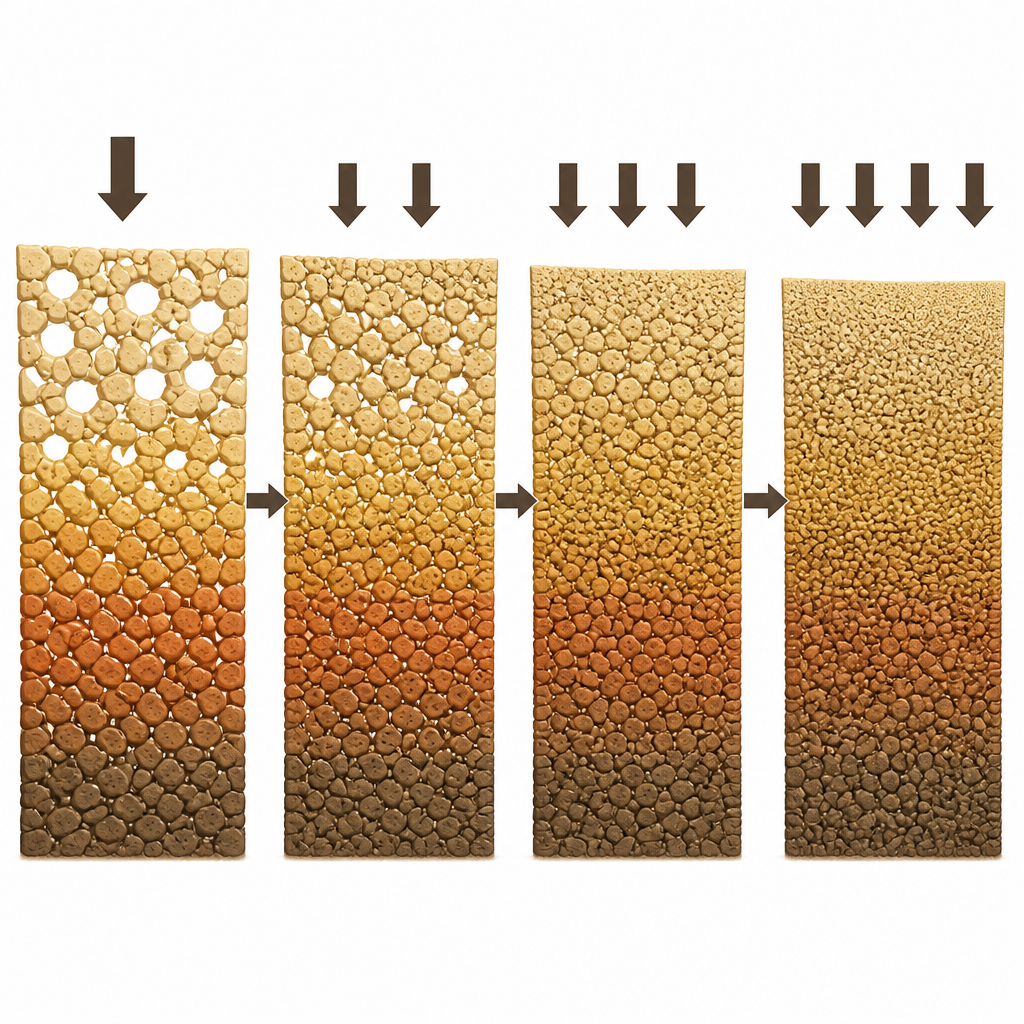
Using a high-pressure testing device, the team compressed undisturbed samples from each depth in one direction while preventing sideways movement, similar to how soil is squeezed beneath a broad foundation. They tracked how the tiny spaces between grains, known as pores, shrank as pressure increased. All samples showed a curved, not straight, relationship between pressure and deformation. At low pressures the soil compacted slowly, at medium pressures it compressed faster as loose structure collapsed, and at high pressures it stiffened again as a stronger grain skeleton took over. A quantity called the secant modulus, which reflects how stiff the soil is over a given stress range, rose quickly at first, then more steadily, and finally approached a plateau at high stress.
A simpler way to describe how stiffness changes
Existing formulas used to link soil stiffness with pressure often work only over part of this range or require many poorly understood fitting constants. The authors proposed a new mathematical description called a composite power exponential secant modulus model. Instead of guessing stiffness directly, they first express the strain of the soil as pressure rises using a compact function with three parameters, then derive stiffness from that curve. Each parameter has a clear physical role: one controls the overall level of possible compression, another shapes the curve in the low to medium pressure range where structure is failing, and the third governs how quickly the stiffness settles toward a stable value at high pressure when the grain skeleton is dominant.
Testing predictions of real-world settlement
To see whether this new model is useful outside the laboratory, the researchers used it to calculate the total vertical settlement of a typical 40 meter thick loess fill, treating the ground profile as a stack of layers with different properties. They compared the predicted settlement with three common methods, including a traditional layered approach, a widely used older secant modulus model, and a more conservative compression index method. All methods gave similar total settlements, but the new model produced a value that lay between the simpler and more conservative estimates, matched monitored field behavior, and gave a smooth distribution of deformation with depth. It also behaved stably when extended to stresses higher than those used for fitting, an important test for engineering reliability.
What this means for safer man-made hills
In plain terms, the study shows that the way compacted loess stiffens under load follows a consistent pattern tied to pore closure, loss of fragile structure, and rearrangement of grains into a stronger framework. The new three-parameter model captures this whole sequence with a single expression, needs only standard laboratory tests to calibrate, and links its numbers to understandable soil features like moisture state and compaction quality. For engineers planning large fills in loess regions, it offers a more physically meaningful and still practical tool to estimate how much the ground will settle over time, helping them design supports and drainage systems that keep roads and buildings level and serviceable.
Citation: Li, Z., Ren, S., Shen, A. et al. A power–exponential secant modulus model for the compression and settlement behavior of compacted loess fill. Sci Rep 16, 15410 (2026). https://doi.org/10.1038/s41598-026-46222-5
Keywords: compacted loess, foundation settlement, secant modulus, high-fill embankment, soil compression