Clear Sky Science · en
Hierarchical tree-structured belief rule base for fault diagnosis of complex electromechanical systems
Smarter safety checks for machines
Modern trains, factories, and aircraft rely on complex electromechanical systems packed with sensors and control circuits. When a hidden fault slips through, the consequences can be costly or even dangerous. This paper presents a new way to spot such problems early, using a layered reasoning system that blends human engineering insight with data from machines, while keeping the logic transparent enough for experts to understand and trust.
Why hidden faults are hard to catch
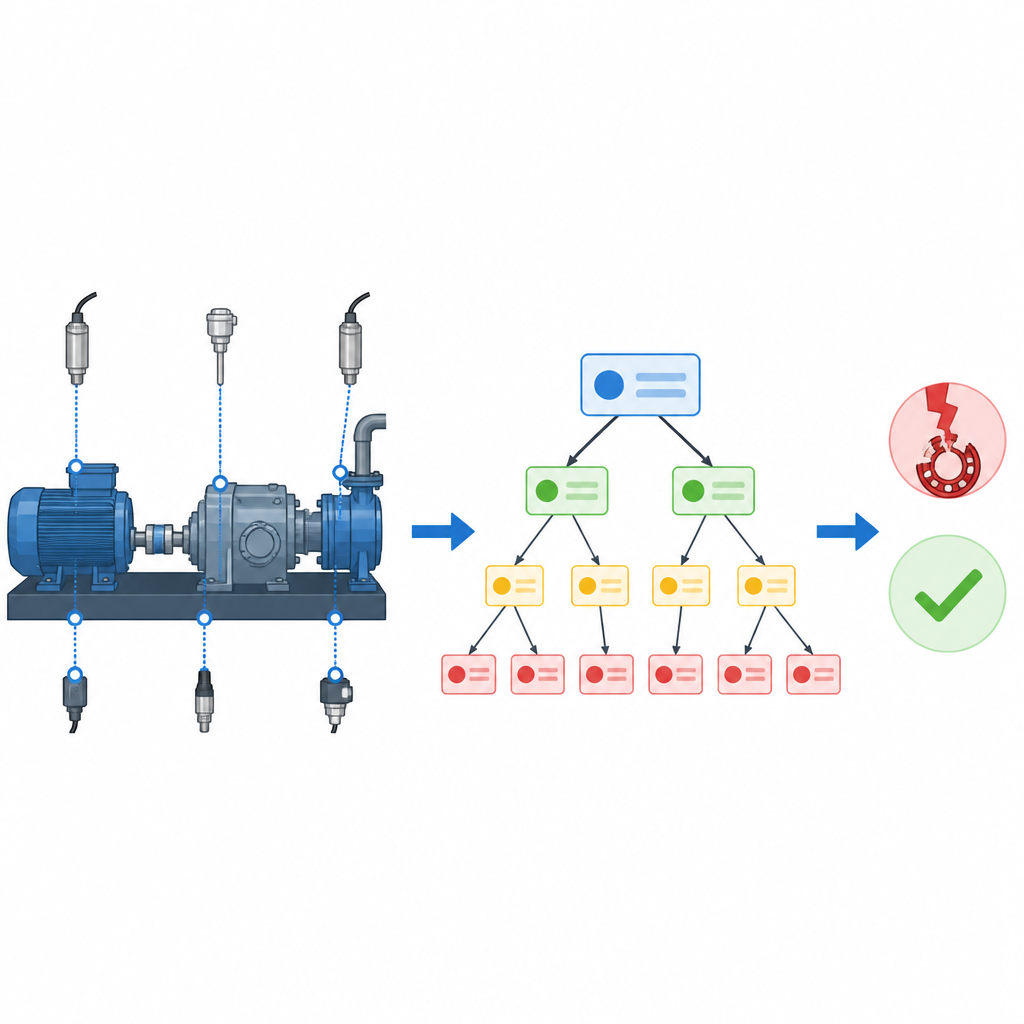
Large machines, such as permanent magnet motors in high speed trains, are built to be very reliable. Real faults are rare, so there are few faulty examples to train standard machine learning models. At the same time, the signals coming from these systems are rich and tangled: many sensors, many operating conditions, and faults that can be steady, slowly growing, or sudden and random. Traditional physics based models can be too hard to build in detail, and pure data based models can act like black boxes, giving accurate answers without explaining their reasoning. Existing rule based systems that try to mix expert rules with data often run into a different wall: as the number of sensor features grows, the number of possible rules explodes, making the approach too bulky to use in practice.
A layered tree of human friendly rules
The authors tackle this rule explosion head on by reshaping how the rules are organised. Instead of one huge flat rule table that tries every combination of features, they build a tree of smaller rule blocks. Each small block looks at only a few carefully chosen features and outputs a belief about which fault state the machine is in. These blocks are arranged in a hierarchy, so that high level blocks handle the most informative features, while lower level ones refine the decision with extra details. An evolutionary search process automatically explores many possible tree layouts and keeps the ones that balance accuracy with simplicity, so engineers do not have to hand craft the entire structure themselves.
Choosing the right signals to watch
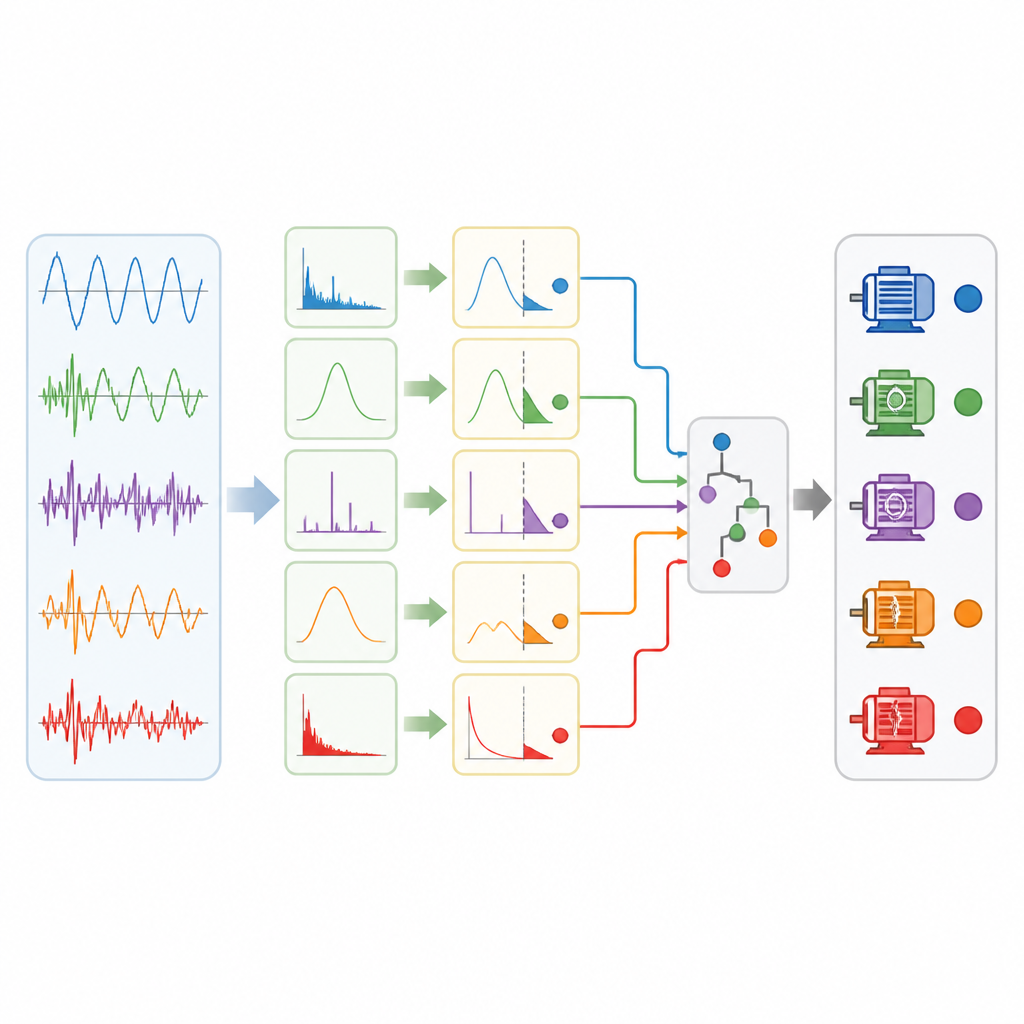
Even before building the tree, the method works to pick the most useful sensor features. It measures how strongly each feature relates to the fault types using ideas from information theory, then adjusts these scores with expert knowledge about how faults really affect currents, vibrations, and other signals. For example, a feature that often changes with speed or load but not with faults is down rated, while a feature known to track a specific fault pattern is boosted. The final score for each feature blends data evidence, physical insight, and past experience across different operating conditions. Only the top ranked features are kept, trimming the input space and stopping unnecessary rules from being created in the first place.
Combining overlapping clues without double counting
Because the tree contains several rule blocks that may rely on related signals, their outputs are not independent. If this overlap is ignored, a standard fusion method can unintentionally count the same piece of evidence several times and skew the final diagnosis. To avoid this, the authors adapt a framework called MAKER, which measures how similar the outputs of different blocks are, including subtle nonlinear links. Each block is assigned a reliability based on its past accuracy, a weight that reflects its importance, and a correlation measure that reflects how much of its information is already present elsewhere. These factors are used together to adjust how much each block influences the final decision, so that strong but redundant clues are toned down while unique, trustworthy clues carry more weight.
Putting the method to the test on real motors
To test their approach, the researchers used a real electric drive system built around a permanent magnet synchronous motor, similar to those used in high speed rail. They injected four types of sensor faults into the current measurements: steady offset, wrong gain, slow drift over time, and random intermittent spikes, along with a healthy state. From simple time based statistics of the current, such as energy and peak related measures, the method selected a compact set of six features and built a hierarchical rule tree. On just 480 data samples, it matched or exceeded the accuracy of several advanced machine learning models, while using far fewer rules than a traditional belief rule system and keeping every step of the reasoning traceable. The tree structure also made training and real time inference faster, an important point for industrial monitoring.
What this means for safer machines
In plain terms, the study shows that complex machines can be monitored with a rule system that stays manageable, explains its choices, and works well even when there are few fault examples. By first choosing the most informative signals, then organising small rule blocks into a tree and fusing their outputs in a correlation aware way, the method avoids the usual blow up in rule count and the opacity of many learning models. For operators of trains, factories, and other safety critical systems, this offers a path toward fault diagnosis tools that are both accurate and understandable, helping human experts trust and refine automated alerts rather than simply taking them on faith.
Citation: Chen, M., Su, T., Cheng, C. et al. Hierarchical tree-structured belief rule base for fault diagnosis of complex electromechanical systems. Sci Rep 16, 15267 (2026). https://doi.org/10.1038/s41598-026-45997-x
Keywords: fault diagnosis, electromechanical systems, belief rule base, sensor faults, hierarchical modeling