Clear Sky Science · en
Multi-objective scenarios analysis for optimizing mariculture spatial allocation: a case study of Lianyungang, China
Feeding a Growing Appetite for Seafood
People in China, like many around the world, are eating more fish and shellfish as they seek healthier and more varied diets. Yet current harvests from the sea still fall far short of nutrition guidelines. This gap between what people need and what the ocean currently supplies raises a basic question: how can we farm the sea in a way that boosts food production without damaging fragile marine ecosystems? This study looks at waters off Lianyungang, a city on China’s east coast, to explore how careful planning of where and how we farm the ocean can help close that gap.
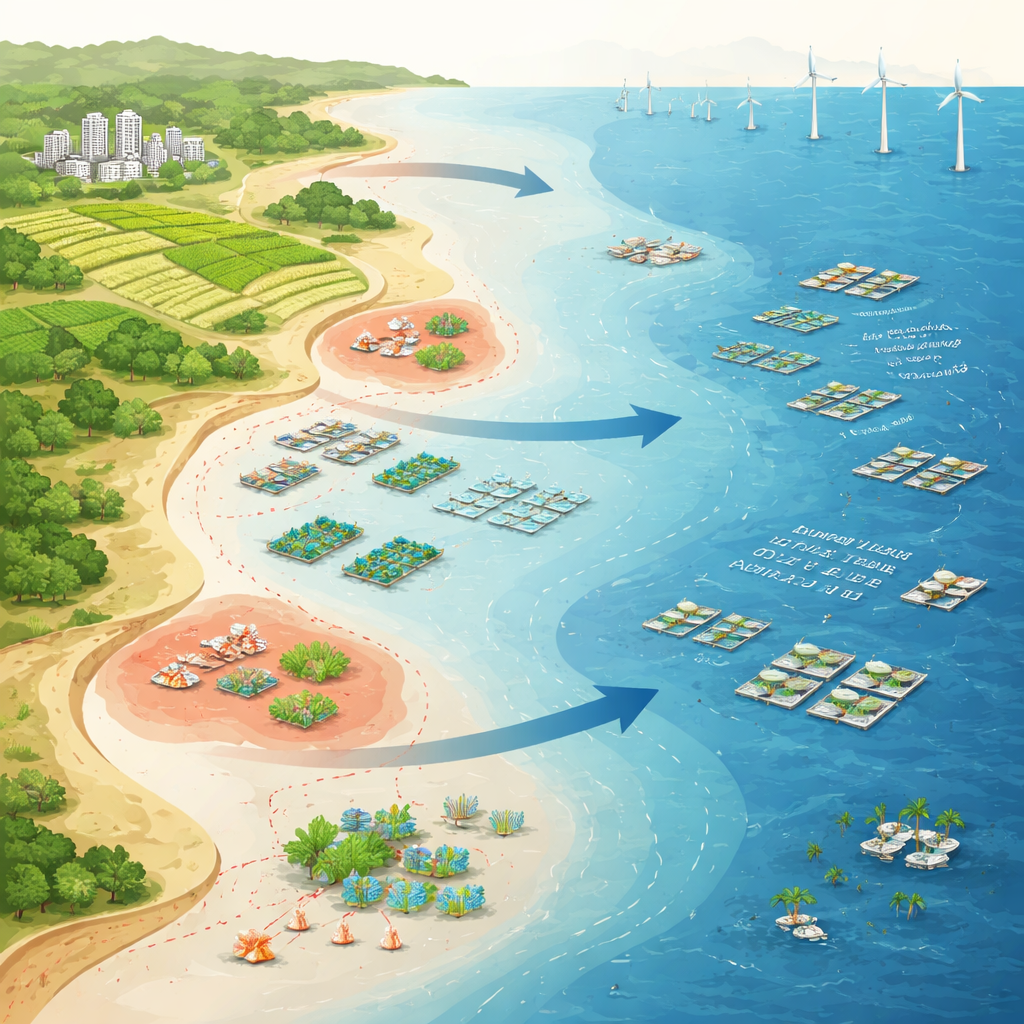
Why Where We Farm the Sea Matters
For decades, most marine farming in China has taken place close to shore, using ponds, rafts, and bottom plots along shallow coastlines. At the same time, China has strengthened protections for marine life and coastal wetlands and has cut back on traditional nearshore fish farms that generate pollution or conflict with conservation zones. As a result, nearshore waters have become crowded with many competing uses: ports, shipping lanes, protected areas, and older-style farms all press against each other. Meanwhile, deeper waters farther offshore remain relatively empty. The authors argue that smarter placement of sea farms could ease these conflicts while helping meet the nation’s growing appetite for seafood.
Balancing Food Needs, Ocean Space, and Farming Methods
The researchers built an optimization framework around three linked questions: how much seafood will be needed, which sea areas are suitable or off-limits, and which farming methods make the best use of those areas. First, they projected how much marine farm output Jiangsu Province would need by 2030, using a compound growth model similar to those used in economics. They adjusted this growth rate for policy changes, technological gains, and environmental risks such as harmful algal blooms and sea ice. Second, they mapped the study area’s seascape: protected zones, key fish habitats like spawning and feeding grounds, shipping routes, existing farms, and offshore wind projects. They also evaluated water quality, nutrient levels, oxygen, plankton, depth, and currents to see where farmed species would thrive or struggle.
Finding the Right Spots for Different Farm Types
Using these layers of information, the team divided the sea into zones that either must be conserved, are suitable for farming, or can support multiple uses at once. They found nearly 892 square kilometers that should be set aside as fishery conservation space and about 1,854 square kilometers that are environmentally suitable for mariculture. Of this, around 1,205 square kilometers in deeper waters (20–30 meters) favor cage-based fish farming, while about 648 square kilometers in shallower waters (10–20 meters) are better for rafts and bottom sowing of species like sea cucumbers. A notable portion of this shallow area can be shared in three dimensions with offshore wind farms, stacking turbines above and aquaculture structures below to use the same patch of ocean more efficiently.
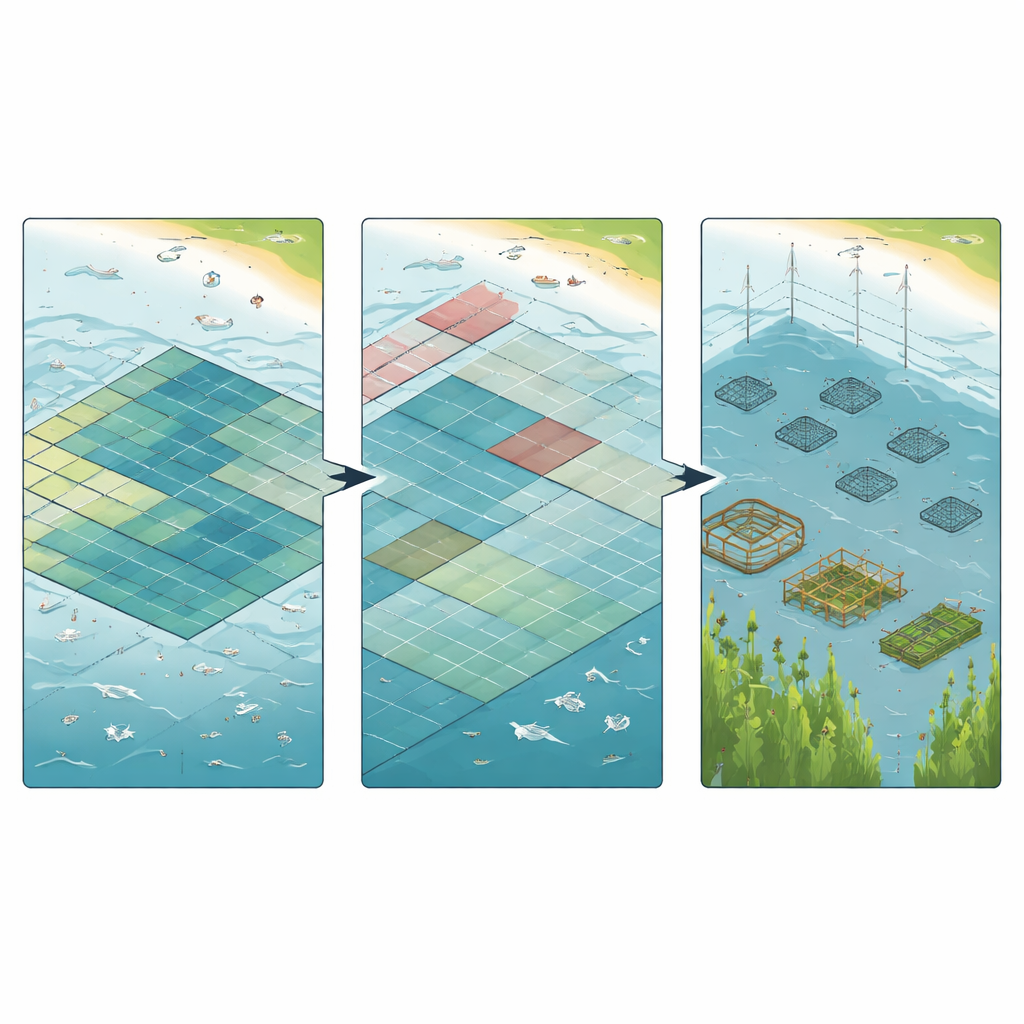
Planning for Different Futures
To account for uncertainty, the study outlines four planning scenarios that combine two different production targets for 2030 with two levels of expected yield per unit area. For each scenario, the authors calculate how much space would be needed for four main types of mariculture: deep-water fish cages, raft culture, hanging baskets for shellfish and crabs, and bottom sowing. They then place these methods into the most suitable zones while avoiding protected areas and busy shipping corridors. In all cases, nearshore farms are pulled back from sensitive habitats and shifted offshore, especially into deeper zones beyond 15 kilometers from the coast where environmental conditions better support large-scale, modern sea farming.
What This Means for the Future of Ocean Farming
In plain terms, the study shows that it is possible to grow more seafood while protecting the sea, if we are deliberate about how we use ocean space. By forecasting demand, mapping environmental and conservation needs, and matching each type of farm to the right conditions, the authors provide a step-by-step blueprint for reorganizing mariculture around Lianyungang. Their framework suggests that moving farms farther offshore, reserving key areas for wild fish, and combining uses such as wind energy and aquaculture can help China’s “Blue Granary” strategy deliver more protein to dinner tables without overburdening coastal ecosystems.
Citation: Wang, Q., Li, C. & Li, Y. Multi-objective scenarios analysis for optimizing mariculture spatial allocation: a case study of Lianyungang, China. Sci Rep 16, 10930 (2026). https://doi.org/10.1038/s41598-026-45733-5
Keywords: mariculture, marine spatial planning, aquaculture zoning, offshore aquaculture, Blue Granary strategy