Clear Sky Science · en
Future of high mountain endemic species under climate change: predicting the potential scenarios for Stellaria pulvinata in the Altai Mountains
Why mountain wildflowers matter
High in the Altai Mountains of Central Asia, a small cushion shaped wildflower called Stellaria pulvinata helps hold thin alpine soils together and shelters other tiny plants from cold and wind. This study asks a pressing question for anyone who cares about nature: as the climate warms and human pressure grows, how much longer will this cold loving mountain specialist be able to hang on, and where will it survive?
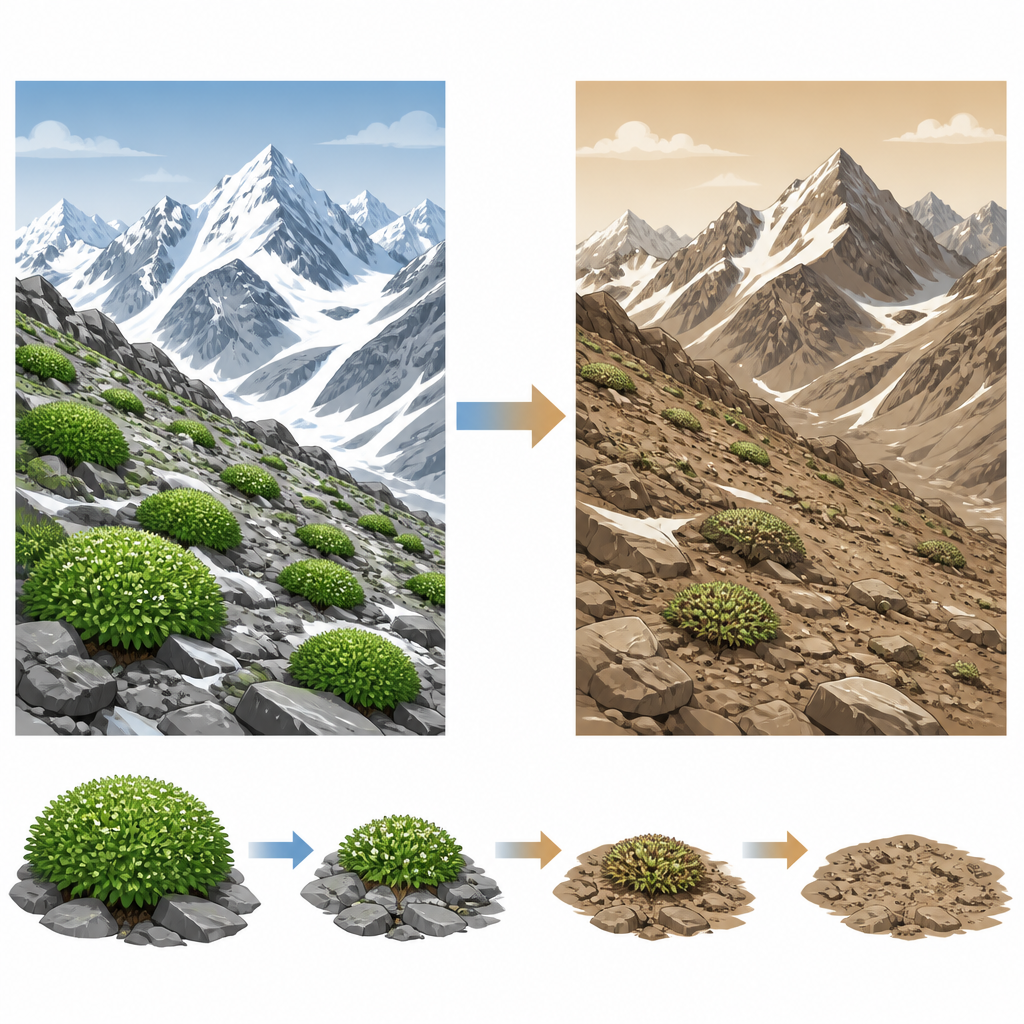
A rare plant on the roof of Central Asia
Stellaria pulvinata is an endemic species, meaning it lives naturally only in a limited region. It forms dense green cushions in the harsh belts of the Altai Mountain Country, which spans parts of Russia, Kazakhstan, Mongolia, and China. These mountains are home to hundreds of unique plant species but are warming faster than the global average. In recent decades the area has seen rising temperatures, shifting rainfall, and growing human impacts such as grazing and tourism, putting narrow range species like this cushion plant at particular risk.
Using data to map hidden refuges
Because it is impossible to search every remote slope in person, the researchers used a computer based approach called species distribution modeling. They gathered 26 reliable records of where the plant has been found from herbaria, global biodiversity databases, and field surveys. Then they combined these records with detailed maps of temperature, rainfall, and terrain to learn which conditions the plant prefers today and to predict where similar conditions may exist in the future. After testing several modeling methods, they selected one called MaxEnt, which showed very high accuracy in matching known sites.
What controls where the plant can live
The models revealed that altitude is the single most important factor shaping the plant’s range, with most suitable habitat between about 2,070 and 4,000 meters above sea level. Seasonal swings in temperature and rainfall also play a strong role, as does moisture during the driest month. Stellaria pulvinata favors cold places with large temperature contrasts between seasons, moderate day night differences, and specific patterns of dry and wet periods. These findings confirm that this cushion plant is finely tuned to the harsh but stable climates of high mountain ridges.
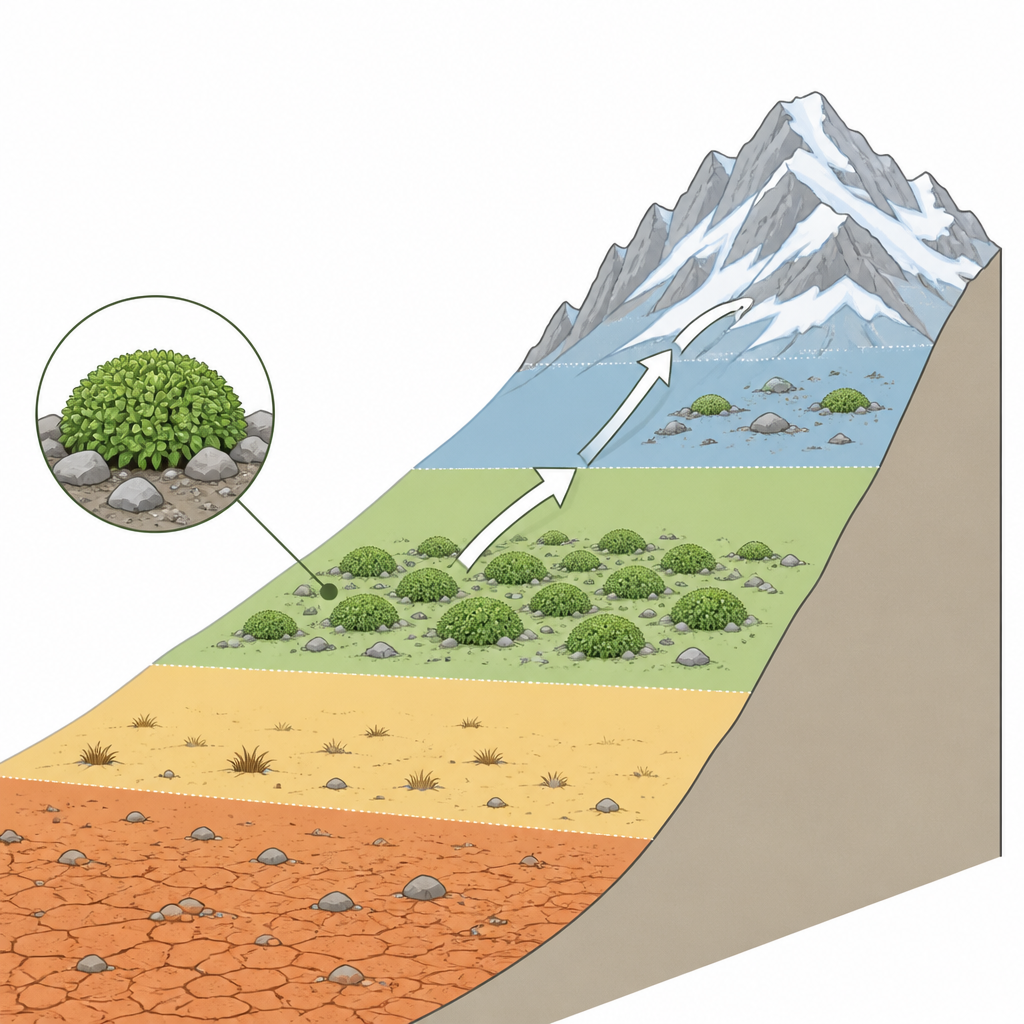
How its habitat is expected to shrink and move
Under current climate conditions, about one quarter of the Altai Mountain Country offers suitable habitat for the species, with the best areas concentrated in the Mongolian Altai highlands. When the team projected conditions into the middle and late twenty first century under two different greenhouse gas pathways, suitable area generally declined. In a mid range emissions future, total suitable habitat fell from about 26 percent of the region to roughly 21 percent by the 2050s and 19 percent by the 2090s. The center of this habitat shifts toward the southeast and to higher elevations, moving on the order of 100 to nearly 200 kilometers. In a higher emissions future, the overall area changes less, but still contracts and reorganizes, with a modest rebound late in the century.
Gaps in protection and what can be done
The study also compared modelled habitat with existing parks and reserves. Only about one third of the most suitable areas for Stellaria pulvinata currently fall inside protected zones, and in some countries of the Altai almost none of the plant’s range is covered. This means many of the safest climatic refuges identified by the model lie unprotected and could be lost to land use change just as the species most needs them. The authors recommend expanding protected areas in key high elevation zones, banking seeds and tissue in conservation collections, and managing grazing and tourism carefully to reduce added stress on remaining populations.
What this means for mountain life
For a general reader, the main message is that a warming climate is likely to squeeze a cold adapted mountain specialist into a smaller, higher, and more fragmented set of refuges. Stellaria pulvinata itself is a small plant, but it stands for many high mountain species that face similar pressures worldwide. By pinpointing where future safe havens are most likely to be, this work offers practical guidance for conservation efforts that could help keep these unique alpine ecosystems alive for generations to come.
Citation: Tsegmed, Z., Baasanmunkh, S., Oyundelger, K. et al. Future of high mountain endemic species under climate change: predicting the potential scenarios for Stellaria pulvinata in the Altai Mountains. Sci Rep 16, 15119 (2026). https://doi.org/10.1038/s41598-026-45612-z
Keywords: Altai Mountains, climate change, endemic plants, species distribution modeling, alpine ecosystems