Clear Sky Science · en
Exploring the importance of shape on dynamic recognition of self-face or friend-face
Why how we see our own face matters
We spend a lifetime seeing our own face in mirrors and photos, yet we rarely watch it move the way others do. This study asks a deceptively simple question with big implications: do we recognize our own moving face in the same way we recognize a close friend’s? The answer sheds light on how the brain builds a sense of self, and uses cutting‑edge deepfake tools not for deception, but as a precise way to pull apart face shape and motion.
Two kinds of information in a face
When we recognize someone, we rely on at least two kinds of visual information. One is face shape: the outline of the jaw, the spacing of the eyes, the curve of the nose. The other is motion: the way the mouth moves when speaking, or the characteristic tilt of the head. For friends and celebrities, we see both shape and motion many times in daily life and in media. For our own face, however, we mostly see a still reflection and only brief, mirror‑reversed movements. That asymmetry raises a puzzle: is our brain’s record of self-face motion as rich as it is for other familiar people, or do we lean more heavily on static shape when deciding “that’s me”?
Using deepfakes as a scientific tool
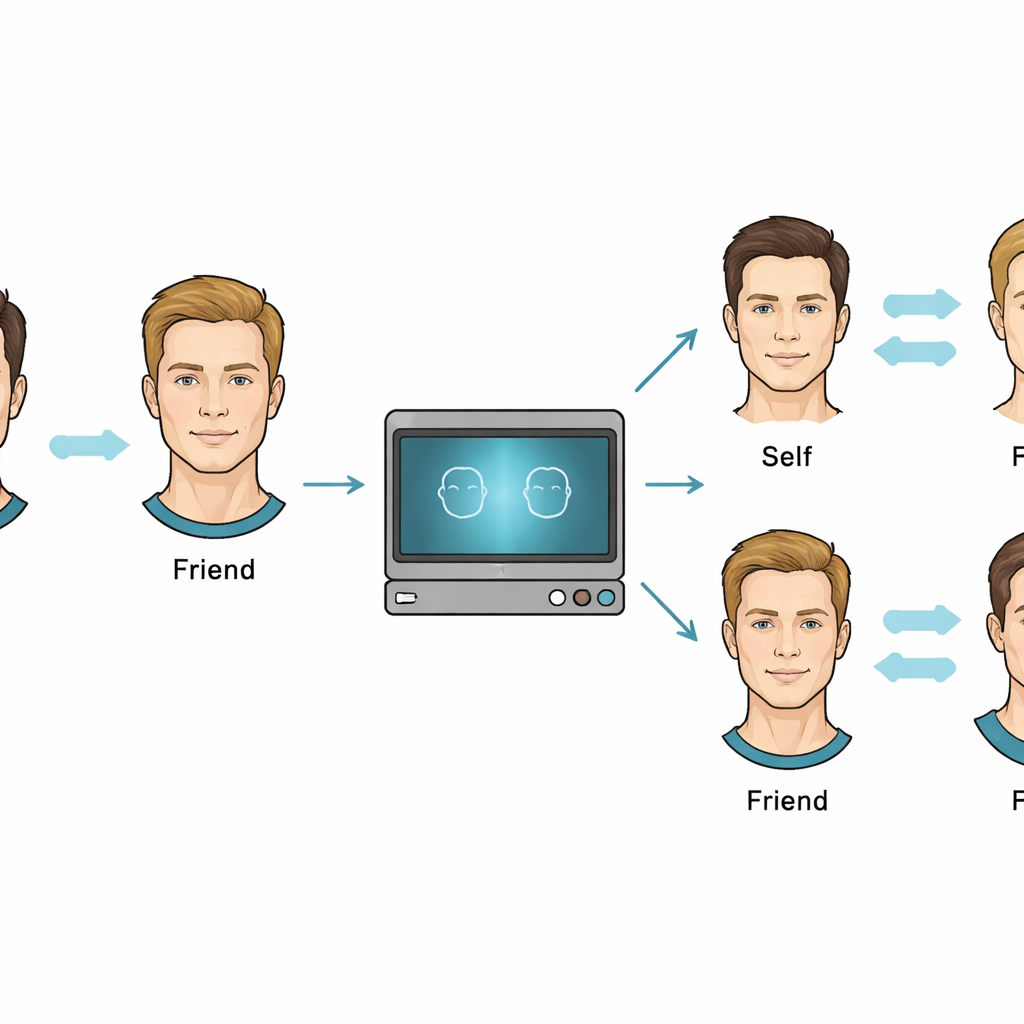
To tease apart shape and motion, the researchers recorded short videos of young men reading sentences aloud. Each participant was paired with a real-life friend, so that each person’s face served both as “self” and “friend” depending on who was watching. Deepfake software was then used not to create hoaxes, but to swap facial shapes while keeping the original motion intact. This allowed the team to generate highly realistic clips where, for example, a friend’s facial movements were played back on the participant’s own facial shape, or vice versa. Participants watched these clips in a darkened room and, after each one, pressed a key to indicate whether the face’s motion belonged to themselves or to their friend, while being told to ignore static appearance as much as possible.
When shape and motion agree—or clash
In the first experiment, there were four clear-cut combinations: self-shape with self-motion, self-shape with friend-motion, friend-shape with self-motion, and friend-shape with friend-motion. The results showed that people could reliably tell self and friend motions apart. For friend motion, performance hardly changed whether the visible face looked like the friend or like the participant; the moving pattern itself was enough. For self motion, recognition was much better when the visible face shape also looked like the self. When self motion was shown on a friend-shaped face, accuracy dropped noticeably, suggesting that people had trouble recognizing their own characteristic movements unless the surrounding shape also signaled “this is me.”
Blending faces to measure shape dependence
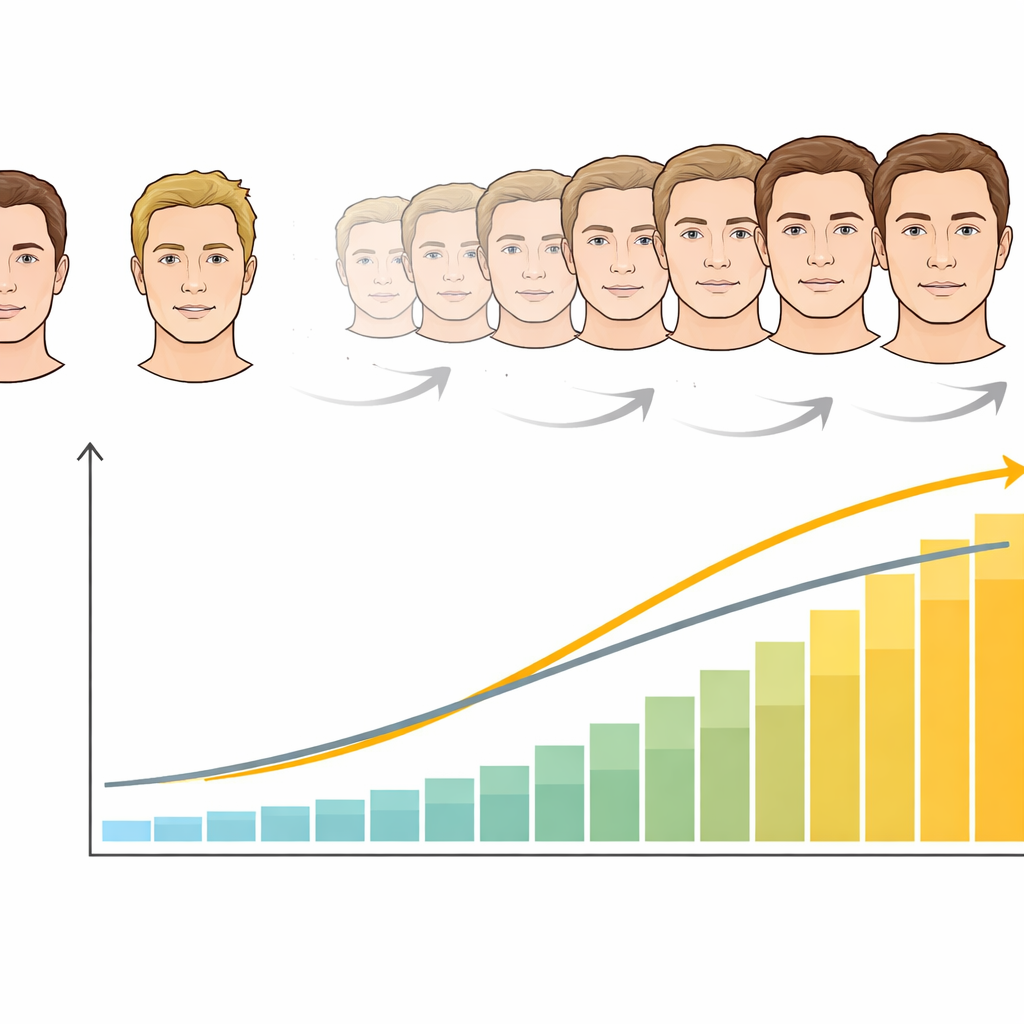
The second experiment pushed this idea further by gradually morphing between the two shapes. Instead of only pure self or pure friend faces, the researchers created eleven intermediate levels, from 100% friend-shape to 100% self-shape, while keeping the motion signal fixed as either self or friend. Participants again judged whose motion they saw, now on these ambiguous blended faces. For friend motion, good performance emerged even when only about one third of the visible shape matched the friend, showing that motion cues alone were powerful. For self motion, participants needed faces that were at least about 60% self-like before they could confidently say the movement was their own. The curve linking recognition to shape was steeper for self than for friend, revealing a stronger reliance on shape for recognizing self motion.
What this means for our sense of self
Taken together, the findings suggest that our own moving face is, in an important sense, less familiar than a close friend’s. We seem to store rich information about how friends move, and can use that motion even when facial shape is altered. In contrast, our internal record of self-face motion appears sparser, so we lean heavily on static shape to anchor the feeling of “that is me.” The authors propose that self-faces may form a special category in perception: familiar in terms of shape, but closer to unfamiliar faces when it comes to dynamic information. This distinction helps explain why manipulated self images can feel strangely off, and shows how modern deepfake tools can be repurposed to probe the delicate balance between appearance, movement, and identity.
Citation: Yumura, S., Lander, K. & Kamachi, M.G. Exploring the importance of shape on dynamic recognition of self-face or friend-face. Sci Rep 16, 10802 (2026). https://doi.org/10.1038/s41598-026-45374-8
Keywords: self face recognition, facial motion, deepfake experiments, face perception, friend vs self identity