Clear Sky Science · en
Legendre neural network-based computational study through hybrid particle swarm optimization for fractional unsteady flow of Sutterby fluid
Fluids That Behave in Surprising Ways
Many everyday substances, from ketchup and yogurt to blood and polymer melts, do not flow like ordinary water. They can thicken when stirred or thin out when squeezed, making them tricky to control in technologies such as food processing, plastic manufacturing, and biomedical devices. This study focuses on one such complex material, called a Sutterby fluid, and shows how modern artificial intelligence tools can predict its motion more accurately under realistic industrial conditions.
Why This Strange Fluid Matters
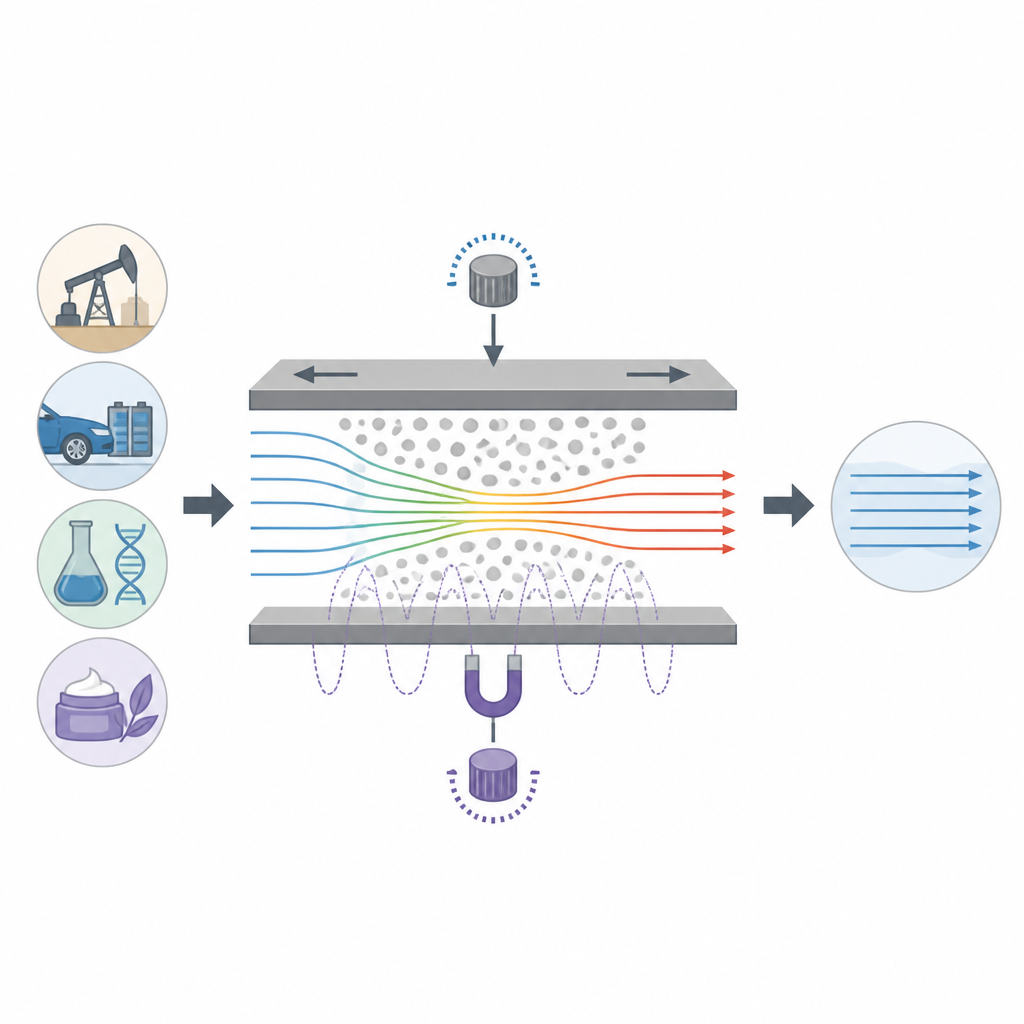
A Sutterby fluid is a model for liquids that can both thin and thicken depending on how strongly they are stirred or stretched. These materials appear in polymer manufacturing, coatings, lubricants, and some biological flows. In many applications the fluid moves over a surface that stretches, is squeezed between plates, or seeps through a porous material such as a filter, all while being affected by magnetic fields. Capturing this behavior with standard equations is difficult because the fluid seems to "remember" how it was moved earlier, so its present motion depends on its history as well as current forces.
Adding Memory to the Fluid Model
The authors describe the unsteady motion of a Sutterby fluid flowing between plates, where the gap can widen or narrow and the lower surface is porous. They represent memory effects with a mathematical tool called a fractional order time derivative, which allows the model to account for past motion in a gradual way instead of using a single sharp timescale. They also include the influence of a magnetic field, the resistance of the porous medium, and squeezing of the plates. This produces a compact equation for how the fluid velocity changes across the gap, together with boundary conditions that describe how the fluid sticks to and moves with the walls.
Teaching a Neural Network to Solve the Flow
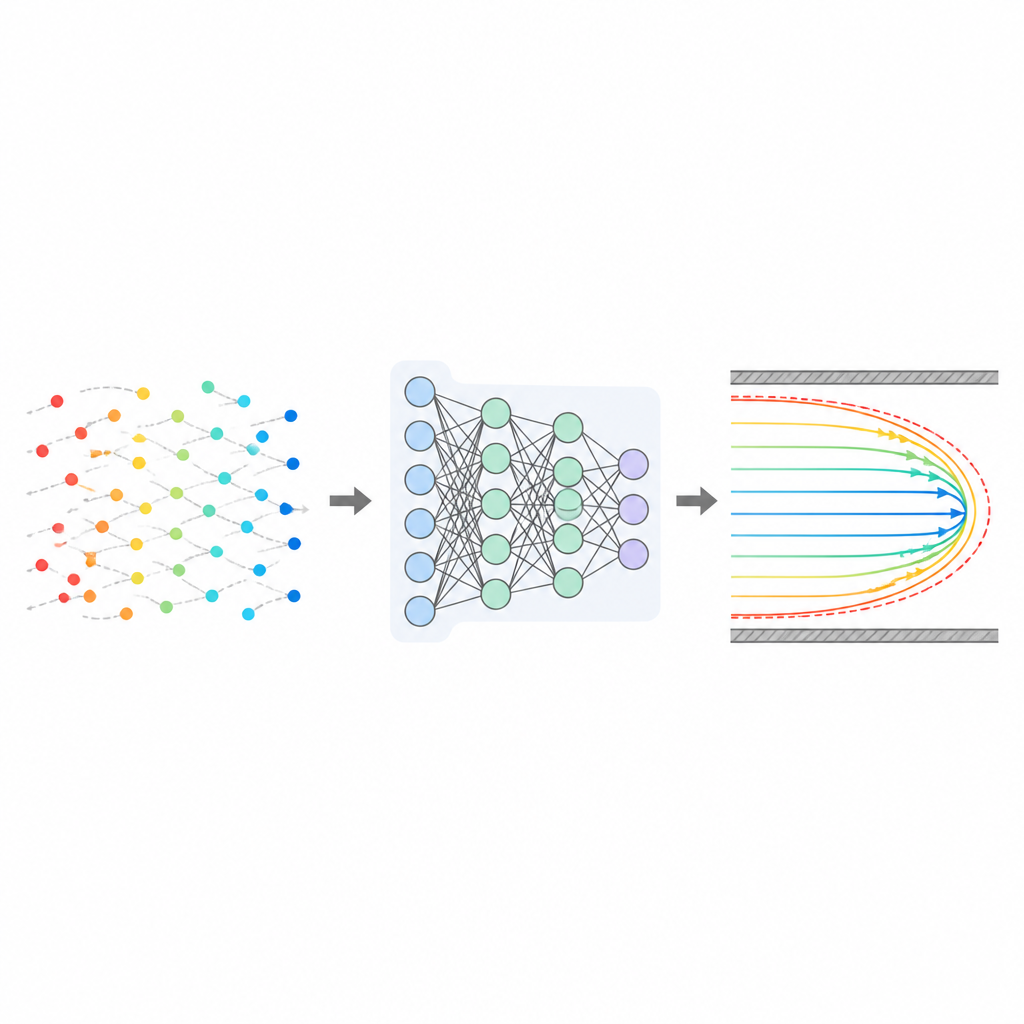
Rather than relying on traditional numerical solvers, the team uses a Legendre artificial neural network, a special type of network that builds its response from smooth, mathematically well behaved wave shapes. The unknown velocity profile is written as a sum of these shapes, and a training process adjusts the network parameters until the governing equation and boundary conditions are satisfied as closely as possible. To find the best parameters efficiently, the authors use a family of search methods inspired by flocking birds, known as particle swarm optimization, including a version that also carries its own memory of past steps and a hybrid that combines the two.
How Flow Controls Change the Motion
With this setup the researchers explore how different knobs in the system alter the flow. Increasing the fractional order, which strengthens the memory effect, makes the fluid accelerate more across the channel. In contrast, greater permeability resistance from the porous surface slows the fluid, as does positive squeezing when the plates move together. Negative squeezing, where the plates move apart, enhances the motion. A stronger magnetic influence tends to lift the velocity profile upward, signifying faster flow. Across these tests the neural network solutions remain stable and closely match reference data, and the hybrid optimization method consistently finds accurate answers with smaller errors than either standard or fractional swarm methods alone.
What This Means for Real World Uses
The study shows that blending memory based fluid models with carefully designed neural networks can capture subtle flow features of complex liquids in realistic settings. The hybrid swarm optimized Legendre network converges quickly, maintains small prediction errors, and handles the strong nonlinearities introduced by porous resistance, squeezing plates, and magnetic forces. Although the work focuses only on momentum and not yet on heat or chemical effects, the approach offers a flexible tool for engineers who design processes involving thick or thin polymer solutions, advanced lubricants, and biofluids that defy simple descriptions.
Citation: Fatima, A., Asjad, M.I., Aslam, M.N. et al. Legendre neural network-based computational study through hybrid particle swarm optimization for fractional unsteady flow of Sutterby fluid. Sci Rep 16, 15285 (2026). https://doi.org/10.1038/s41598-026-45305-7
Keywords: Sutterby fluid, non Newtonian flow, fractional model, neural network, particle swarm optimization