Clear Sky Science · en
ZIF-8 functionalized PCL/BG composite scaffolds with improved bioactivity and osteogenic differentiation
Helping Broken Bones Heal Themselves
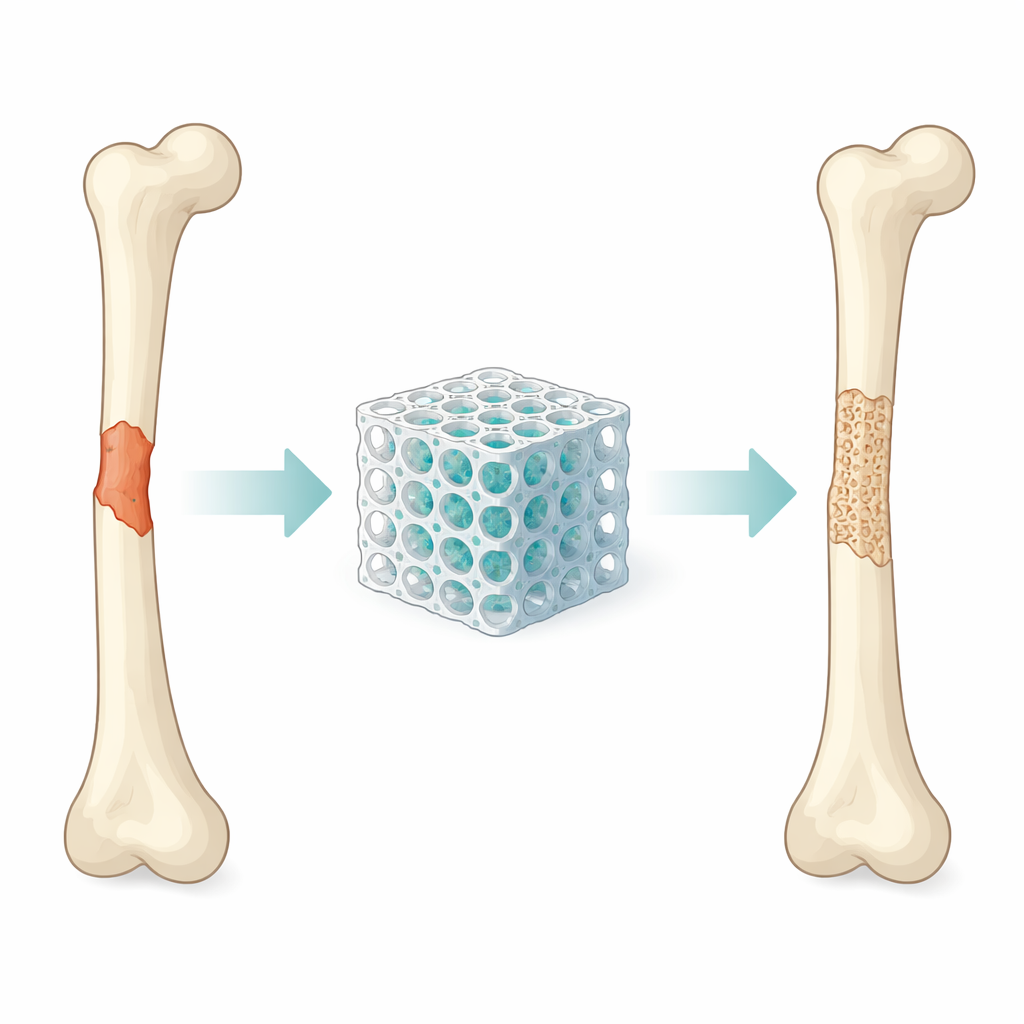
When a bone is badly damaged by an accident, tumor, or disease, the body cannot always repair the gap on its own. Surgeons often rely on bone grafts, but these can be scarce and carry risks. This study explores a new type of 3D‑printed "bone patch" designed to be strong enough for everyday use inside the body while also actively encouraging bone cells to grow, attach, and mature into healthy new tissue.
Why We Need Smarter Bone Patches
Doctors have long searched for materials that can stand in for missing bone. Traditional metal implants are strong but do not bond naturally with living tissue. Donor bone from a patient or another person can integrate well but is limited in supply and may cause pain or complications. Tissue engineers instead build porous structures called scaffolds that act like temporary frameworks: they support the damaged area, let blood vessels and cells move in, and slowly disappear as new bone forms. For this to work, a scaffold must balance three things at once: it has to be mechanically sturdy, friendly to cells, and chemically active enough to spark bone growth.
Building a Better 3D-Printed Framework
The researchers started with a commonly used medical plastic called polycaprolactone, which is easy to 3D print but naturally too soft and too inert for demanding bone repairs. They mixed this plastic with large amounts of ultra-fine particles of a special bioactive glass known as 58S. This glass is famous for forming a bone-like mineral layer when it touches body fluids and for releasing helpful ions such as calcium and silicon. The team printed porous, cube-shaped scaffolds containing 40, 45, or 50 percent glass by weight and tested how much compression each design could withstand. The version with 45 percent glass turned out to be the best compromise, reaching about 35 megapascals in strength—similar to the spongy (cancellous) bone found inside our larger bones—while still staying porous enough for tissue to grow through.
Turning a Passive Frame into an Active Partner
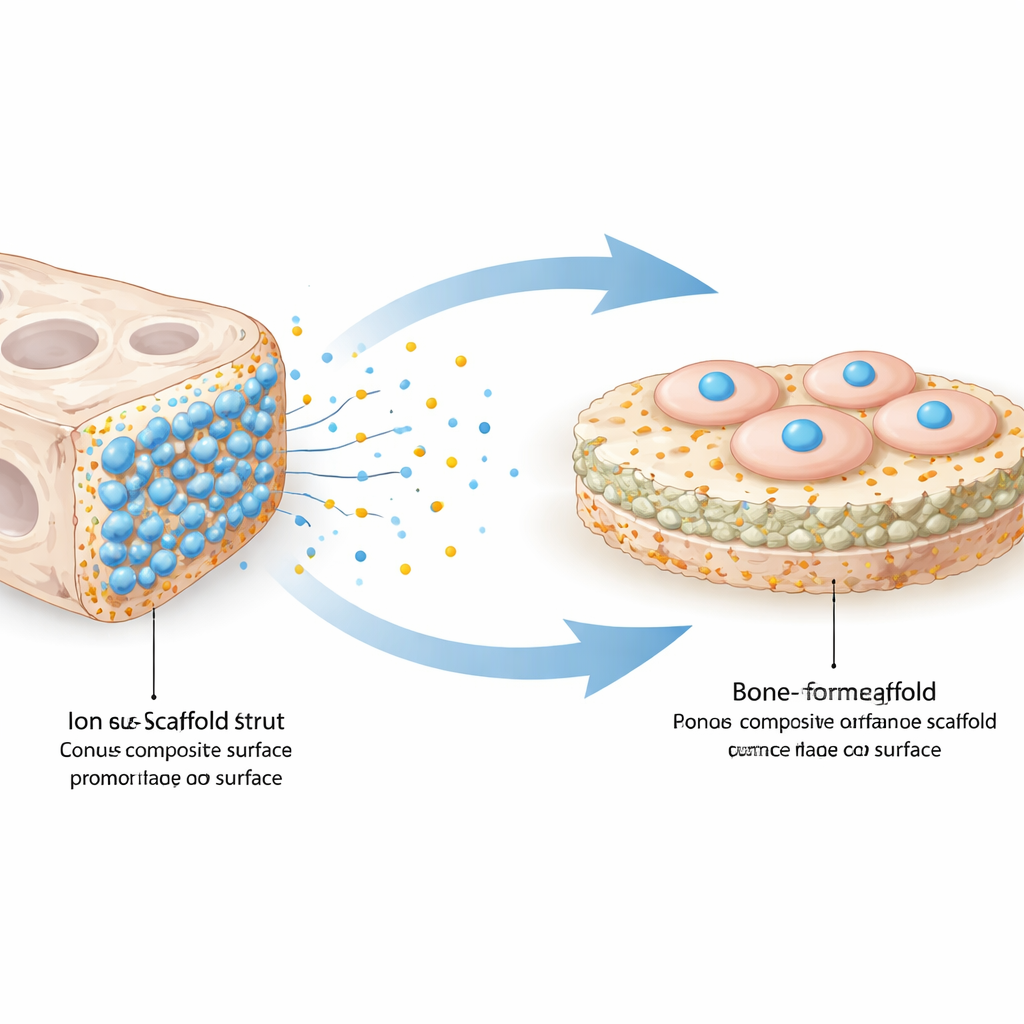
To further upgrade the surface where cells first land, the team coated the chosen 45 percent glass scaffold with a thin layer of a porous material called ZIF‑8, which contains zinc. Using a gentle, water-based process inspired by mussel adhesive chemistry, they first deposited a sticky underlayer and then grew tiny ZIF‑8 crystals directly on the scaffold’s outer surfaces. In fluid that mimics blood plasma, the scaffolds steadily released zinc ions over four weeks without an initial spike, staying in a concentration range considered safe for cells. At the same time, the glass inside the scaffold released calcium, phosphorus, and silicon, which helped drive the formation of a bone-like mineral coating on the surface.
How Bone Cells Respond to the New Scaffold
The team then tested how bone-like cells behaved on the uncoated and ZIF‑8‑coated scaffolds. Under the microscope, both types allowed cells to attach and spread, but the zinc-coated version showed noticeably denser and more uniform cell coverage after only a few days. A standard viability test revealed that cells on the modified scaffold not only survived but multiplied faster than on the plain scaffold and on a flat control surface. When the researchers measured the activity of several genes tied to bone formation, including early "switch" genes and late markers of mature bone cells, they found that all were significantly higher on the zinc-coated scaffold—especially at later time points, when mineralized bone matrix is normally laid down.
What This Could Mean for Future Bone Repair
Taken together, the results suggest that combining a high dose of bioactive glass inside the 3D‑printed plastic with a zinc‑rich outer coating creates a multifunctional scaffold that is strong, slowly degradable, and highly welcoming to bone cells. The material is tailored for filling defects in spongy bone, where it can support load while encouraging the body to rebuild itself. Although further animal studies are needed to confirm long‑term safety and performance, this dual‑action design points toward next‑generation bone patches that do far more than simply occupy space—they actively guide and accelerate the healing process from the inside out.
Citation: Soleymani, M., Moslemi, S., Dini, G. et al. ZIF-8 functionalized PCL/BG composite scaffolds with improved bioactivity and osteogenic differentiation. Sci Rep 16, 14335 (2026). https://doi.org/10.1038/s41598-026-44943-1
Keywords: bone tissue engineering, 3D printed scaffolds, bioactive glass, polycaprolactone, ZIF-8 coating