Clear Sky Science · en
Unraveling genetic diversity in ‘Foşa’ and ‘Yomra’ hazelnut accessions (Corylus avellana L.) using SSR markers and phenotypic analysis
Why these hazelnuts matter to your snack bowl
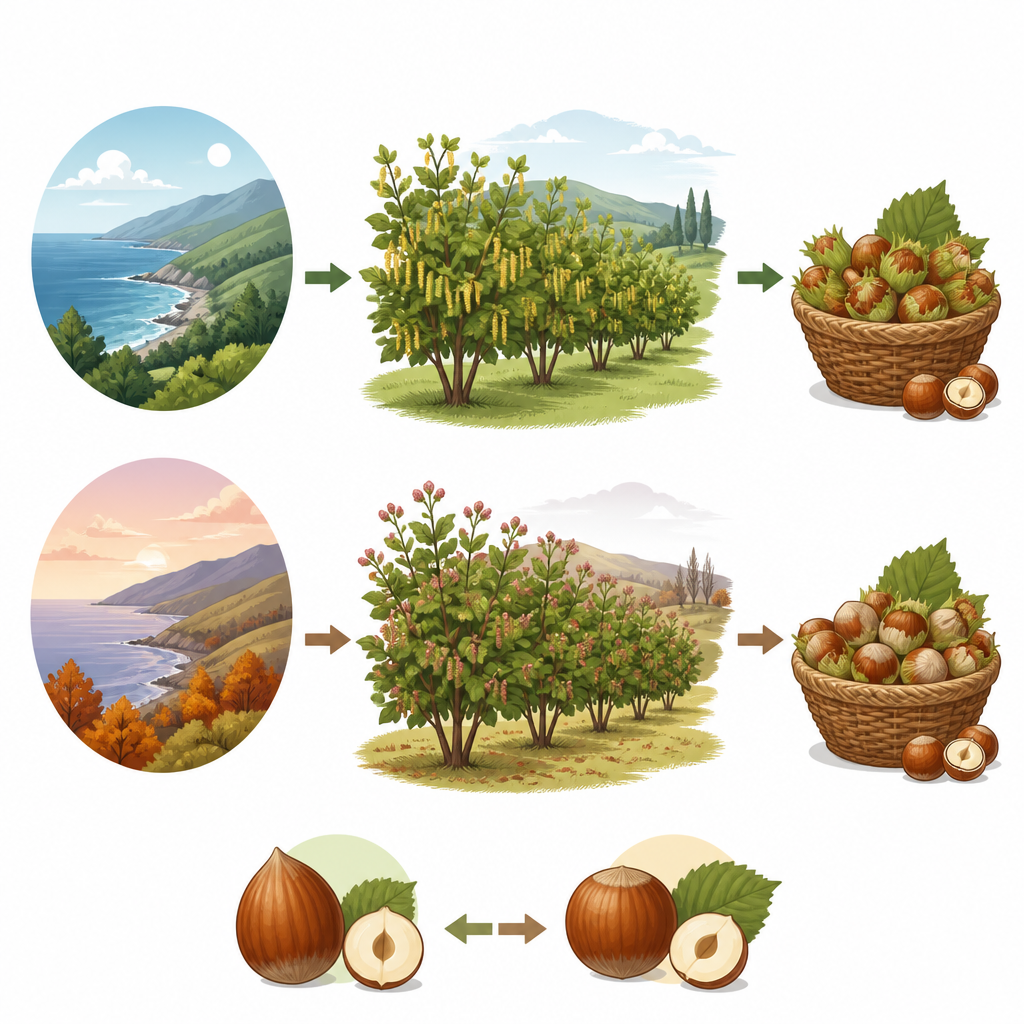
Hazelnuts are a staple of chocolate spreads, desserts, and healthy snacks, and Türkiye supplies most of the world’s crop. In one key growing region along the Black Sea coast, farmers rely heavily on two local hazelnut types, known as Foşa and Yomra. Because these nuts look and grow so much alike, growers, breeders, and traders have long puzzled over whether they are truly different or just local names for the same thing. This study set out to settle that question by combining careful field observations with modern DNA tools.
Two look alike nuts in a vital growing region
The research focused on orchards in Trabzon province, where Foşa and Yomra together cover more than 40 percent of the hazelnut area. Foşa is prized by the food industry for its round nuts, reliable yields, and kernels that peel cleanly when roasted, traits that helped it earn protected status in Türkiye. Yomra, locally called Giresun Yabanisi, is known for pointed nuts and strong adaptation to local soils and weather. Despite these reputations, their similar appearance and overlapping names have created confusion in farms and official records, raising doubts about how best to manage and improve these crops.
Watching trees through the seasons
To understand how the two types behave in the field, the team tracked hundreds of trees across different altitudes and narrowed their detailed work to 80 chosen accessions, or individual tree lines. They recorded when leaves and flowers appeared each year, along with yield and 19 nut and kernel traits such as nut size, shell thickness, kernel weight, shape, and how easily skins were removed. Foşa trees consistently leafed out and flowered earlier than Yomra, with leaf buds opening roughly a month sooner. Both showed a flowering style where male flowers release pollen before or overlap with female flower readiness, but the timing differed between the two groups. Nut measurements revealed wide variation within each type, especially in yield, number of nuts per cluster, kernel weight, blanching ability, and fibrousness, pointing to rich raw material for breeding better varieties.
Reading genetic barcodes inside the nuts
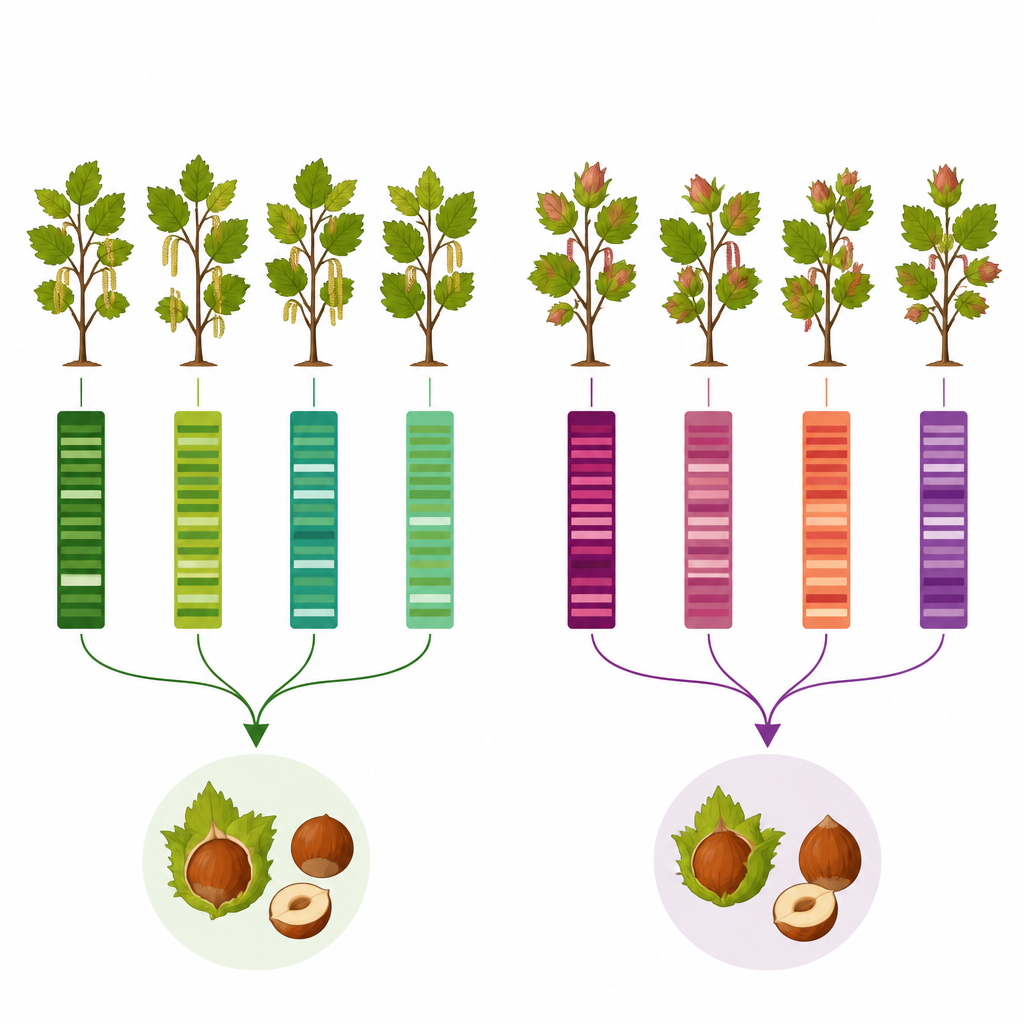
Field traits alone can be shaped by weather and orchard care, so the researchers also examined the trees’ DNA using short repeating sequences that act like genetic barcodes. Ten of these markers were used to scan 43 Foşa and 37 Yomra accessions. The resulting band patterns were compared with computer tools that group similar individuals together. The analysis showed a moderate level of genetic diversity overall and revealed many distinct DNA profiles, even among trees that looked alike. When the team drew family trees and maps of genetic similarity, the accessions fell neatly into two main clusters that matched Foşa and Yomra, confirming that they form two separate genetic groups rather than a single mixed population.
Sorting out hidden relationships
Within each group, some trees turned out to be genetic clones, sharing identical DNA patterns across all markers. Others were clearly distant relatives. Yomra accessions showed slightly more internal genetic variation than Foşa, suggesting that Yomra may include a broader mix of lineages. A few trees showed mixed genetic signatures, bridging the two main clusters. These rare individuals could reflect past crossing between varieties or complex origins, and they are especially valuable for preserving diversity. Statistical methods that combined nut traits, flowering data, and DNA confirmed that the same Foşa and Yomra groupings reappeared no matter which dataset the scientists used.
What this means for farmers and future hazelnuts
For growers, breeders, and the food industry, the take home message is that Foşa and Yomra are not just different names for the same hazelnut. They are genuinely distinct groups with their own flowering schedules, nut qualities, and genetic identities. The study pinpoints particular trees that are both unique and productive, recommending that they be preserved in genetic collections and used as parents in future breeding programs. By clarifying which trees belong to which group and where the most diversity lies, this work provides a roadmap for developing improved hazelnut varieties while protecting the local heritage that underpins much of the world’s hazelnut supply.
Citation: Bilgen, Y., Akça, Y., Yıldız, K. et al. Unraveling genetic diversity in ‘Foşa’ and ‘Yomra’ hazelnut accessions (Corylus avellana L.) using SSR markers and phenotypic analysis. Sci Rep 16, 14940 (2026). https://doi.org/10.1038/s41598-026-44863-0
Keywords: hazelnut diversity, Foşa variety, Yomra variety, SSR markers, plant breeding