Clear Sky Science · en
Human recognition of feline stress-related behavioral states from visual cues depends on observer characteristics
Why reading your cat’s mood is not so simple
Many cat owners feel they can tell when their pet is relaxed or upset just by looking. This study puts that belief to the test by asking nearly two thousand people to judge cats’ stress levels from short, soundless videos. The results show that while people do a bit better than guessing, our eyes alone are not very good at spotting feline stress, and some types of observers are better at it than others.
What the researchers wanted to know
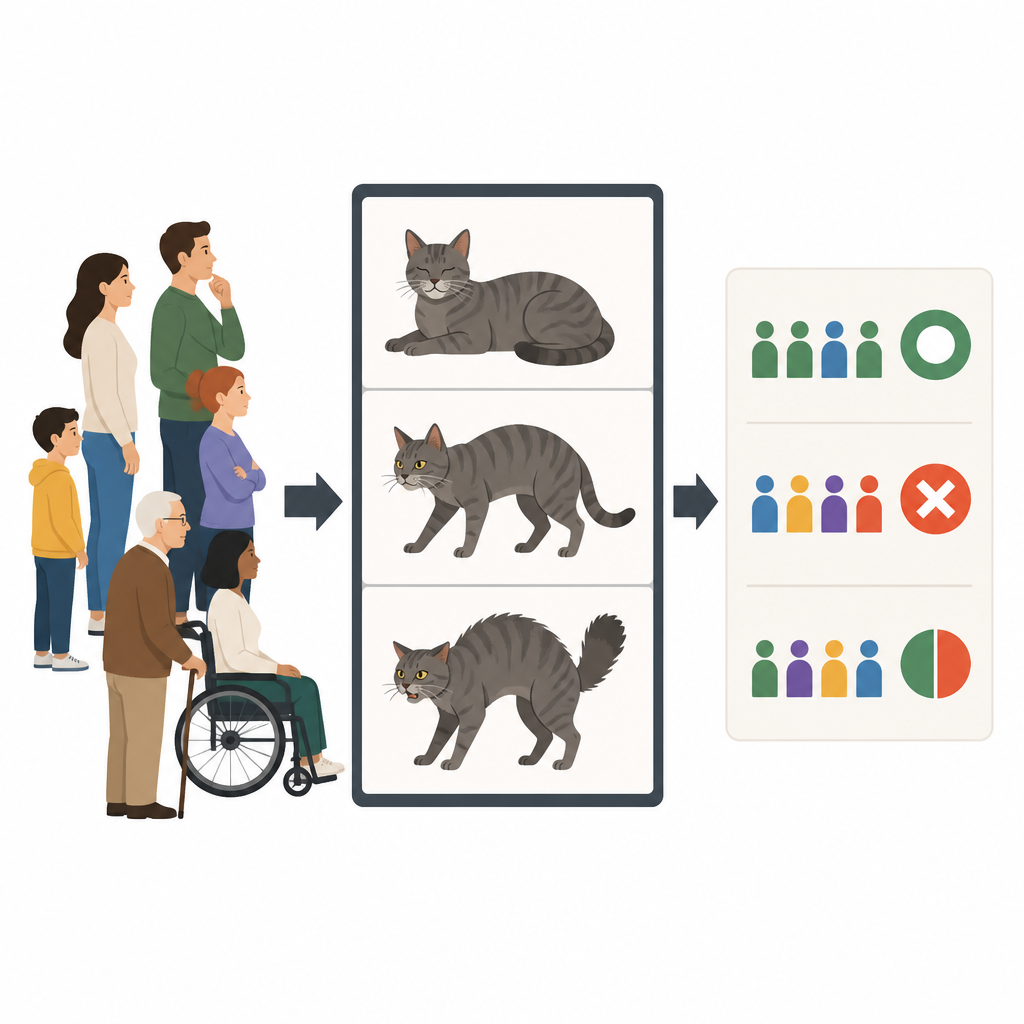
The team set out to explore how accurately people can read cats’ stress-related body language, and which human traits help or hinder that skill. Cats use their whole body to signal how they feel, from ear angle and eye shape to posture and tail position. The researchers focused on three everyday states that matter for welfare and for home life: relaxed, tense, and fearful. They also examined whether age, gender, and having owned a cat shaped how well people could tell these states apart.
How the study was done
Almost 2,000 volunteers aged 6 to 83 took part, recruited at a public science event and via social media. Each person watched 12 three-second video clips showing different cats in one of the three behavioral states. The videos had no sound so that only visual cues were available. After each clip, viewers chose whether the cat seemed relaxed, tense, or fearful. The clips had been carefully selected and labeled in advance by veterinary behavior experts, using clear indicators such as muscle tension, eye openness, ear position, and tail movement.
What people got right and wrong
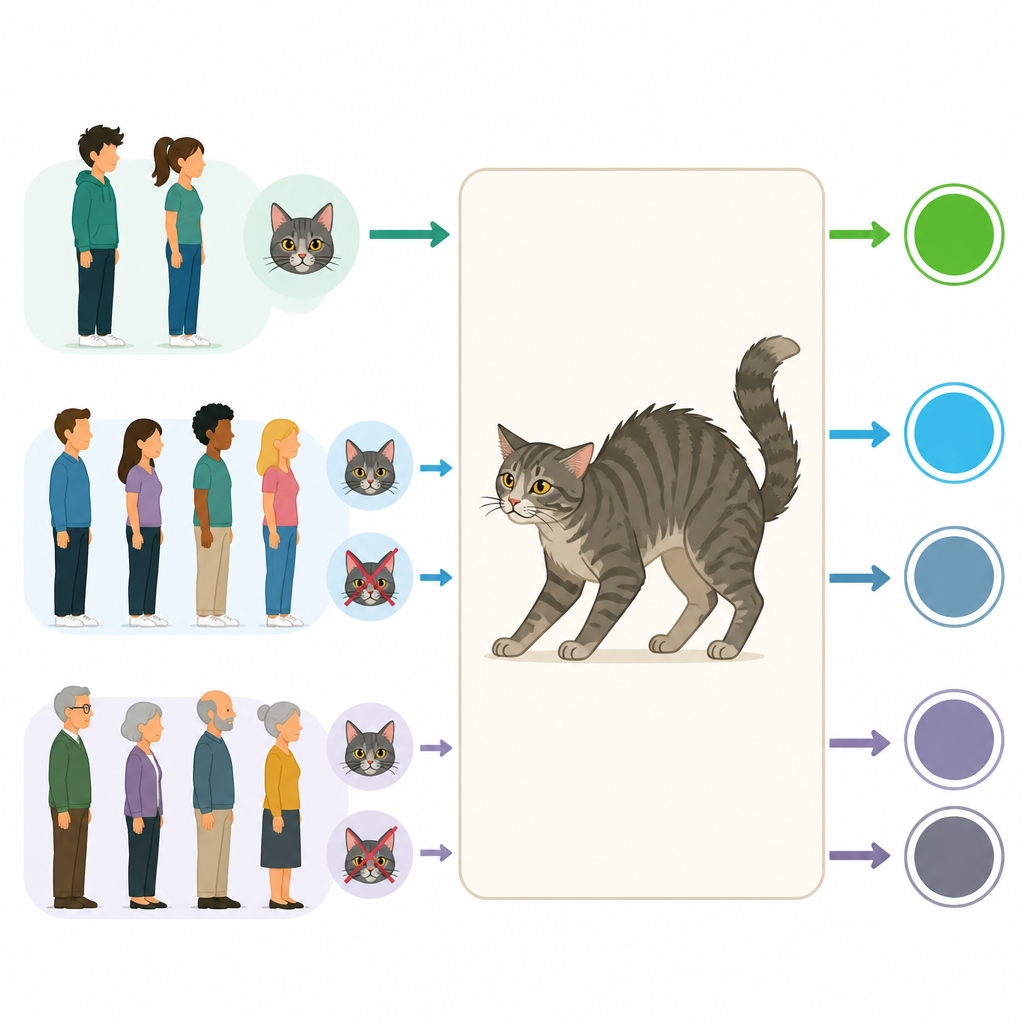
On average, participants answered correctly about 54 percent of the time, better than random choice but still leaving much room for error. Even relaxed cats, the easiest category, were misread in a sizeable number of cases, and tense and fearful cats were often confused with each other or with relaxed ones. When the researchers used statistical models that took into account differences between individual people and between videos, they found no strong effect of the cat’s specific behavioral state on accuracy. In other words, people did not reliably tell relaxed, tense, and fearful states apart just from what they saw on screen.
Who was better at reading cats
Performance depended more on who was watching than on what the cat was doing. Participants who identified as female were more accurate than males, echoing broader research that finds women often score higher on tasks involving reading emotions. People who had at some point owned a cat also performed better than those who had never lived with one, suggesting that everyday exposure sharpens sensitivity to subtle signals. Age played a smaller but consistent role: accuracy tended to decline gradually as adults got older, in line with known age-related changes in emotion recognition.
Why this matters for cats and people
These findings suggest that many of us struggle to notice early or moderate signs of stress in cats when relying on sight alone. Because cats often do not vocalize in such situations, missing these cues could lead to ongoing discomfort or conflict at home. The study highlights that understanding feline body language is a learned and uneven skill, shaped by experience and personal characteristics. Raising awareness and offering simple, visual guidance on cat signals could help more people recognize when their pets are uneasy, leading to kinder handling, better human–cat relationships, and improved animal welfare.
Citation: d’Ingeo, S., Nolè, M., Straziota, V. et al. Human recognition of feline stress-related behavioral states from visual cues depends on observer characteristics. Sci Rep 16, 14891 (2026). https://doi.org/10.1038/s41598-026-44812-x
Keywords: cat body language, feline stress, human animal interaction, emotion recognition, animal welfare