Clear Sky Science · en
Cyberchondria among college students and associated factors: a latent profile analysis
Why worry about online health searching
Most college students turn to the internet when they feel unwell or curious about symptoms. What begins as a quick search can sometimes spiral into hours of scrolling through worst‑case scenarios, leaving people more anxious than before. This study looks closely at that pattern, often called cyberchondria, in a large group of Chinese college students to understand how common it is, what forms it takes, and which students are most at risk.

Different ways online checking can play out
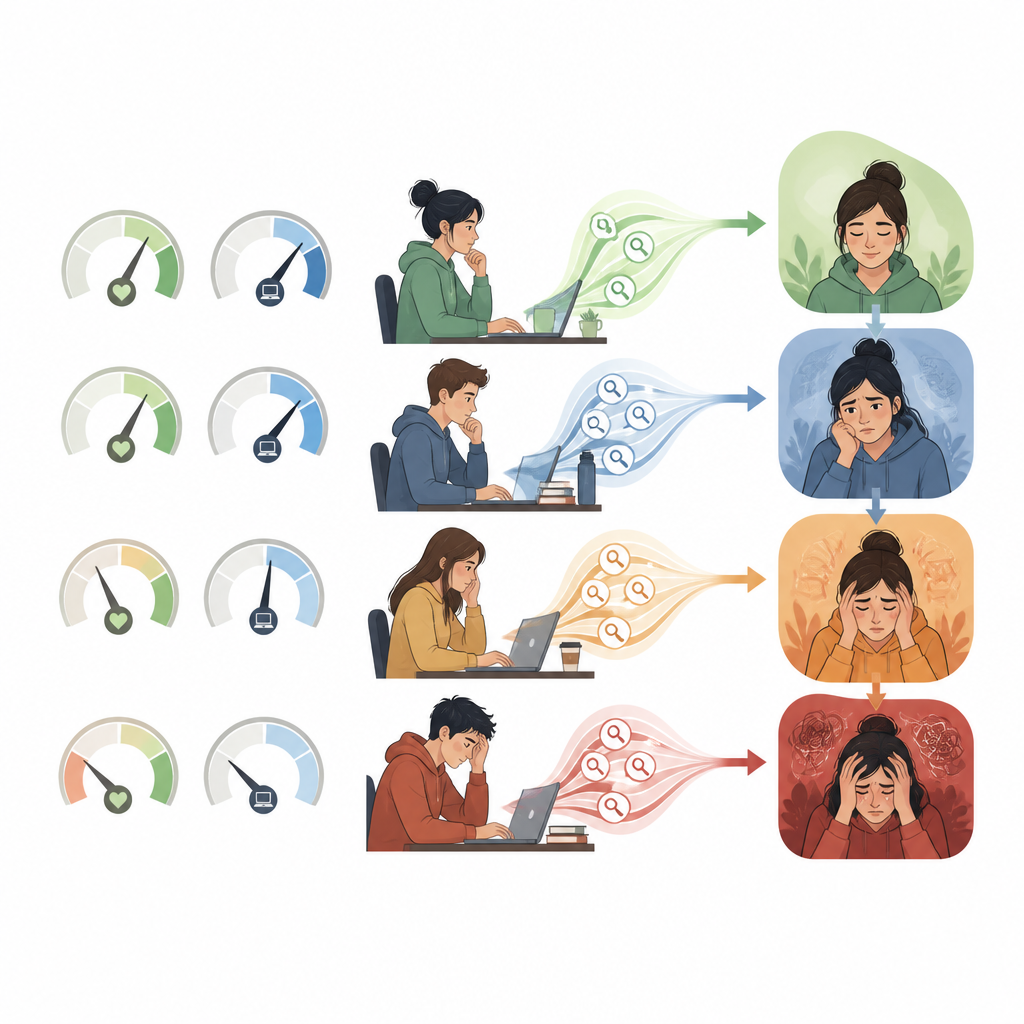
The researchers surveyed more than 5600 students at a major university about how often they search for health information online, how upset it makes them feel, whether it interferes with daily life, and how often it drives them to seek extra reassurance from doctors. Instead of treating cyberchondria as one single score, they used a statistical method to see whether students naturally fell into distinct groups based on their answers. Four clear patterns emerged, showing that not all heavy online health searchers are the same.
The four groups of student searchers
One small group, about one in ten students, had generally low levels of cyberchondria. They did repeat searches and sometimes asked doctors for reassurance, but these habits did not cause much upset or disruption; this was called the Low‑Variable group. At the other extreme, another one in ten students scored high on every aspect: they searched a lot, felt strong negative emotions, found that searching interfered with daily life, and often sought reassurance. This High‑Severe group showed the most troubling pattern of online health use.
Two middle paths between calm and distress
The remaining students fell into two middle groups. In the Moderate Seeking group, which included about 40 percent of the sample, students searched for health information frequently and looked for reassurance, yet the behavior did not strongly disrupt daily routines. In the Moderate Affective group, another 38 percent, students also searched often but mainly stood out for how distressed and worried they felt while doing so. These two groups suggest that for many young people, the main problem is either emotional strain or the pull of repeated checking, rather than both at once.
Who is more likely to struggle
To see what might push students into the more troubled groups, the team examined factors such as gender, self‑rated health, and skill at using online health information, known as eHealth literacy. Students who felt their health was poorer were more likely to belong to any of the three higher‑concern groups. Female students were more likely than males to fall into the two moderate groups, especially the one marked by strong emotional reactions. Surprisingly, students who rated themselves as more skilled at finding and using online health information were more likely to be in the High‑Severe group, perhaps because they search more often and encounter more worrying content.
What this means for students and campuses
This study shows that cyberchondria among college students is not a single problem but a set of patterns that range from mild worry to severe, life‑disrupting anxiety. Students who feel less healthy and those who see themselves as highly capable online appear especially vulnerable to getting caught in a loop of searching and worry. The authors suggest that campus health and counseling services should offer tailored support that helps students judge online health information more critically, keep their searching in balance, and manage anxiety before it overwhelms study and daily life.
Citation: Yao, Z., Qin, N., Shi, S. et al. Cyberchondria among college students and associated factors: a latent profile analysis. Sci Rep 16, 14767 (2026). https://doi.org/10.1038/s41598-026-44658-3
Keywords: cyberchondria, online health search, college students, health anxiety, eHealth literacy