Clear Sky Science · en
First Isolation of Fusarium foetens from coriander in Palestine and preliminary evaluation of essential oils for its control
Why sick coriander plants matter
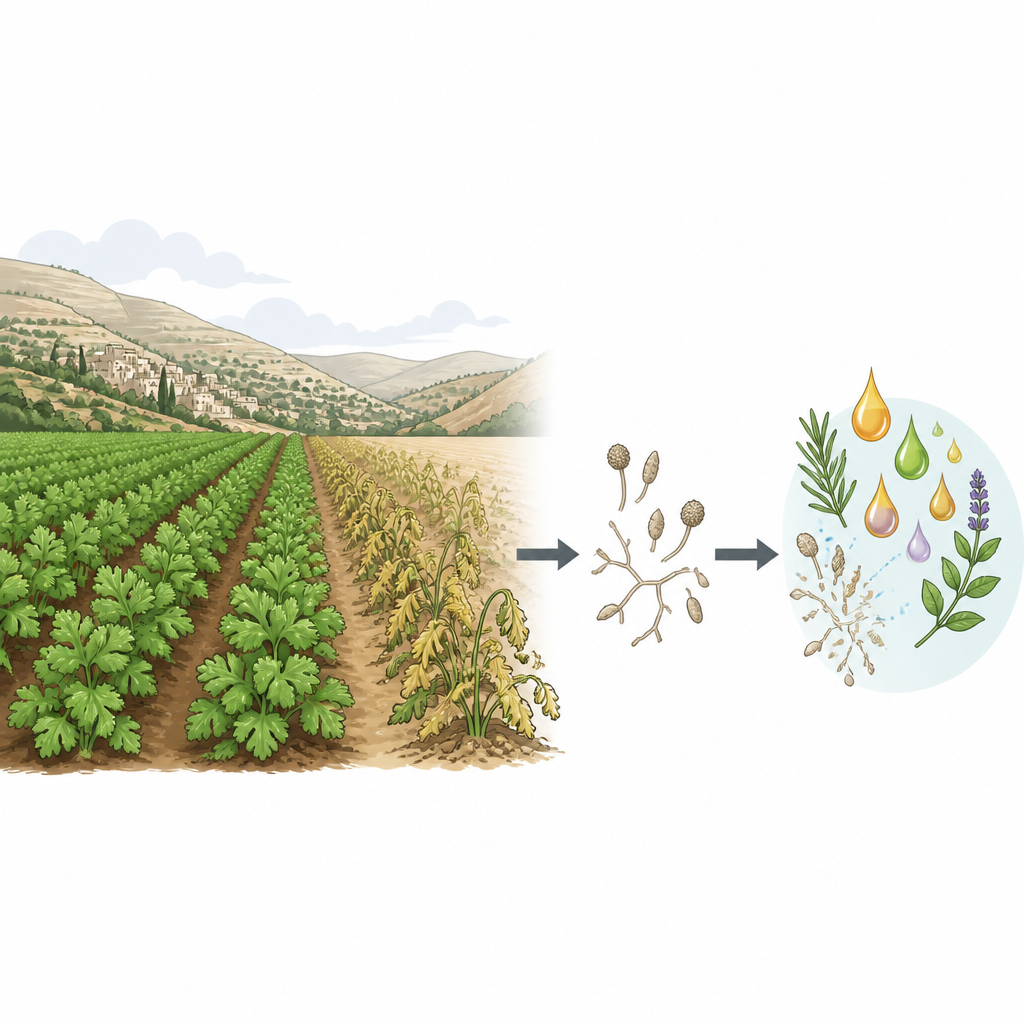
Coriander, also known as cilantro, flavors many dishes and is cherished in kitchens and traditional medicine across the Mediterranean and Middle East. Farmers in Palestine recently faced a worrying problem: young coriander plants in some fields were turning yellow, collapsing, and dying in large numbers. This study explains what was killing the plants and tests whether natural plant oils could help protect this important herb in a safer and more sustainable way than standard chemical sprays.
A new culprit in the coriander field
During the spring of 2024, researchers visited coriander fields in the Al-Beqai’a area of the Tubas district in Palestine after farmers reported severe losses. They found seedlings with yellowing leaves, wilted stems, and classic “damping-off,” where young plants rot at the base and topple over. In the lab, they carefully cleaned pieces of the diseased tissue and grew any hidden microbes on nutrient plates. The fungus that emerged formed dense white to pinkish colonies and distinctive banana-shaped spores, matching the general appearance of a well-known group of plant-damaging fungi called Fusarium.
Pinpointing the fungus behind the disease
To be sure that this fungus was really the cause of the disease, the team carried out a standard test in plant pathology. They prepared a suspension of the fungal spores and used it to infect healthy coriander seedlings. Within about two weeks, the treated plants developed the same wilt and stem rot seen in the farmers’ fields, while untreated plants stayed healthy. This satisfied Koch’s postulates, the basic checklist used to prove that a particular microbe causes a particular disease. The scientists then extracted DNA from the fungus and amplified a genetic region that is widely used as a barcode for fungi. By comparing the DNA sequence to entries in an online database and building a family tree of related fungi, they identified the culprit as Fusarium foetens. This is the first time F. foetens has been confirmed on coriander in Palestine.
Testing natural plant oils as helpers
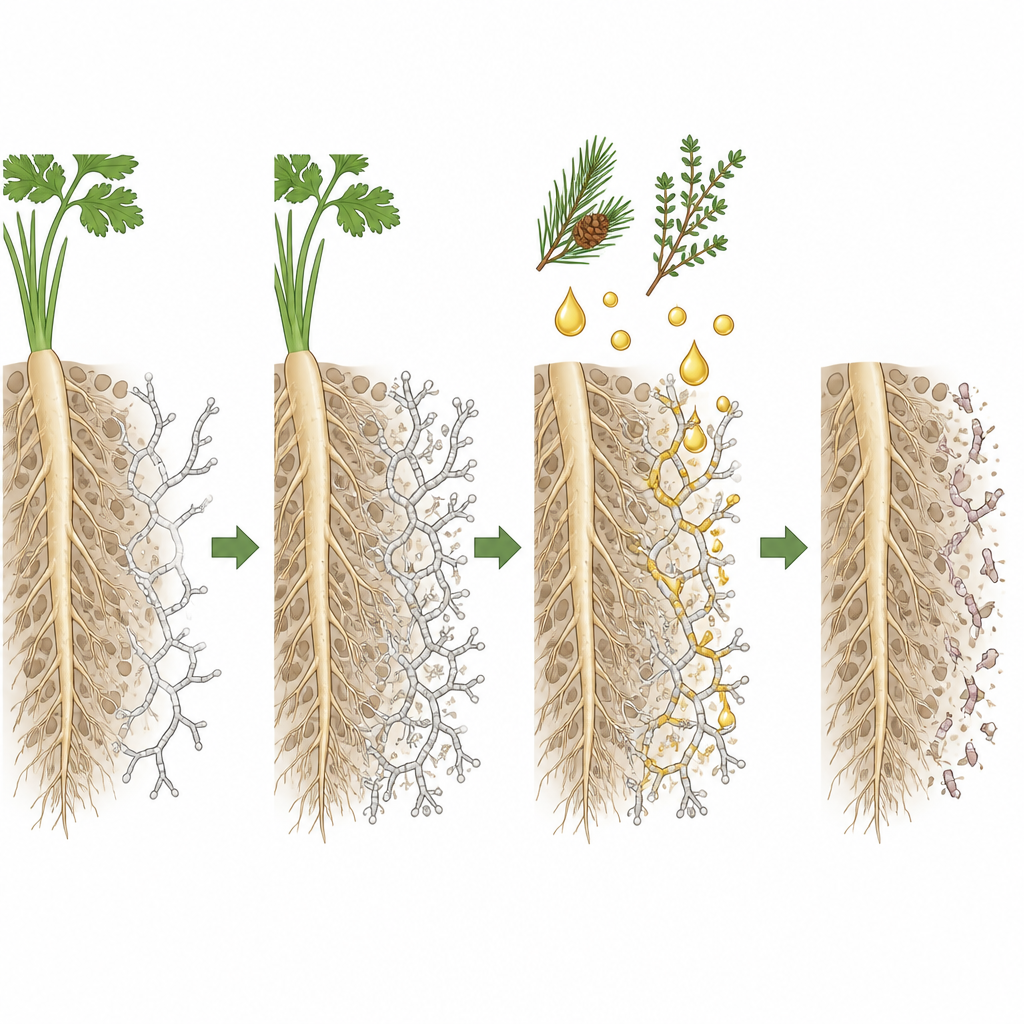
Because long-lasting chemical fungicides can harm the environment and drive resistance in pests, the researchers turned to a more natural toolkit: essential oils. These are concentrated, fragrant mixtures distilled from leaves, flowers, and peels of various plants. The team tested twelve oils traditionally used in Palestinian folk medicine, including oils from pine needles, wild thyme, regular thyme, lemon peels, lavender, sage, basil, and others. In one test, they placed tiny discs soaked with each oil on plates where the fungus was growing and measured the clear zone where growth was stopped. In another, they diluted the oils in liquid culture to find the lowest amount that prevented visible growth.
Which oils showed the strongest protection
The results were striking. Oils from wild thyme and pine completely halted fungal growth on the test plates, producing the largest possible clear zones. Both of these oils also worked at the lowest tested concentration in liquid culture, suggesting strong antifungal power. Regular thyme oil was nearly as effective, while oils from lemon, lavender, lily, and basil had only moderate or weak effects. Several other oils, such as eucalyptus, rosemary, orange peel, sage, and fringed rue, showed no measurable protection in these laboratory tests. The team links the success of wild thyme and pine oils to their rich content of active molecules like phenols and terpenes, which are known to disrupt fungal membranes and interfere with vital processes inside the cells.
What this means for farmers and food lovers
This study alerts growers and plant health officials that Fusarium foetens has become a new threat to coriander crops in Palestine. Identifying the fungus accurately is an important first step toward smarter field management, including crop rotation and careful monitoring of seed and soil health. At the same time, the promising performance of wild thyme and pine essential oils suggests that natural products could one day be part of an eco-friendly toolkit to manage this disease. While more work is needed to test these oils in real fields and to design safe, practical formulations, the findings point toward a future where the scent of herbs does more than flavor our food—it may also help keep the plants themselves healthy.
Citation: Alkowni, R., Jaradat, N., Kmail, R. et al. First Isolation of Fusarium foetens from coriander in Palestine and preliminary evaluation of essential oils for its control. Sci Rep 16, 15298 (2026). https://doi.org/10.1038/s41598-026-44502-8
Keywords: coriander disease, Fusarium foetens, essential oils, antifungal activity, plant biocontrol