Clear Sky Science · en
Effects of sensory IEQ comfort on employees’ indoor satisfaction and well-being in overall office spaces: a multi-group SEM approach
Why Office Comfort Matters for Your Life
Most of us spend the bulk of our waking hours in offices, often under bright lights and in front of glowing screens. This study asks a simple but far-reaching question: how do the sights, sounds, temperatures, and lighting in different parts of an office—both workstations and break areas—shape how satisfied people feel with their jobs and even with their lives overall? By tracing these links, the researchers show how thoughtful office design can support not only productivity, but everyday well-being.
The Many Ingredients of Feeling Comfortable Indoors
The authors focus on indoor environmental quality—things like thermal comfort, lighting, noise, and visual surroundings. These elements are experienced through our senses and can either support or strain our minds and bodies. Earlier research had already shown that good air, light, and sound conditions are tied to better health, focus, and performance. But most studies treated the office as a single, uniform space and relied on simple one-to-one correlations. This left open big questions: how exactly do moment-to-moment sensations turn into broader judgments about the work environment, job satisfaction, and life satisfaction? And do these links look different in spaces meant for focused work versus spaces intended for rest and socializing?
Comparing Desks and Break Areas
To dig into these questions, the researchers surveyed 264 employees working on nine floors in four high-rise office buildings in China. All participants had individual workstations in open-plan areas. The team distinguished between “work spaces” (rows of desks with computers) and “leisure spaces” (pantries, lounge chairs, discussion zones, and other informal areas). For each type of space, workers rated how comfortable they felt in terms of temperature, light, sound, and visuals, as well as their sense of overall environmental comfort. They also rated satisfaction with the work environment, satisfaction with their job, and satisfaction with their life, along with work stress, personal traits, and how many hours they spent on a computer each day.
From Sensations to Work and Life Satisfaction
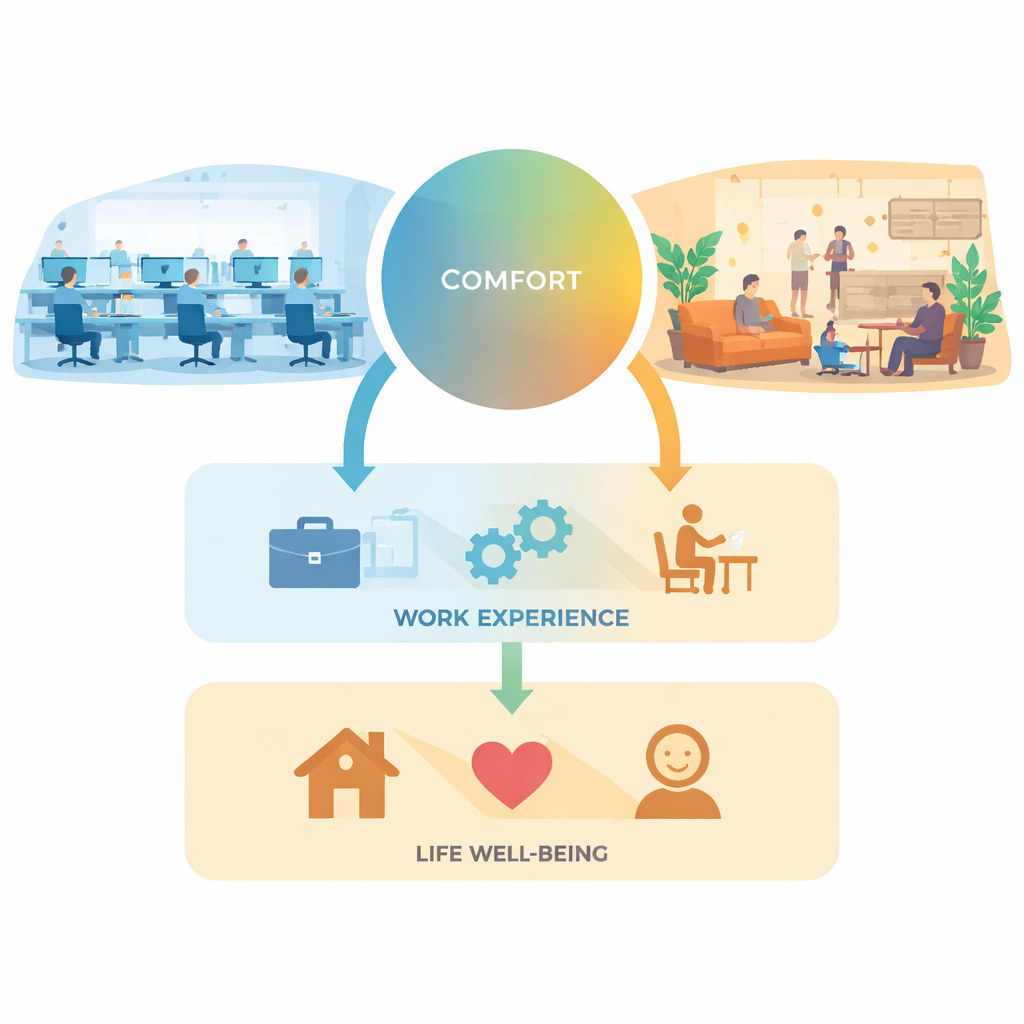
Using a statistical approach called structural equation modeling, the authors mapped how these pieces fit together. They found that sensory comfort does not leap straight into life satisfaction. Instead, it first shapes a person’s overall judgment of the environment, which then feeds into satisfaction with the work setting and the job itself, and only then spills over into life satisfaction. In both work and leisure areas, comfort strongly boosts this overall environmental rating, which in turn raises work-environment and job satisfaction. However, leisure spaces played a special role: comfort in lounges and break zones showed stronger pathways to life satisfaction than comfort at desks, and overall comfort in leisure areas enhanced both environmental and job satisfaction. In contrast, overall comfort in work areas mainly improved job satisfaction, not people’s immediate sense of how pleasant their workplace felt.

The Hidden Cost of Screen Time
The study also highlights computer usage time as a quiet but powerful influence. Employees who spent more of their workday on screens reported lower satisfaction with both their work environment and their job, and this erosion in satisfaction dragged down life satisfaction as well. Heavy screen use was linked to poorer ratings of artificial lighting in work areas, likely due to glare and visual fatigue. Interestingly, the harmful effects were especially clear in leisure spaces: long screen time was tied to worse comfort ratings there, suggesting that when work bleeds into break zones, people feel less restored by those spaces.
Designing Offices That Support Everyday Life
Overall, the study concludes that indoor comfort in offices affects more than momentary convenience; it subtly shapes how people feel about their work and their lives. Comfort in leisure spaces—where people unwind and reset—seems particularly important for life satisfaction, while comfort in work areas mainly lifts job satisfaction. The findings caution that looking at just one room type can overestimate how much any single space matters; instead, it is the combined experience of desks and break areas that counts. Finally, the strong negative role of long computer use suggests that managing screen time and designing lighting and rest spaces around it are key levers for healthier, happier workplaces.
Citation: Fang, W., Shen, S. Effects of sensory IEQ comfort on employees’ indoor satisfaction and well-being in overall office spaces: a multi-group SEM approach. Sci Rep 16, 14592 (2026). https://doi.org/10.1038/s41598-026-44300-2
Keywords: indoor environmental quality, office comfort, work satisfaction, leisure space, computer usage time