Clear Sky Science · en
Corneal allogenic intrastromal ring segments improve visual and topographic outcomes in advanced keratoconus
Why this matters for everyday sight
Keratoconus is an eye condition that tends to strike people in their teens and twenties, warping the clear front window of the eye and blurring vision just as school, work, and driving become essential. Many patients eventually struggle to see even with glasses or contact lenses and may face a full corneal transplant. This study explores a gentler surgical option that reshapes the cornea from within using tiny donor-tissue rings, aiming to restore clearer sight while avoiding or delaying transplantation.
A bulging cornea and its challenges
In keratoconus, the normally round cornea thins and bulges into a cone-like shape. This causes severe distortion of incoming light, creating double vision, streaks around lights, and a general sense that nothing ever looks quite sharp. In advanced cases, glasses cannot correct the blur, and special rigid or scleral contact lenses may be uncomfortable, hard to fit, or too costly. Until recently, people with very advanced keratoconus had few choices beyond a corneal graft, which replaces much of the front of the eye and carries long-term risks such as rejection, scarring, and the need for repeated surgery.
A new way to support and reshape the cornea
Corneal allogenic intrastromal ring segments (CAIRS) offer an in-between option. Instead of using plastic rings, surgeons implant thin curved strips made from donated human corneal tissue into a circular tunnel inside the patient’s own cornea. A femtosecond laser creates this tunnel with high precision at a set depth. The donor ring segments are then slid into place along the steepest part of the bulge, where their natural stiffness helps flatten and regularize the cornea. Because the material is real corneal tissue rather than plastic, it may integrate better with the eye and be less likely to erode or work its way out over time. 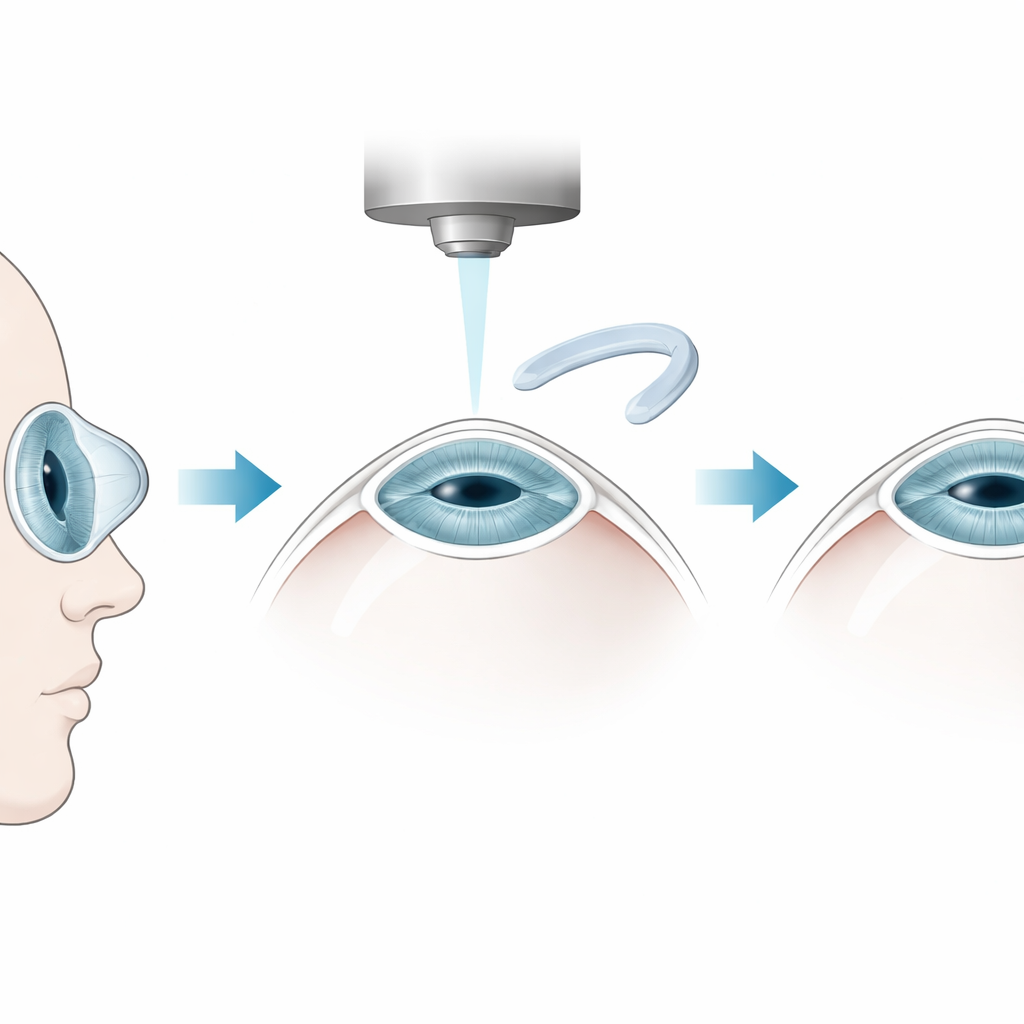
Testing the approach in the hardest cases
The authors looked back at 25 eyes from 20 people with clearly advanced keratoconus, all with very steep corneas and poor vision despite glasses, and many unable to tolerate scleral lenses. Some had previously undergone a stiffening treatment called cross-linking, while others had not. Every patient received CAIRS guided by corneal maps, and if the first result was not ideal, the surgeons were able to remove, trim, rotate, or even add a second ring segment through the same tunnel to fine-tune the shape. On average, patients were followed for about 11 months, long enough to see whether the early gains would hold.
Sharper vision and smoother corneas
Vision improved dramatically. On average, distance vision without glasses improved from the level of legal blindness to a range where many daily tasks become much easier, and best-corrected vision improved even more. Nearly half of the eyes gained 10 or more lines on the standard eye chart—a leap from seeing only large letters to reading much smaller ones. The overall focusing error dropped from about minus ten diopters (very strong nearsightedness) to around minus one, a change that makes simpler glasses or contact lenses far more effective. Detailed corneal scans showed that the front surface became flatter and more regular, while overall thickness stayed stable. A key type of visual distortion called “coma,” which causes starbursts and smearing of images, was cut to about one-third of its original level. Importantly, no serious side effects, such as infection, tissue rejection, or ring extrusion, were reported during the follow-up period. 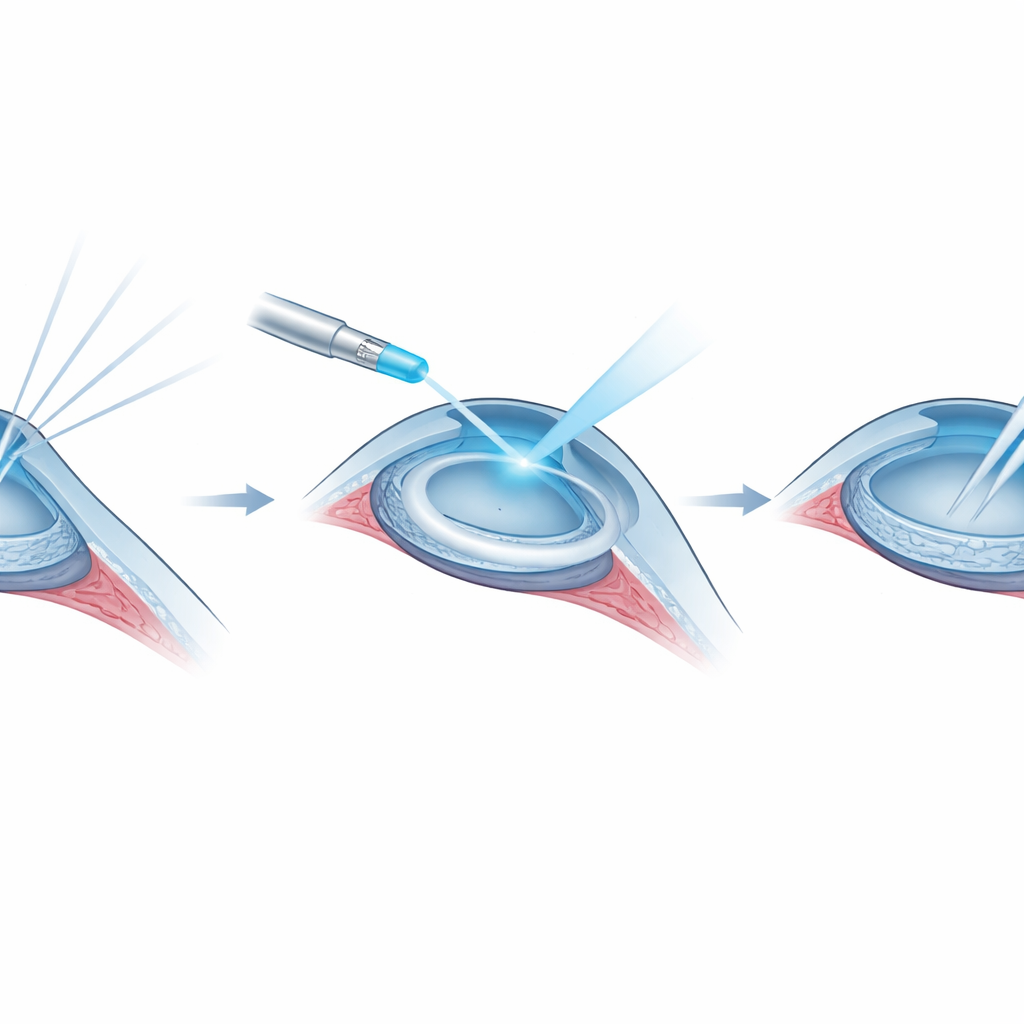
Fine-tuning and future directions
The study also highlights the flexibility of CAIRS. In some eyes that became too flat or changed unevenly, the ring segments were shortened or reshaped; in others where the first ring did not do enough, a second one was stacked in the same tunnel to boost the effect. Results were similarly good whether or not patients had undergone earlier cross-linking, though those without cross-linking tended to gain slightly more lines of vision. Overall, the improvements in clarity and corneal shape appeared early and remained stable over nearly a year, suggesting that the reshaping effect is durable at least in the medium term.
What this could mean for patients
For people facing the prospect of a corneal transplant because of advanced keratoconus, this work offers an encouraging possibility. By using donor corneal tissue ring segments to gently re-shape the eye from within, surgeons were able to restore much clearer vision in many severely affected eyes, without thinning the cornea further or triggering major complications. While larger, longer studies are still needed, CAIRS may become a valuable step between contact lenses and full transplantation, giving young patients a better chance at stable, comfortable vision with less invasive surgery.
Citation: Yesilirmak, N., Kara, N., Aksoy, B.E. et al. Corneal allogenic intrastromal ring segments improve visual and topographic outcomes in advanced keratoconus. Sci Rep 16, 13209 (2026). https://doi.org/10.1038/s41598-026-43962-2
Keywords: keratoconus, corneal ring segments, CAIRS, corneal transplant alternative, vision restoration