Clear Sky Science · en
Biological effects of 5G-modulated 700 MHz RF-EMF exposure on neuronal and glial cell models under isothermal conditions
Why this study matters to everyday life
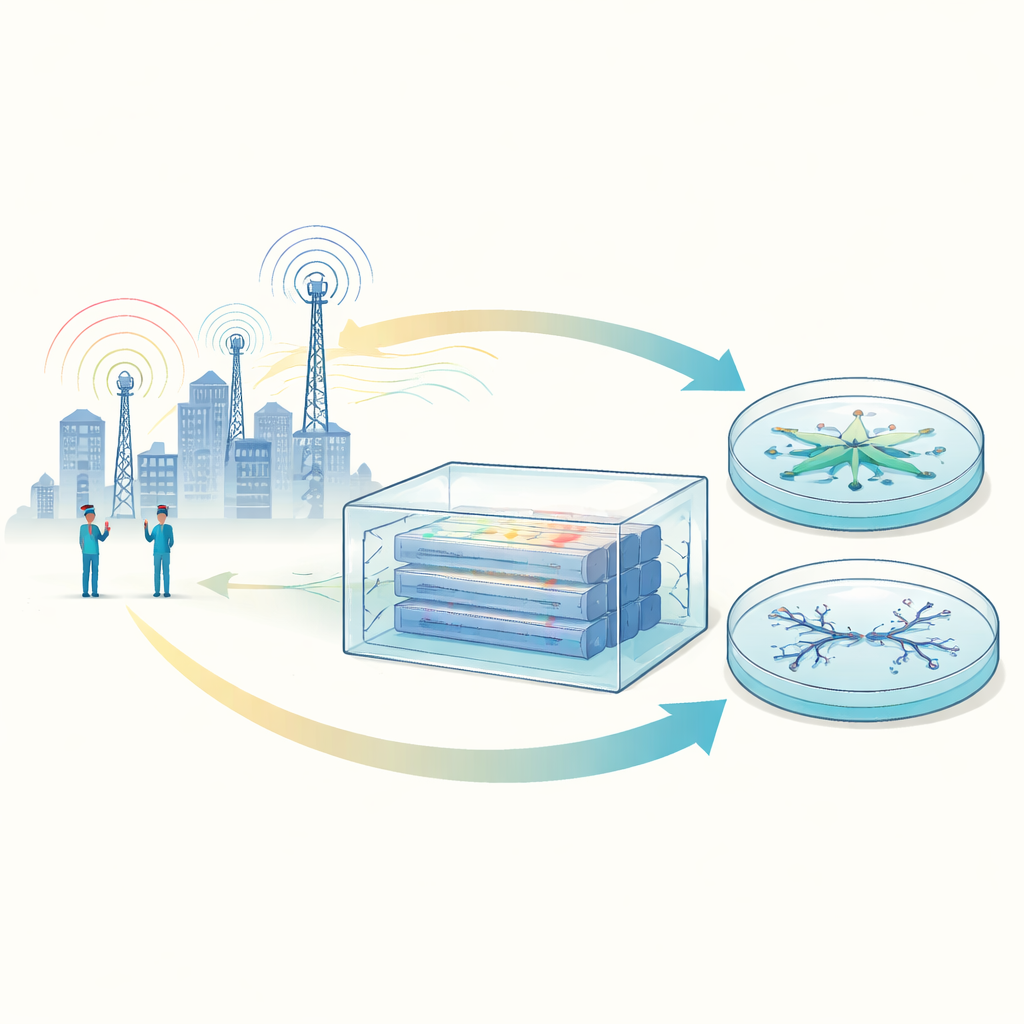
As mobile networks move from 4G to 5G, many people wonder what constant exposure to new wireless signals might mean for the brain. This study zooms in on that question for one specific slice of the 5G spectrum, asking whether a commonly used 700 MHz signal can harm key brain cells under carefully controlled laboratory conditions. The work does not try to settle every question about wireless technology and health, but it directly tests a leading concern: that these signals might silently stress or damage brain cells even when they do not noticeably heat tissue.
The main concern: invisible stress on brain cells
Radio waves from phones, base stations, and Wi‑Fi routers are a form of non-ionizing radiation, meaning they do not carry enough energy to break chemical bonds the way X‑rays do. Still, some studies have hinted that wireless signals could disturb the cell’s internal balance and trigger oxidative stress, a chain reaction involving reactive oxygen species that can damage DNA, proteins, and cell membranes. Because the International Agency for Research on Cancer has classified radiofrequency fields as “possibly carcinogenic,” scientists and public health agencies have called for controlled experiments that test whether modern communication signals can disturb brain cells without raising their temperature.
How the researchers tested the 5G-like signal
The team focused on the 700 MHz band now used for wide-area 4G and early 5G coverage. They grew two types of cells that stand in for major players in the brain: rat astrocytes, star-shaped helper cells that support and protect neurons, and human SH‑SY5Y cells, a widely used model for nerve cells. The cells were placed in precise exposure chambers called TEM cells, which create a uniform radio wave field. They were then exposed for either one hour or twenty-four hours to a 5G‑style signal at two power levels, a very low level similar to public exposure limits and a much higher level near the top of what safety guidelines allow for local tissue heating. Careful measurements and temperature control kept the experiments “isothermal,” meaning any effects would have to come from the signal itself, not from warming.
What they measured inside the cells
To see whether the radio waves disturbed the cells, the researchers used flow cytometry, a technique that passes thousands of cells one by one through a laser beam to read out fluorescent markers. They tracked several basic indicators of cell health. One dye lit up if the mitochondria—the cell’s tiny power plants—produced extra reactive oxygen species. Other markers revealed whether cells were alive, beginning programmed cell death (early apoptosis), or already dead or badly damaged (late apoptosis or necrosis). A separate dye that becomes more diluted each time a cell divides allowed the team to follow how quickly the cells multiplied over time. As a built‑in check that their methods were sensitive, they also treated some cells with hydrogen peroxide, a strong chemical oxidant known to boost oxidative stress and cell death.
What the experiments actually found
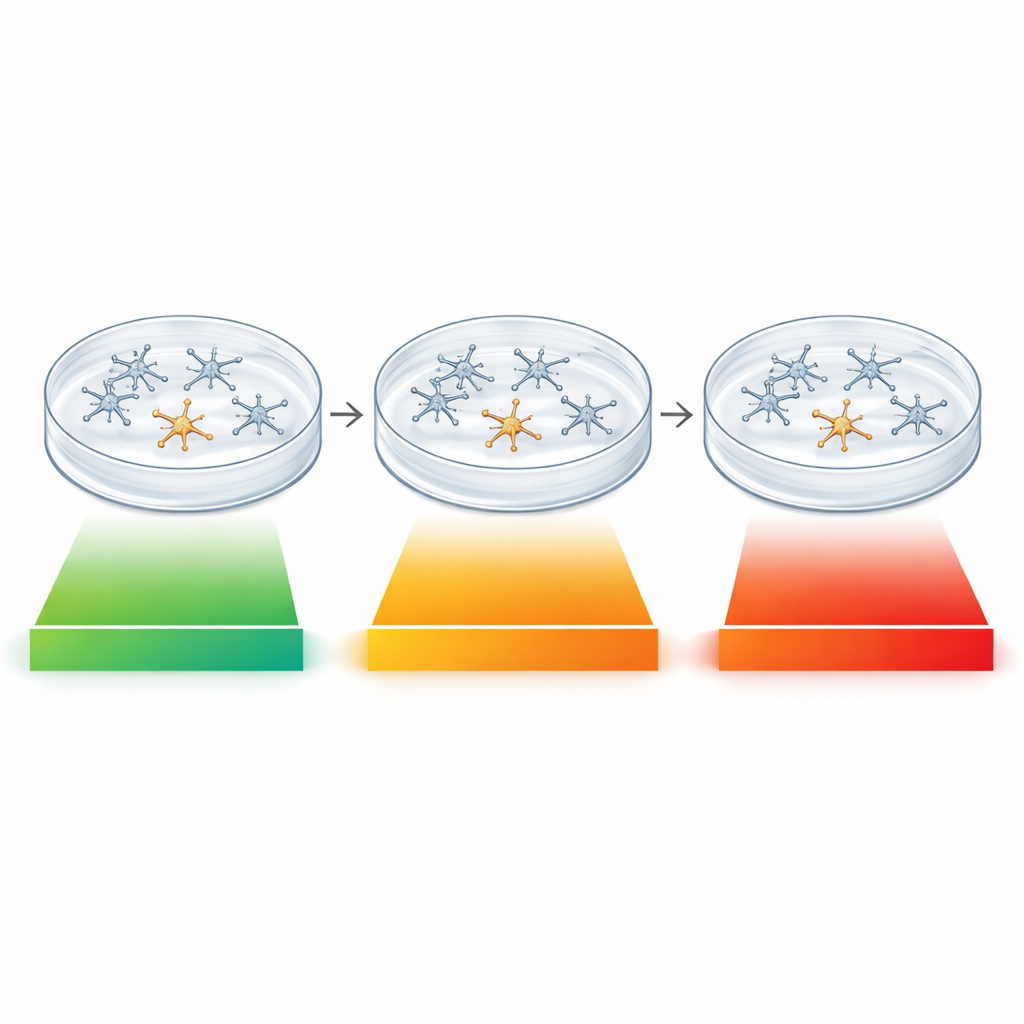
Across all combinations of exposure time, power level, and cell type, the results were strikingly consistent: cells exposed to the 700 MHz 5G‑like signal looked the same as unexposed cells. Cell survival stayed high, with no rise in the fractions of cells in early or late stages of death. The level of reactive oxygen species inside mitochondria did not increase, and there was no sign that the cells divided more slowly or more quickly after exposure. In contrast, the hydrogen peroxide controls behaved exactly as expected, showing clear spikes in oxidative stress and cell death. That contrast showed that the experimental system was capable of detecting harm when it truly occurred, strengthening confidence that the flat results under radiofrequency exposure reflected a real absence of detectable damage under the tested conditions.
How this fits into the bigger 5G picture
Placed alongside earlier work, these findings support a growing set of carefully controlled studies in which radiofrequency fields, applied without heating, do not disrupt basic functions of brain-related cells. The authors also acknowledge that their study does not cover every scenario: they did not test long-term, intermittent exposures over many days, more complex mixtures of brain cell types, or subtle molecular changes that might not show up as cell death or growth changes. Still, by tightly controlling temperature, rigorously characterizing the exposure, and working under blinded conditions, they reduce many sources of doubt that cloud earlier studies. Their data therefore add weight to the idea that, at least under conditions similar to those tested here, 700 MHz 5G‑style signals do not produce acute or short-term harm to two key kinds of brain cells.
What this means for everyday exposure
For a non-specialist, the take‑home message is that when brain-like cells are exposed in the lab to a strong 700 MHz 5G‑modulated signal—stronger and more tightly focused than what people typically experience in daily life—and the temperature is held steady, the cells do not show signs of distress, extra oxidative damage, or changes in growth. This does not eliminate every possible concern about wireless technologies, but it strengthens the scientific basis for current safety guidelines and suggests that non-heating effects on basic brain cell health at this frequency are unlikely under comparable conditions. Ongoing studies looking at longer exposures, more complex cell systems, and finer molecular details will further refine this picture, but for now, these results are reassuring rather than alarming.
Citation: Puginier, E., Leclercq, L., Poulletier de Gannes, F. et al. Biological effects of 5G-modulated 700 MHz RF-EMF exposure on neuronal and glial cell models under isothermal conditions. Sci Rep 16, 10767 (2026). https://doi.org/10.1038/s41598-026-43960-4
Keywords: 5G exposure, radiofrequency radiation, brain cells, oxidative stress, cell viability