Clear Sky Science · en
Exploring quantum Heider balance theory
Why Our Social Lives Act a Bit Like Quantum Worlds
Everyday relationships rarely fall neatly into “all good” or “all bad.” A close friend can also be a rival, and alliances in politics or workplaces can feel both supportive and strained at the same time. This paper asks what happens if we stop forcing such relationships into simple yes-or-no boxes and instead borrow ideas from quantum physics—where things can exist in mixtures of possibilities—to describe the push and pull of social balance in networks of people, groups, or even countries.
From Simple Triangles to Messy Real Life
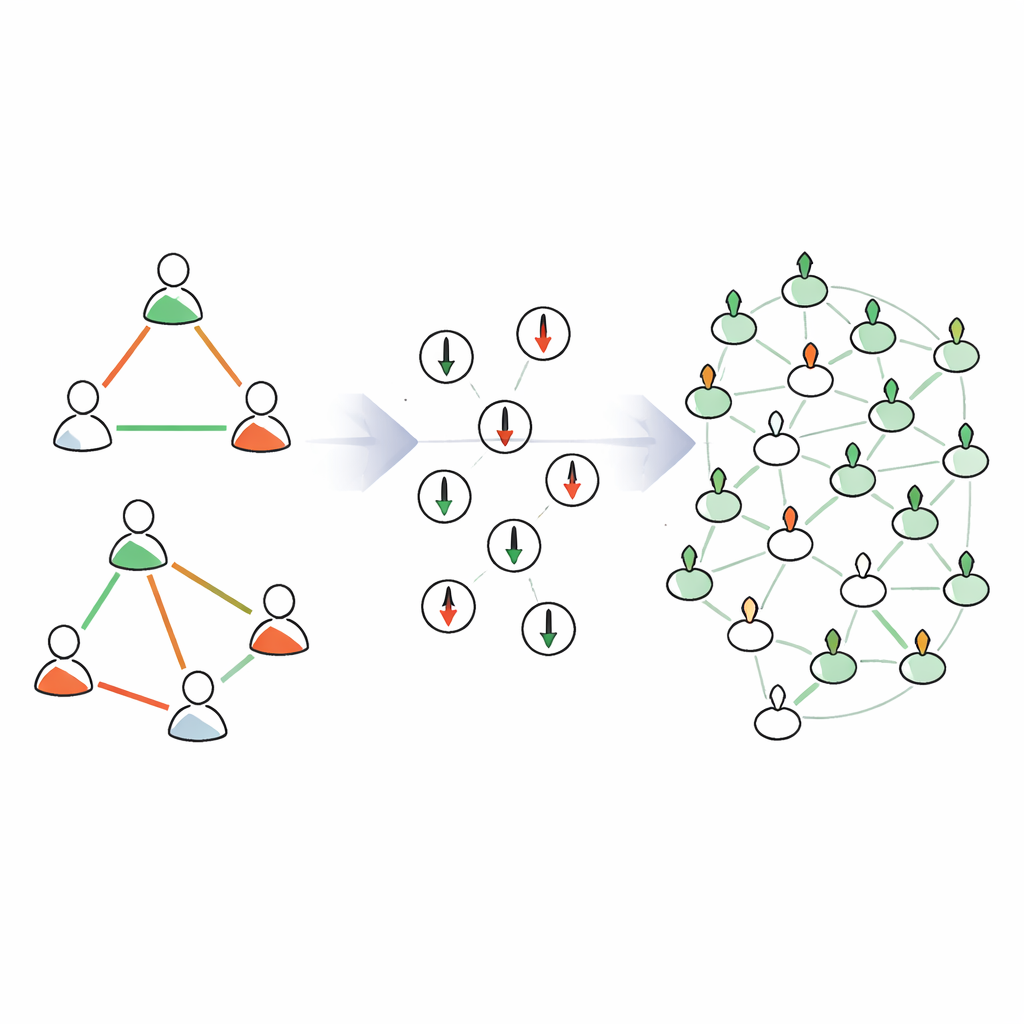
Classical balance theory, introduced by social psychologist Fritz Heider, starts from a very simple picture: consider three people connected in a triangle. Each connection is either friendly or hostile. Some combinations feel “comfortable” (for example, two friends sharing a common enemy), while others feel unstable (such as three mutual enemies). Over time, the theory suggests that people change their ties to reduce these uncomfortable situations, nudging the overall network toward a more balanced, less tense state. This classical framework has been used to study everything from international relations and political polarization to brain networks and financial systems.
Yet this black‑and‑white view misses much of what makes real relationships complicated. In practice, a triad of three people is rarely perfectly balanced or perfectly unbalanced. Feelings can be mixed, change slowly, and be strongly influenced by what is happening in the wider network. One strained friendship in a group can ripple outward, destabilizing other ties. The authors argue that to capture this fuzziness, we need a description where a triad can be partly balanced and partly imbalanced at the same time, and where different triads can be deeply interdependent.
Bringing Quantum Ideas into Social Triangles
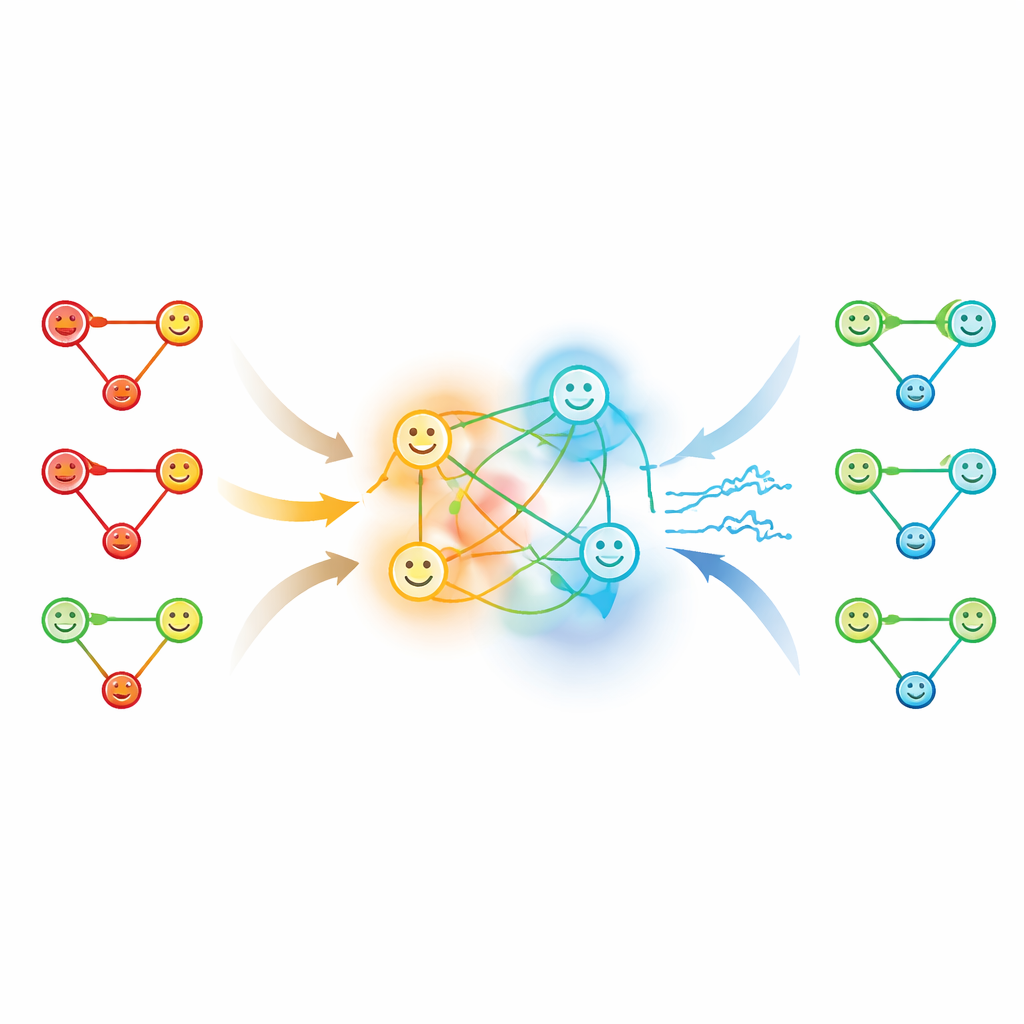
Quantum mechanics offers exactly such a language. In this work, each triad is treated as a tiny “quantum bit” that can be in a blend, or superposition, of balanced and imbalanced states. Instead of assigning a single, definite label, the model assigns probabilities: a given triad has some chance of acting like a stable, low‑tension relationship and some chance of behaving like a source of conflict. The authors also allow triads to become entangled, a quantum term meaning that they are no longer independent. When triads are entangled, changing the state of one immediately affects the other, echoing how a shift in one part of a community can unexpectedly affect relationships elsewhere.
To formalize this, the authors adapt tools from quantum physics usually used to describe spinning particles. They represent balanced and imbalanced triads as two basic states, then build up large networks by combining many such units. Special “ladder” operators describe how a triad can flip from imbalance to balance or back again, and a central mathematical object called a Hamiltonian encodes all the allowed transitions in the network. By analyzing the Hamiltonian’s spectrum—its characteristic modes of change—they can predict how different starting patterns of relationships will evolve over time.
How Quantum Social Networks Settle Down
Using this framework, the authors study simple examples, such as a system containing just two connected triads. They show how different initial conditions—clearly separated triads, mixtures of states, or already‑entangled pairs—lead to distinct pathways of change. In each case, the probabilities of various configurations shift with time, and the system tends to move away from strongly imbalanced patterns. In the long run, the most likely surviving state is a highly balanced arrangement, mirroring the classical idea that people prefer to reduce social tension, but now emerging from a richer, probability‑based picture that includes superposition and entanglement.
The study then steps beyond an idealized, perfectly orderly world by introducing temperature, a stand‑in for randomness, noise, or outside disturbances. At zero temperature, the network relentlessly moves toward balance. At higher temperatures, however, transitions that reintroduce imbalance become possible and even frequent. By gradually increasing this “social temperature,” the authors uncover a threshold: below it, the network remains mostly ordered and balanced; above it, random, conflicted configurations become common, and orderly patterns melt into a more chaotic phase. As the size of the network grows, this tipping point shifts and becomes harder to pin down precisely, reflecting the computational challenges of analyzing large quantum‑like systems.
What This Means for Understanding Complex Societies
In plain terms, the paper suggests that our social worlds may behave less like rigid machines and more like quantum systems full of overlapping possibilities. Relationships can simultaneously carry trust and doubt, calm and tension, and the fate of one small group can be tightly bound to another far away. By giving classical balance theory a quantum makeover, the authors reveal new types of collective behavior, including nonlocal influences and subtle phase transitions between harmony and disorder. While the work is theoretical, it points toward fresh ways of thinking about decision‑making, conflict resolution, and the fragile emergence of order in everything from online communities to international politics.
Citation: Kiani, A., Fazeli, S.M. & Jafari, G.R. Exploring quantum Heider balance theory. Sci Rep 16, 13481 (2026). https://doi.org/10.1038/s41598-026-43801-4
Keywords: social networks, quantum models, structural balance, collective behavior, conflict dynamics