Clear Sky Science · en
Analyzing the digital customer journey: a novel framework for sequential behavior modeling
Why Your Clicks on Health Apps Matter
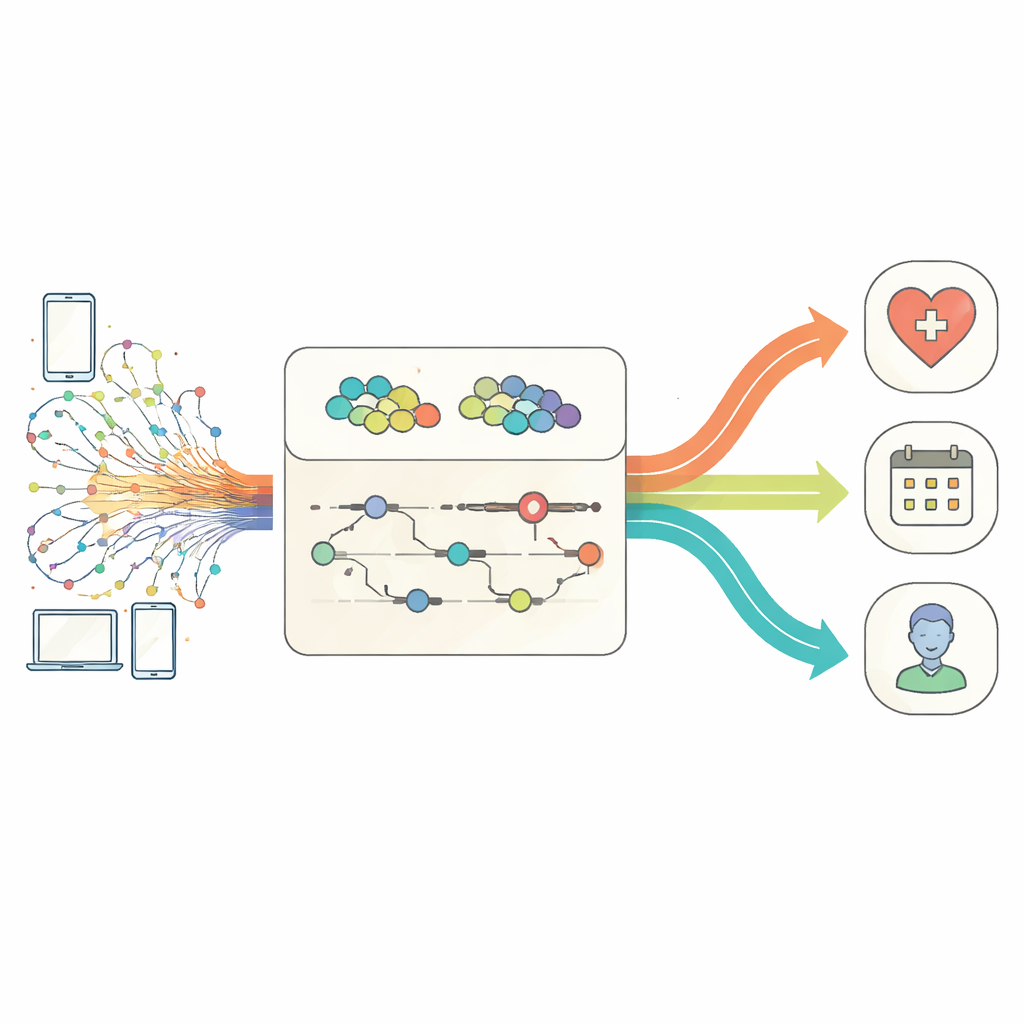
Every tap, swipe, and screen you open in a health app quietly tells a story about what you are trying to do—book a doctor, check lab results, or read a message. When millions of people use such apps, those stories pile up into huge, tangled records that are almost impossible to read by eye. This paper introduces a new way to untangle those records so health providers can see the main routes people take, spot where they get stuck, and redesign their digital services to be smoother, safer, and less frustrating.
From Click Chaos to Clear Journeys
The authors focus on the “digital customer journey,” meaning the sequence of steps a person takes while using a website or mobile app to complete a task. In busy online services—such as e‑commerce, banking, or healthcare—there can be countless possible paths, leading to what designers call a “spaghetti model”: a messy, overlapping map of clicks that no one can interpret. The study tackles this problem using data from a large Israeli health maintenance organization’s mobile app, where about 120,000 users generated roughly 5.5 million events a day. The aim is to boil this complexity down into a small set of typical journeys that still preserve the essence of how people actually move through the app.
Teaching Algorithms to Recognize Common Tasks
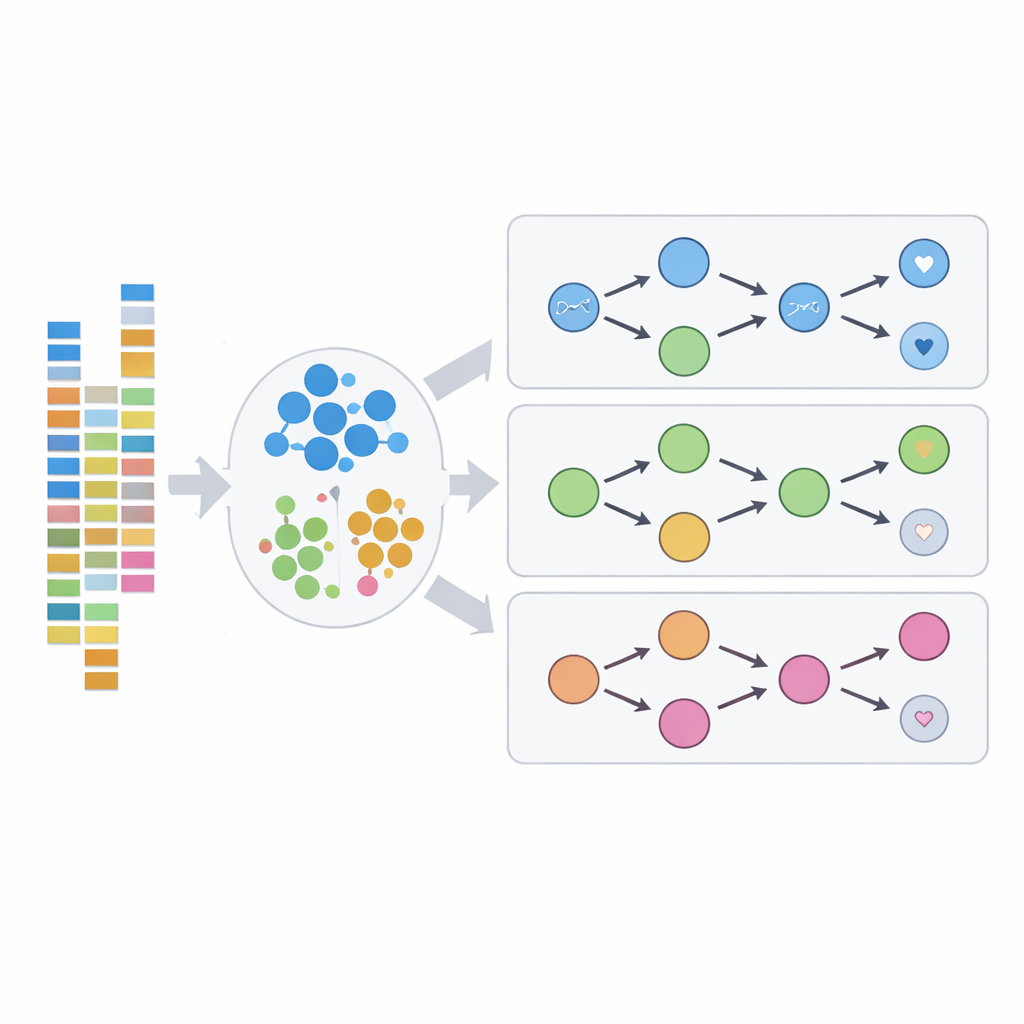
The first part of the framework treats each user session—one visit to the app from login to logout—as if it were a short document made out of “words,” where each word is an action such as opening a screen or pressing a button. A technique called topic modeling, originally designed to find themes in large text collections, is used to group sessions that share similar actions. In everyday terms, the algorithm learns that some sessions are mostly about scheduling an appointment, others about checking test results, and others about messaging a doctor. A more advanced version can even arrange these themes into a tree, showing broad topics at the top (for example, “doctor interactions”) that split into more specific ones (such as “requesting a prescription” or “reading doctor messages”).
Following the Steps, Not Just Counting Them
Knowing which actions tend to appear together is only half the story; what really matters is the order in which they occur. In the second part of the framework, the authors zoom in on each group of sessions and model the step‑by‑step flow using Markov chains, a simple mathematical way to estimate how likely one action is to follow another. This makes it possible to highlight the most typical paths within each type of journey and to see which clicks often lead straight to a dead end, such as a technical error or a premature exit from the session. By comparing how topic modeling and the step‑by‑step model assign sessions to groups, the method can also flag “ambiguous” journeys where users appear to mix several tasks—useful hints that the app design may not match how people really think.
Real Problems Revealed in a Health App
Applying this framework to the health app uncovered concrete design issues that would be hard to spot manually. In one appointment‑related journey, the most common real‑world path ended with an error message instead of the expected confirmation screen, revealing a technical fault at the last step of the process. In another case, users checking lab results often clicked a button meant to explain a test name; instead of showing information inside the app, it bounced them to an external website, after which many simply abandoned their session. The analysis also showed how different age groups use the same feature differently—for example, younger users scheduling more appointments on behalf of family members—suggesting ways to tailor experiences for specific segments.
What This Means for Everyday Users
For non‑experts, the key message is that careful analysis of click‑level data can move beyond pretty diagrams and actually pinpoint the exact screens and steps that cause confusion, wasted time, or dropped tasks. By combining two complementary tools—one that finds the main types of journeys and one that traces the most likely action‑by‑action paths—the framework gives health organizations a practical way to improve their apps, reduce errors, and support people in completing vital tasks online. The same approach can be used in shopping, banking, and learning platforms, making digital services more intuitive and reliable without requiring users to do anything more than what they already do: use the app.
Citation: Bar-El, L., Chalutz-BenGal, H., Gazit, S. et al. Analyzing the digital customer journey: a novel framework for sequential behavior modeling. Sci Rep 16, 14553 (2026). https://doi.org/10.1038/s41598-026-43762-8
Keywords: digital customer journey, healthcare apps, user behavior, event log analysis, sequential modeling