Clear Sky Science · en
Influence of endodontic access cavity design on root canal localization in mandibular first premolars using microscope and ultrasonic tips
Why the Hidden Spaces in Teeth Matter
When a dentist performs a root canal, the goal is to clean out every tiny space inside a tooth where germs can hide. But some teeth, especially certain back teeth in the lower jaw, have more than one internal channel, and one of them can be hard to find. If that hidden passage is missed, pain and infection can return. This study asks a practical question for everyday dentistry: can dentists safely use smaller, tooth‑saving openings while still reliably finding these extra channels, as long as they also use modern tools like microscopes and ultrasonic instruments?
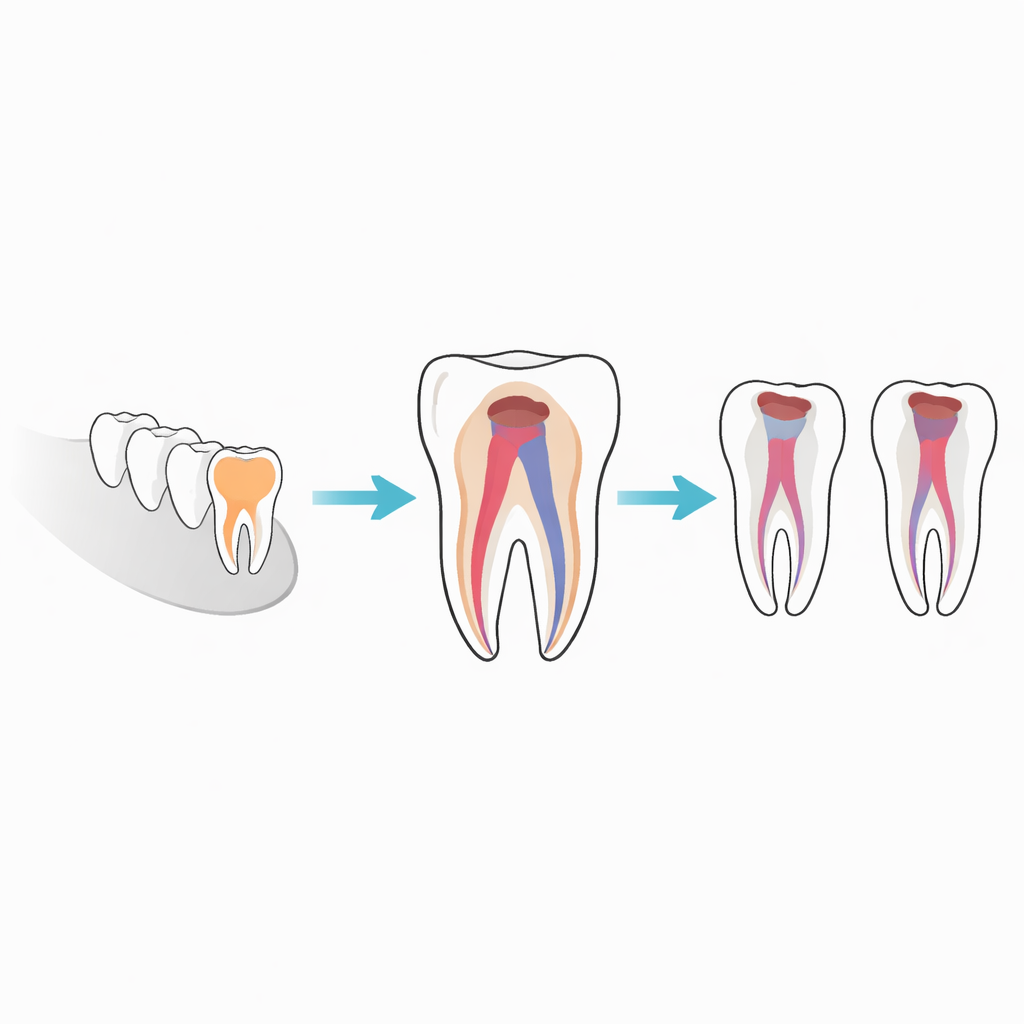
Different Doorways Into the Same Tooth
To reach the inside of a tooth, dentists must first drill an opening through the biting surface. A traditional opening is wider and gives a broad view but removes more tooth structure. A conservative opening is smaller and preserves more of the tooth, which may help prevent cracking later on. Some clinicians worry that a smaller doorway could make it harder to see and reach all the internal spaces, particularly a frequently hidden “lingual” canal in lower first premolars (the small teeth just in front of the molars). The researchers set out to see whether the shape and size of this opening actually changes how often that second canal is found.
Testing Teeth Under Realistic Conditions
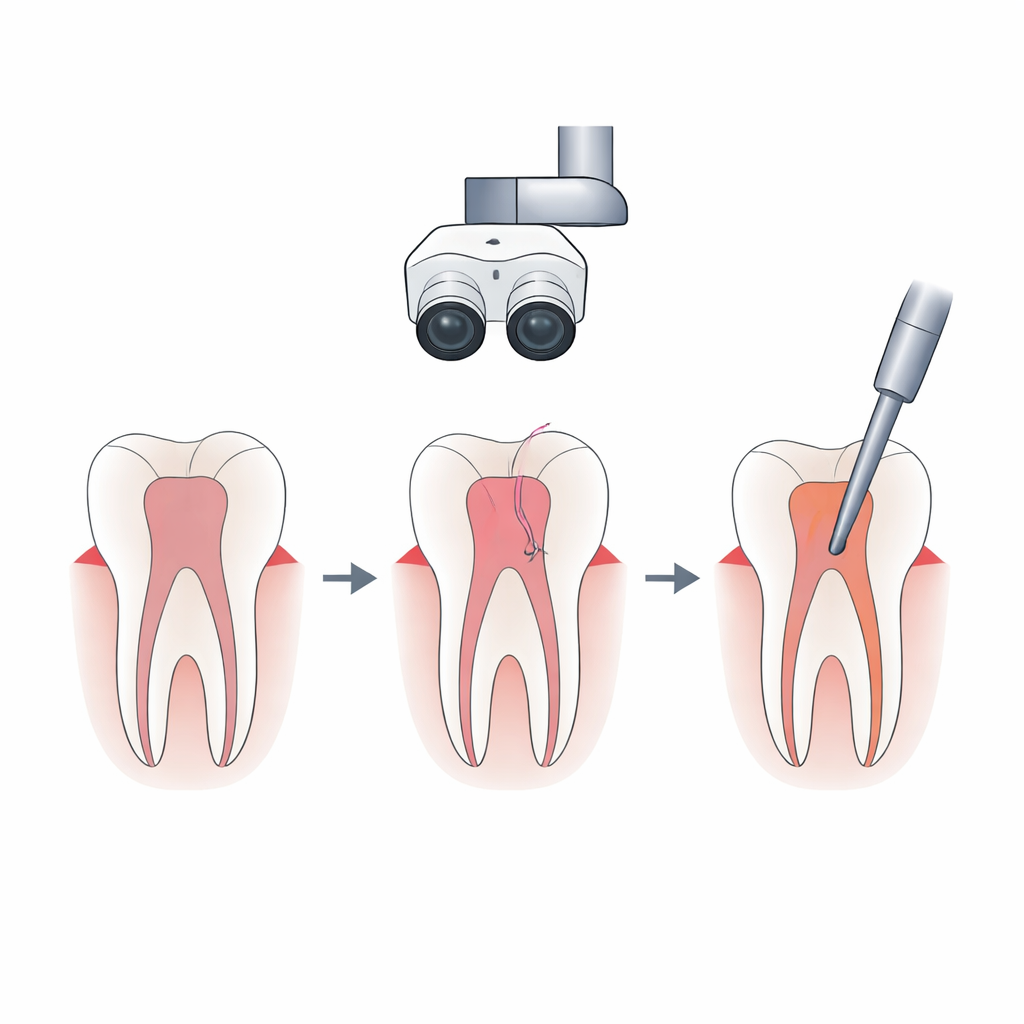
The team collected 72 extracted lower first premolars. Using three‑dimensional scans, they confirmed exactly which teeth had a single canal and which had two. Half the teeth received a conservative access cavity, and the other half a traditional one. To mimic real‑world treatment, each tooth was mounted in a dental mannequin head, and an experienced endodontist—who did not know the scan results—worked on them as if treating a patient. The search for the hidden canal was done in three steps: first with normal dental instruments and mirrors only, then with the help of a surgical microscope, and finally with both the microscope and fine ultrasonic tips that gently shave away small amounts of dentin to reveal obscured openings.
What Better Vision and Gentle Tools Can Do
Without any magnification, the dentist’s ability to spot the extra canal was poor, regardless of the type of opening. The microscope alone improved detection, but the biggest jump came when ultrasonic tips were added. In teeth with conservative openings, sensitivity for finding the second canal soared from very low in the first step to excellent in the third step. Traditional openings showed a similar pattern of improvement, but their final accuracy was slightly lower, though still good. Importantly, at every stage there was no meaningful difference between conservative and traditional openings in how often the second canal was correctly identified. Both designs achieved perfect performance in recognizing when there was only a single canal, meaning the dentist did not mistakenly “find” canals that were not there.
What This Means for Everyday Dental Care
These results suggest that the critical factor in uncovering hidden spaces inside teeth is not how wide the initial opening is, but how well the dentist can see and gently refine the internal area. High‑powered microscopes improve visibility of the tiny floor where canals begin, while ultrasonic tips help carefully remove small ridges and calcifications that can hide an entrance. This combination appears especially helpful when dentists aim to save as much tooth as possible with a conservative opening.
Take‑Home Message for Patients
For people facing a root canal on a lower premolar, this study offers reassuring news. Dentists can choose either a more traditional or a more tooth‑preserving entry design without sacrificing the ability to find an important hidden canal—as long as they use modern magnification and ultrasonic tools. In simple terms, your dentist can protect more of your natural tooth while still thoroughly cleaning out the infection, reducing the risk that unseen spaces will allow problems to return.
Citation: Gonçalves, M.F., Limoeiro, A.G., Andrade, R.F. et al. Influence of endodontic access cavity design on root canal localization in mandibular first premolars using microscope and ultrasonic tips. Sci Rep 16, 13447 (2026). https://doi.org/10.1038/s41598-026-43652-z
Keywords: root canal, endodontic access, dental microscope, ultrasonic tips, mandibular premolar