Clear Sky Science · en
Nasal and oral breathing modes reconfigure brain network dynamics between stabilizing integration and promoting fragmentation
Why the way we breathe matters
Most of us switch between breathing through our nose and mouth without a second thought. Yet this simple choice may change how different parts of the brain talk to each other. This study used brain scans to show that nasal and oral breathing place the brain in distinct patterns of communication, shifting it between more unified and more fragmented modes of activity. The findings hint that nasal breathing could support steadier, more coordinated brain function, while mouth breathing may push the brain toward a more scattered state.
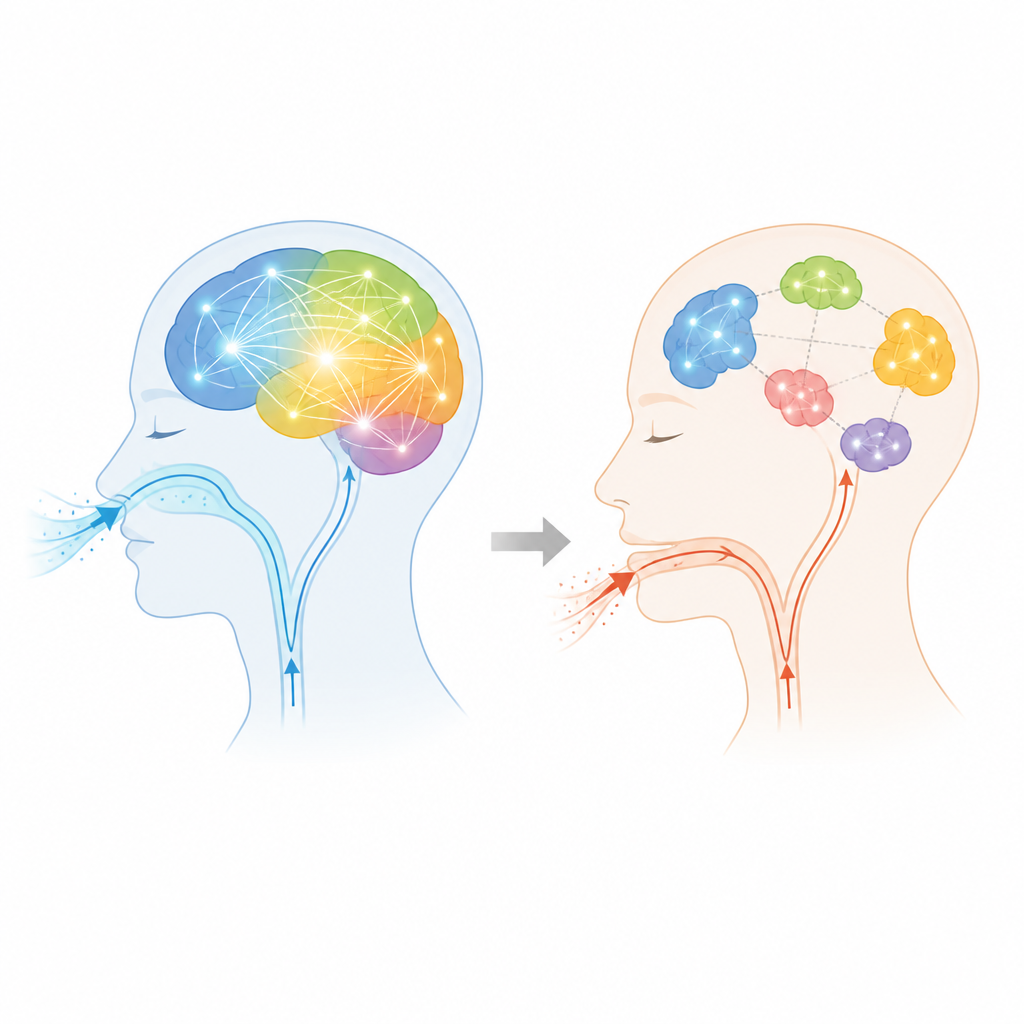
The breath as a rhythm for the brain
Breathing does more than move air in and out of the lungs. When we breathe through the nose, air flows across smell receptors that also act as tiny motion sensors. These sensors send rhythmic signals to the olfactory bulb and then to deeper emotional and thinking centers. Mouth breathing bypasses this route and relies mainly on automatic circuits in the brainstem. Earlier work from the same group showed that these two modes of breathing shape which brain areas are linked at rest, but only in a static way. The new study asked how these links change over time and whether nasal or oral breathing makes the brain settle into certain patterns more than others.
Peering into shifting brain states
The researchers scanned the brains of 20 healthy adults while they rested quietly in an MRI scanner, once breathing only through the nose and once only through the mouth. They focused on a frequency band where brain signals are known to follow the rhythm of breathing. Instead of averaging connections over the whole scan, they used a mathematical tool called a hidden Markov model to detect recurring “states” of brain-wide communication. This approach allowed them to identify how often each state appeared, how long it lasted, how quickly the brain jumped between states, and how likely it was to switch from one state to another.
Three patterns of brain communication
The analysis revealed three main states that kept reappearing. One state showed weak links between distant networks and strong separation between them, like small islands with little trade. A second state was globally integrated, with strong connections within and across networks involved in attention, memory, emotion, and control, as well as key deep structures. A third state fell in between: some networks, especially those handling vision and movement, were well connected within themselves, but long-range ties among higher thinking and emotional systems were reduced. Graph theory measures confirmed that the integrated state was the most efficient and least divided into separate modules, while the other two were more segregated.
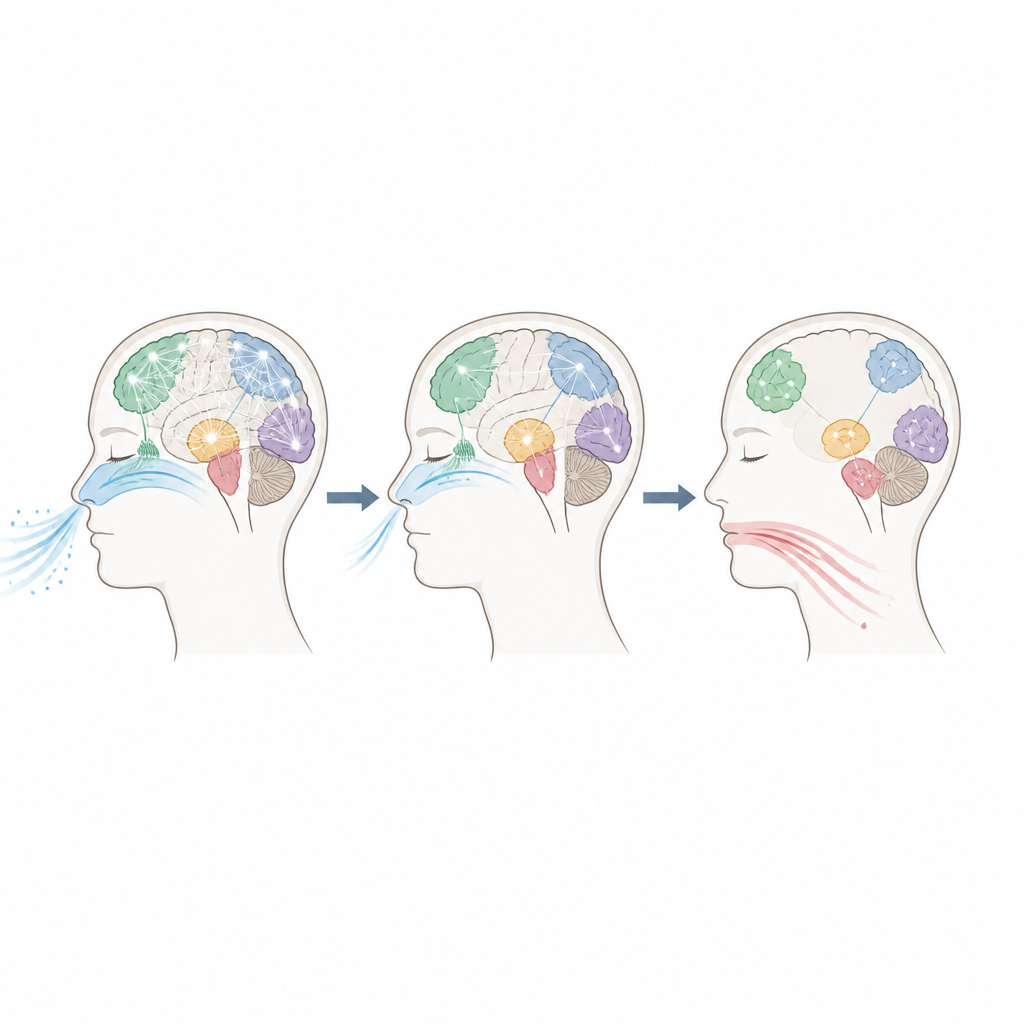
How nose and mouth breathing tip the balance
Breathing mode strongly changed how the brain moved among these states. During nasal breathing, the integrated state dominated: it lasted longer and the brain switched between states less often. In contrast, oral breathing led to more time spent in the intermediate, partly fragmented state and produced faster switching overall. The chance of moving from the integrated state into the more fragmented state was especially higher with mouth breathing. These differences suggest that nasal airflow helps hold the brain in a stable, whole-brain configuration, likely through the rhythmic drive from nasal sensors to limbic and cortical regions, while oral breathing removes this stabilizing input and allows the system to break into more local clusters.
What this means for everyday life
To a non-specialist, the key message is that how we breathe may gently steer the brain between a more unified, communicative mode and a more broken-up one. Nasal breathing appears to favor a stable, efficient pattern that links networks important for memory, attention, and emotion, whereas mouth breathing makes the brain’s communication map more fragmented and restless. Although this study did not measure behavior directly, its results offer a possible brain-level explanation for reports that nasal breathing supports mental performance and that chronic mouth breathing relates to cognitive difficulties. The work raises the intriguing idea that simple habits like keeping the lips closed and breathing through the nose could influence how smoothly our brain networks work together.
Citation: Mohammadi, S., Hossein-Zadeh, GA. & Raoufy, M.R. Nasal and oral breathing modes reconfigure brain network dynamics between stabilizing integration and promoting fragmentation. Sci Rep 16, 15917 (2026). https://doi.org/10.1038/s41598-026-43617-2
Keywords: nasal breathing, mouth breathing, brain networks, resting-state fMRI, dynamic connectivity