Clear Sky Science · en
Cardiorespiratory fitness is differentially associated with motor cortex laterality in middle-aged and older adults
Why Exercise Might Matter for Everyday Dexterity
As we get older, many of us notice small changes in everyday skills like buttoning a shirt, typing, or handling tiny objects. This study asks a simple but important question: does staying aerobically fit help the aging brain control the hands more youthfully, and does that relationship change between midlife and later life? By peering into the brain while people performed a hand-movement task, the researchers explored how fitness, brain activity patterns, and fine motor skills are linked across the second half of adulthood.
How the Two Sides of the Brain Normally Share the Work
When a healthy young adult moves their right hand, the left side of the brain’s motor area usually does most of the work, while the right side quiets down. With age, this tidy division of labor often fades: both sides of the brain become active even for simple one-handed tasks. Scientists call this a reduction in “hemispheric asymmetry” and have debated whether it represents the brain cleverly compensating for age-related wear, or a loss of efficiency in how specialized each side is. This study focused on that shift in balance between the two brain hemispheres and how it relates to fitness and real-world hand skills.
Testing Fitness, Brain Activity, and Hand Control
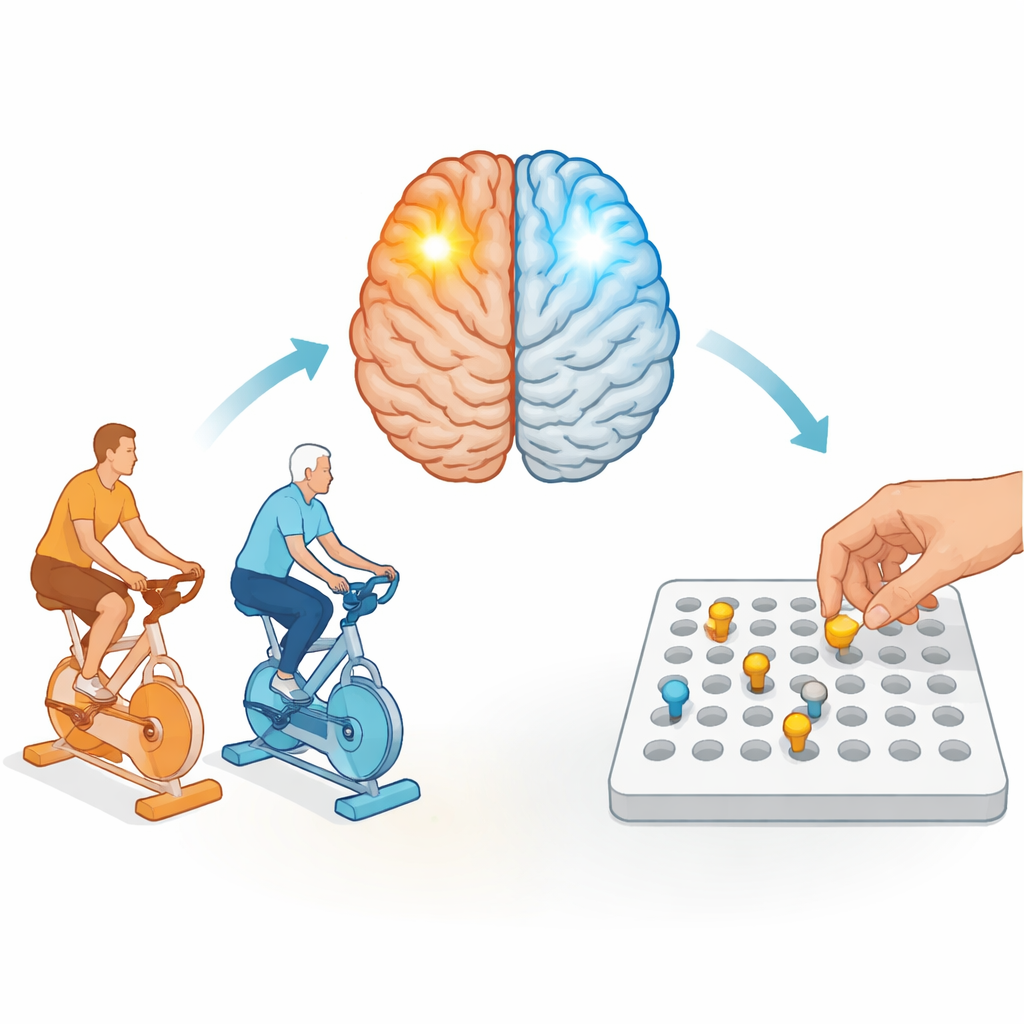
The research team studied 64 adults between 35 and 86 years old. First, each person completed a rigorous cycling test to determine peak oxygen uptake, a gold-standard measure of cardiorespiratory fitness. Inside an MRI scanner, participants viewed a flashing checkerboard and pressed buttons with their right hand to indicate changes on the screen. This simple task let the scientists measure how strongly the left and right motor regions of the brain responded. Outside the scanner, participants also completed a more demanding fine-motor test: using their right hand to quickly place small pegs into oddly oriented holes on a board, a task that requires coordination, speed, and precise finger control.
Fitness and “Youthful” Brain Patterns in Midlife
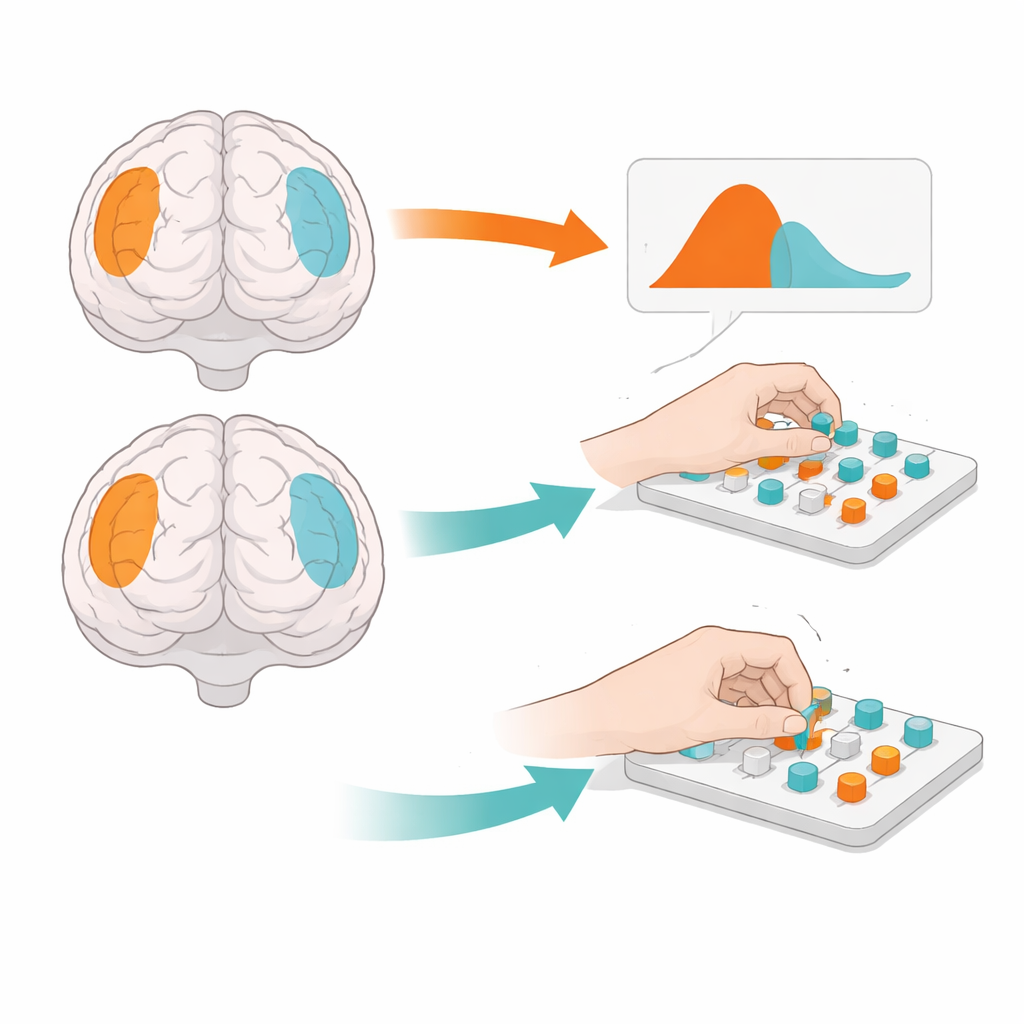
Across the sample, older age was linked with less difference in activity between the left and right motor areas during the right-hand task, consistent with the typical age-related shift toward more bilateral activation. But fitness changed this picture—especially in midlife. Among adults aged 35 to 64, higher fitness was associated with a more clearly one-sided motor response, closer to the pattern seen in younger adults. In this group, there was also a tendency for people with more one-sided brain activity to perform slightly better on the complex pegboard task, suggesting that maintaining a sharper division of labor between hemispheres may support fine motor skills in midlife.
When the Story Changes in Older Age
For adults 65 and older, the relationships looked different. Higher fitness was still linked to better performance on both the simple button-pressing task and the more challenging pegboard test, indicating that being aerobically fit supports motor function in later life. However, fitness was no longer clearly related to how one-sided or bilateral the motor cortex response was. In fact, there was a weak hint that, for the pegboard task, older adults who showed more balanced activity across both hemispheres might perform slightly better. This suggests that by late life, the brain may be relying on different strategies—possibly recruiting both sides more—to keep performance up, even among fitter individuals.
What This Means for Aging Brains and Everyday Function
To a layperson, the takeaway is that staying aerobically fit appears to support better hand skills across the second half of life, but the brain may use different wiring strategies at different ages. In midlife, fitness seems tied to a more “youth-like” pattern where one side of the brain leads the movement, and this pattern may help preserve fine motor control. In older age, fitness still benefits performance, but not by keeping this same pattern intact; instead, more balanced activity across both hemispheres may sometimes help. These findings point to midlife as a potentially important window when improving or maintaining cardiorespiratory fitness could influence how the brain organizes movement, with lasting consequences for everyday dexterity as we grow older.
Citation: Cloud, J.A., Howe, I.A., Kraemer, W.J. et al. Cardiorespiratory fitness is differentially associated with motor cortex laterality in middle-aged and older adults. Sci Rep 16, 13051 (2026). https://doi.org/10.1038/s41598-026-43466-z
Keywords: cardiorespiratory fitness, brain aging, motor cortex, hemispheric asymmetry, fine motor skills