Clear Sky Science · en
Vibration error correction in absolute gravity measurement using BP neural network
Why tiny shakes matter
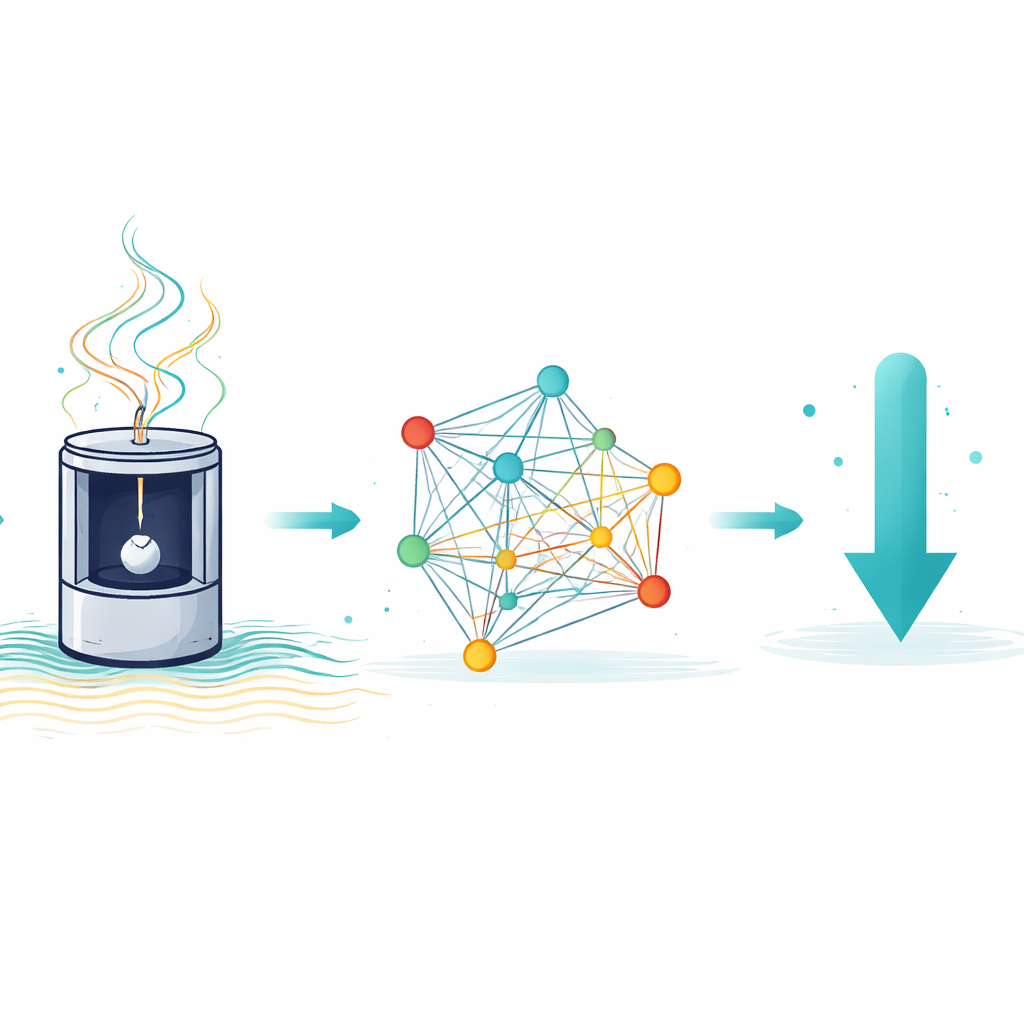
Even when we stand perfectly still, the ground beneath us is never truly at rest. Waves from oceans, passing trucks, distant earthquakes and even wind make the Earth’s surface tremble. For most of us, these motions go unnoticed. But for scientists trying to weigh our planet’s pull with exquisite precision, such tiny shakes can completely blur the picture. This study introduces a smart, software-based way—using a type of artificial intelligence called a neural network—to cancel out those unwanted jitters and sharpen measurements of gravity down to a few parts in a billion.
Weighing the Earth with falling objects
Modern “absolute gravimeters” measure gravity by timing how fast a small object falls in a controlled chamber. A laser tracks the object’s position as it drops, building up a detailed trajectory from which the local strength of gravity can be calculated. Instruments like the widely used FG5‑X gravimeter can already reach astonishing precision, enough to detect subtle changes in Earth’s crust or help test fundamental physics. However, these measurements are extremely sensitive to vibrations of the device’s reference mirror and surrounding structure. When the ground moves, the laser signal wobbles, shifting the exact moments when the instrument thinks the falling object passes key points. These tiny time shifts translate directly into errors in the calculated value of gravity.
How ground motion distorts the fall
The authors first built mathematical and computer models to understand exactly how different kinds of vibration—slow drifts, curved swings and rapid oscillations—distort the laser signal. They showed that each vibration pattern leaves a distinct fingerprint in the timing errors of the falling object’s path. Importantly, these errors do not simply pile up over time; instead, each moment’s error is closely linked to the vibration at that instant. That means that if you know the vibration signal well enough, you could, in principle, reconstruct and undo the timing mistakes it causes. The challenge is that the relationship between the raw vibration readings and the resulting timing errors is highly nonlinear and too complex to capture with simple formulas.
Teaching a neural network to undo the noise
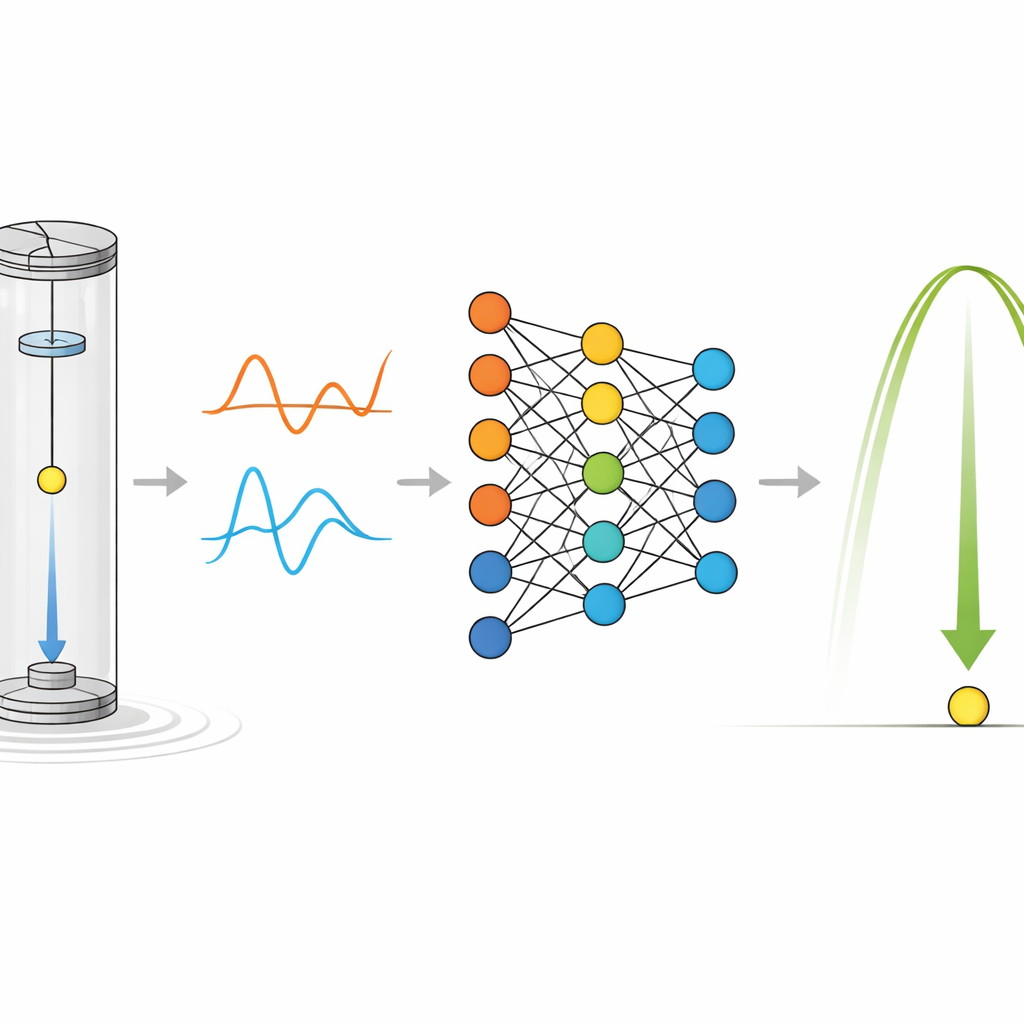
To tackle this, the team turned to a backpropagation (BP) neural network, a common machine-learning model that excels at learning complicated input–output relationships. They generated 100,000 simulated examples of gravity measurements, each combining an ideal free-fall signal with realistic vibration patterns spanning quiet laboratories, typical field sites and noisy environments. For every case, they computed the exact timing error caused by the vibration. The neural network was then trained to take the measured vibration waveform (plus timing information) as input and output the corresponding timing correction. To speed and stabilize the learning process, the authors replaced the traditional training method with the Adam optimization algorithm, which adaptively tunes how strongly the network updates its internal weights. This combination allowed the model to converge faster and predict timing errors with extremely small average mistakes.
From computer tests to real-world gravity points
After confirming the method in simulations, the researchers tested it with their own compact laser gravimeter, Tide‑010, at three very different sites near Beijing: a quiet underground national gravity benchmark, a ground-floor office, and a mountainous area with loose soil and strong environmental vibrations. At each location they recorded both the laser interference signal and the motion of the reference point using a sensitive accelerometer. The raw data were first filtered to remove very high-frequency noise, then fed into the trained neural network, which produced corrected time coordinates for the falling object. Using these corrected trajectories, the team recomputed gravity and compared the spread and bias of the results with those from conventional “direct” fitting. Across the board, the neural network reduced random scatter in the gravity readings by roughly 80–85%, and kept average errors very close to zero.
Sharper gravity readings and what they mean
For a layperson, the key outcome is that this AI-assisted approach lets a gravity meter “listen” to the ground’s shaking and then mathematically subtract its effect, much like noise-cancelling headphones remove background hum from your music. In quiet underground conditions and in an ordinary building, the corrected measurements matched or even surpassed the performance of the best commercial instruments, reaching accuracies of about one to two microgals—a millionth of the acceleration we feel from gravity. Even in a noisy mountain setting, the method still held errors to around three microgals. This improvement does not require bulky new hardware; it mainly relies on smarter data processing. As a result, the technique could help countries develop their own high-precision gravimeters, support better monitoring of earthquakes and volcanoes, and enable more accurate tests of fundamental physics, all by teaching instruments to see through the Earth’s constant, subtle tremble.
Citation: Niu, Y., Wu, Q., Zhang, Y. et al. Vibration error correction in absolute gravity measurement using BP neural network. Sci Rep 16, 14072 (2026). https://doi.org/10.1038/s41598-026-43402-1
Keywords: gravity measurement, ground vibration, neural networks, precision geophysics, signal correction