Clear Sky Science · en
Evaluation of off-the-shelf wearable for ambulatory clinical event monitoring and patient localization in hospital settings
Why tracking moving patients matters
When people are in the hospital but well enough to walk around, they often leave the watchful eyes of monitors and nurses. A hidden problem is that a patient’s heart or breathing can suddenly worsen while they are in a hallway, cafeteria, or waiting area. This study asks a simple question with big stakes: can everyday smartwatches and smartphones be turned into a low-cost safety net that keeps tabs on patients wherever they go in the hospital?
Turning everyday gadgets into a safety net
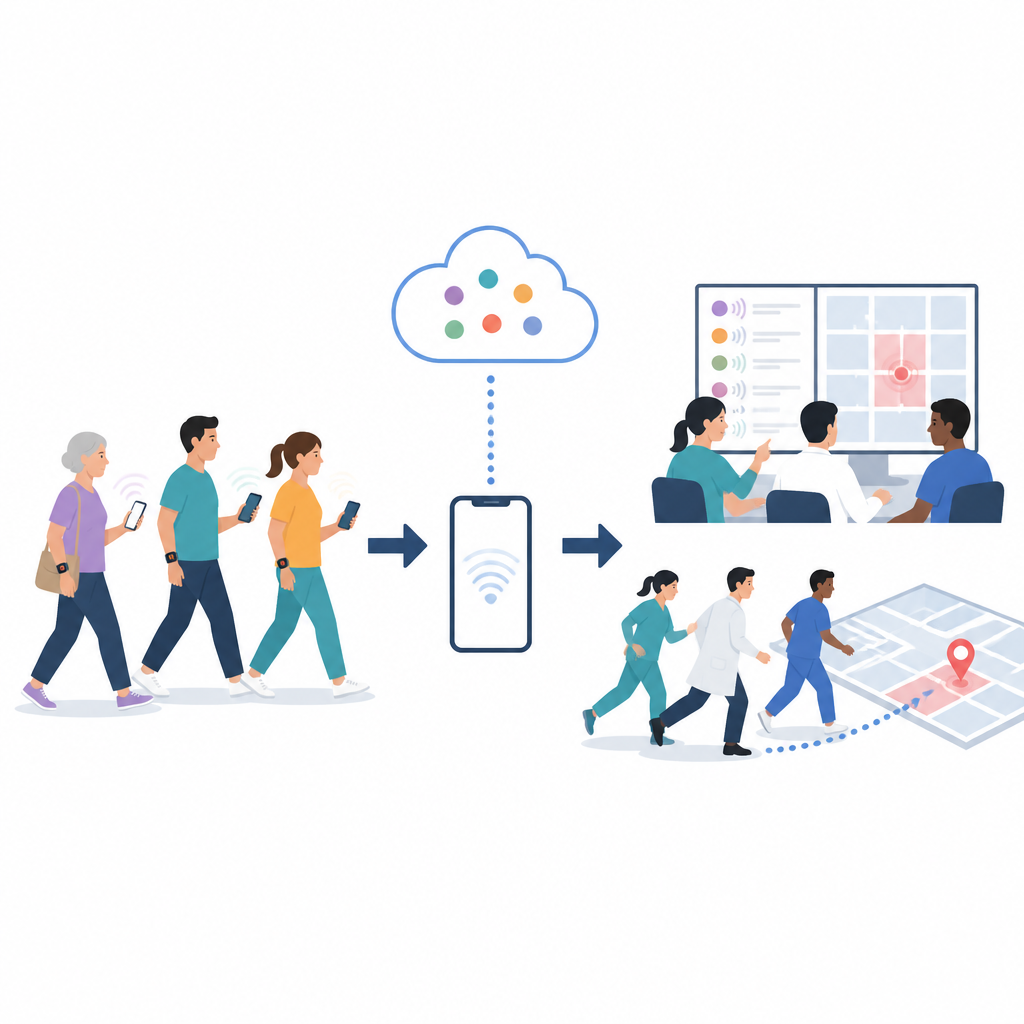
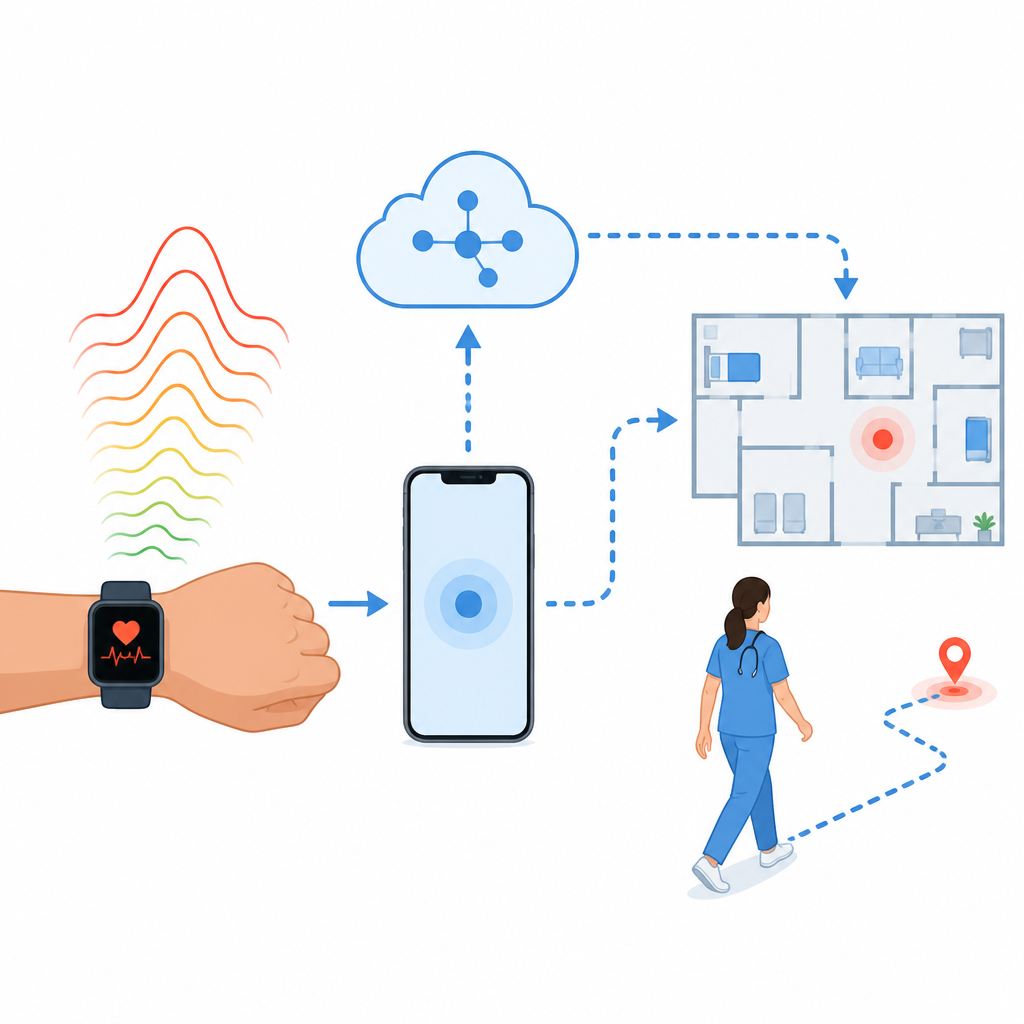
The researchers built a monitoring system from two off-the-shelf Garmin smartwatches paired with smartphones and a cloud-based dashboard. The watches tracked heart rate and allowed users to tap for help, while the phones supplied location inside the hospital. When the system detected a very fast or very slow heartbeat, loss of signal, or a manual call for help, it sent alerts to medical staff through an online messaging tool. The idea was to let patients move freely while still giving staff a live map of who might be in trouble and where they were.
Testing alerts and signal delays in the real world
To see how well this setup worked in real hospital conditions, the team ran several experiments with 10 healthy volunteers. On treadmills, they compared heart rates from the smartwatches with a medical-grade electrocardiogram. They measured how long it took from the moment a volunteer’s heart rate crossed a high threshold to the moment an alert appeared for staff. They also tested what happened when the watch was taken off, and when wireless signals were weakened in a shielded imaging room, to mimic poor reception in parts of a hospital.
Finding people inside a maze-like building
Knowing that something is wrong is only half the battle; staff also need to find the patient quickly. The researchers used hospital building plans and official survey points to check how accurately smartphones reported position on different floors and in different areas. They found that location in the horizontal plane was usually within a few meters, but accuracy varied by spot and could be worse in crowded public areas. Vertical position was more precise in terms of spread but consistently off by about 40 meters, meaning it could not reliably tell one floor from another without extra tricks.
How long until help arrives
The team then staged a “hide-and-seek” scenario on the first floor of the hospital. Volunteers triggered emergency calls from various locations, while staff started from a reading room and walked to the reported spot using the system’s map. The farther away the patient was, the longer it took, with arrival time rising by about three quarters of a second per meter of distance. For a patient 100 meters away, staff were expected to arrive in just over two minutes. When combined with the several-minute delay between an actual heart rate change or watch removal and the alert, this means total time to bedside could exceed five minutes in some emergencies.
What the results really mean
The findings show that consumer wearables can form the backbone of a hospital-wide safety net, but they are not yet a match for medical equipment. Tachycardia alerts lagged behind clinical monitors by several minutes, one of ten tests never triggered at all, and indoor location was good but not perfect. The study does not offer a finished product; instead, it sets clear performance numbers that future systems need to improve on. For patients, the message is that their own gadgets may one day help keep them safer as they move around the hospital, but careful upgrades and larger studies are still needed before such systems can be trusted for critical decisions.
Citation: Fukuyama, K., Sakamoto, R., Fujimoto, K. et al. Evaluation of off-the-shelf wearable for ambulatory clinical event monitoring and patient localization in hospital settings. Sci Rep 16, 15683 (2026). https://doi.org/10.1038/s41598-026-43212-5
Keywords: wearable monitoring, hospital patients, smartwatch heart rate, indoor positioning, clinical alerts