Clear Sky Science · en
Arabic validation of the VAGUS insight into psychosis scale among Lebanese patients with schizophrenia
Why understanding illness insight matters
When people live with schizophrenia, one of the most puzzling challenges is that many do not fully recognize that they are ill or that they need treatment. This lack of “insight” can derail care, strain families, and increase the risk of relapse. Yet most of the tools used to measure insight were created in Western settings and languages. This study asks a simple but crucial question: can a modern insight scale be accurately used with Arabic-speaking patients in Lebanon?

A closer look at insight in psychosis
Psychosis, including schizophrenia, can blur the line between what is real and what is not. Some people may hear voices that others do not, or hold firm beliefs that those around them see as clearly untrue. Insight refers to how aware a person is that these experiences are part of an illness, that treatment can help, and that the condition can have serious consequences if ignored. Better insight is linked to taking medication more regularly, benefiting more from therapy, and avoiding repeated hospital stays. Because insight can change over time with symptoms and treatment, clinicians need short, reliable tools to track it.
Bringing the VAGUS scale into Arabic
The VAGUS Insight into Psychosis scale is a brief tool with two faces: one is filled out by clinicians, and the other by patients themselves. It covers four main areas of insight, such as recognizing the illness, understanding that unusual experiences are due to the disorder, seeing the need for treatment, and realizing that the condition can harm one’s life. Until now, the VAGUS scale had been tested in several languages but not in Arabic, where only one other insight tool existed. To fill this gap, researchers in Lebanon carefully translated the VAGUS scale into standard Arabic, then refined it with input from bilingual experts and the original developers to ensure that the wording fit both the language and the culture.
Testing the tool in a Lebanese hospital
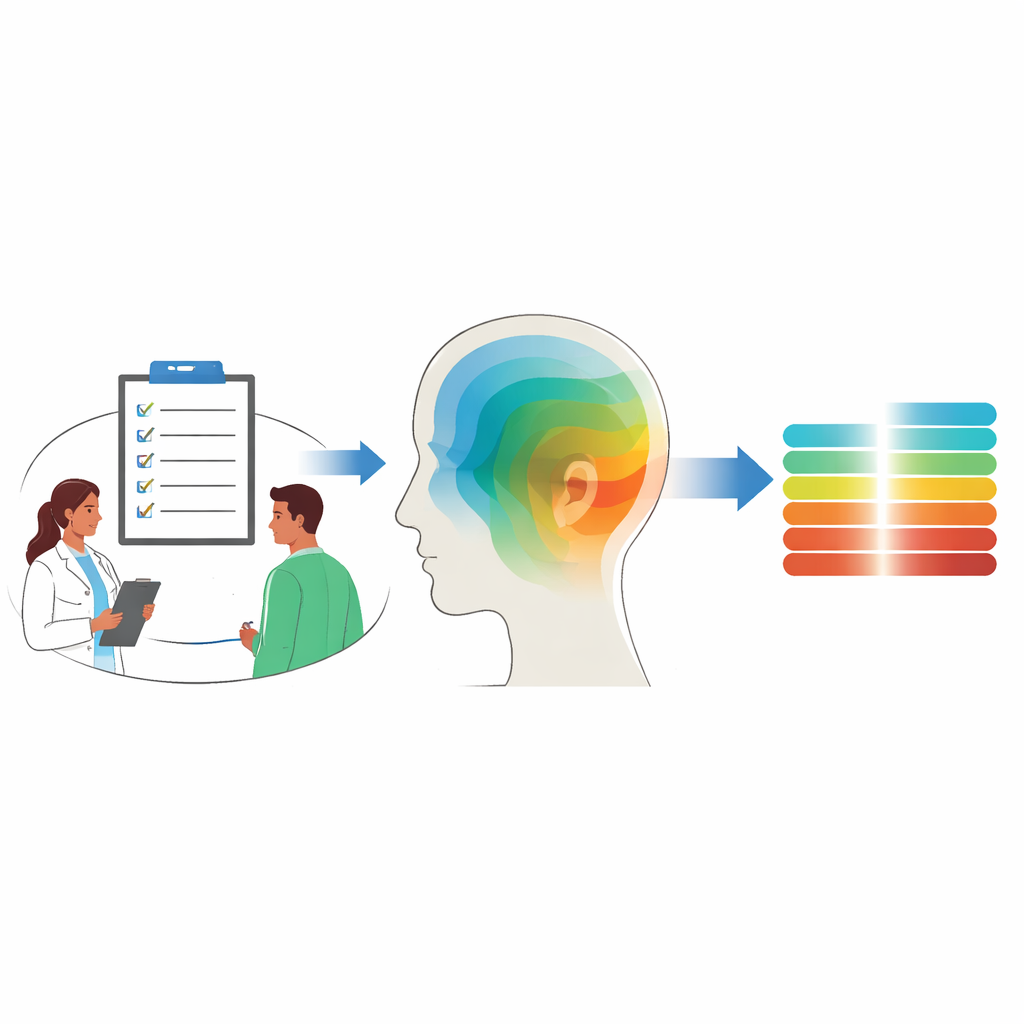
The team then put the Arabic VAGUS to the test in a psychiatric hospital near Beirut. They enrolled 121 adults diagnosed mainly with schizophrenia, many of whom had been ill and hospitalized for years. Each participant completed the self-report VAGUS form with help if needed, while clinicians used the companion version based on interviews and observation. The researchers also collected scores from another established insight scale and from a widely used checklist of schizophrenia symptoms. By repeating the VAGUS assessments in smaller subgroups over short time spans, and by having a second clinician re-rate some patients, they could see how stable and consistent the new Arabic version really was.
How well did the Arabic VAGUS perform?
The clinician-rated part of the Arabic VAGUS behaved like a single, coherent measure of insight and showed solid reliability: different raters reached similar conclusions, and repeated testing produced similar scores. The self-report side broke down into three related components, reflecting different shades of awareness, and its overall score was also stable over time, though one sub-area—how people explain their symptoms—was less consistent. Crucially, both versions of the VAGUS lined up well with the existing Arabic insight scale, but were only weakly linked to how severe the patients’ symptoms were. This suggests that the scale is really capturing insight itself, rather than simply mirroring how ill someone appears.
What this means for patients and clinicians
In everyday terms, the study shows that the Arabic VAGUS scale gives doctors and patients in Lebanon a quick, reasonably dependable way to talk about and measure a person’s awareness of their illness. While the self-report version still needs more testing in larger and more varied groups, both forms already offer a richer picture than older tools and can be used side by side to balance professional judgment with the patient’s own perspective. In a region where mental health resources and research tools have been scarce, this work is an important first step toward more tailored, culturally aware care for people living with schizophrenia.
Citation: Jalkh, C., Haddad, C., Sacre, H. et al. Arabic validation of the VAGUS insight into psychosis scale among Lebanese patients with schizophrenia. Sci Rep 16, 12425 (2026). https://doi.org/10.1038/s41598-026-42930-0
Keywords: schizophrenia insight, psychosis assessment, Arabic mental health, clinical scales, VAGUS validation