Clear Sky Science · en
Neuroergonomic evaluation of risk-warning eHMI penetration rates in vehicle platoons: effects on pedestrians’ mental workload, situation awareness, and gap acceptance
Why this matters for everyday street crossings
As cars learn to drive themselves, people on foot still have to make split-second decisions about when it is safe to cross the road. This study looks at a new kind of light signal on autonomous vehicles that warns pedestrians about crossing risk, and asks a simple but crucial question: does adding these signals actually make it easier and safer for people to decide when to cross—or can it sometimes make things more confusing?
New warning lights on self-driving cars
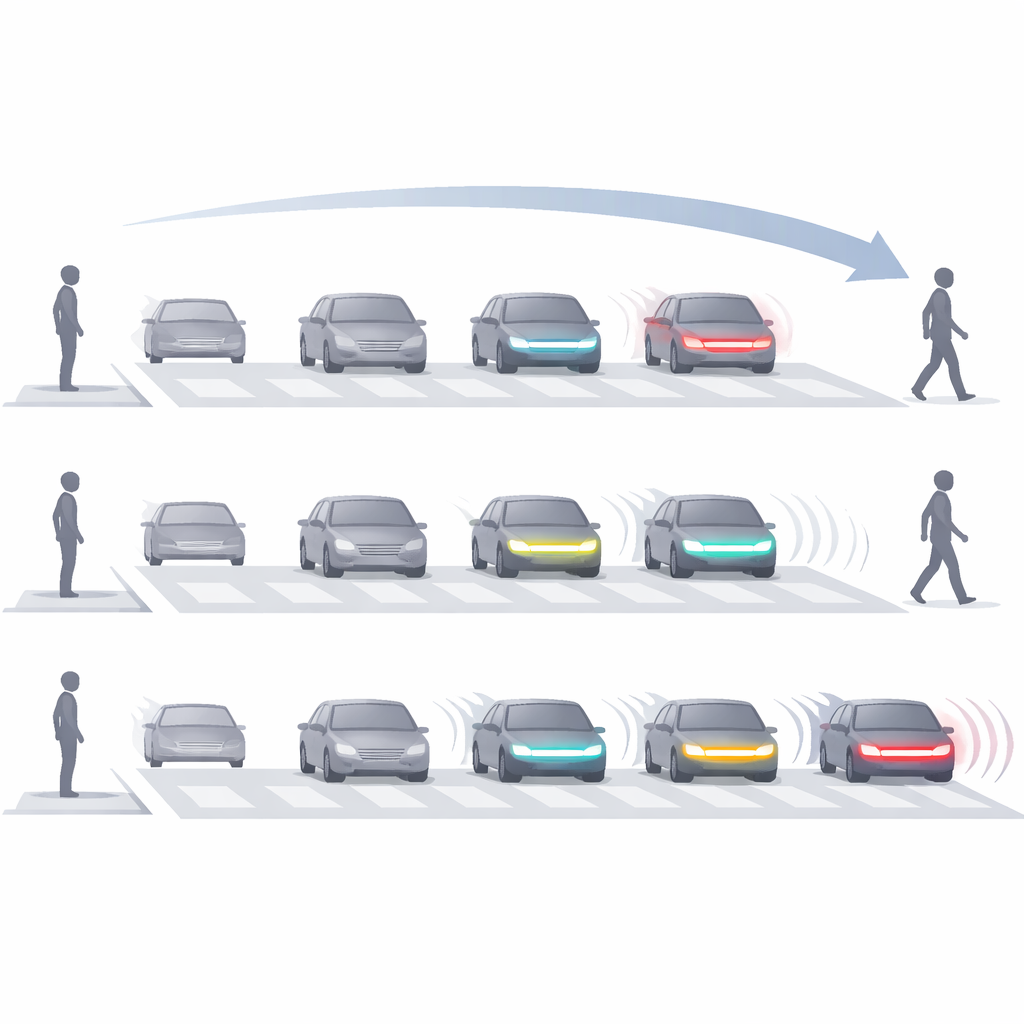
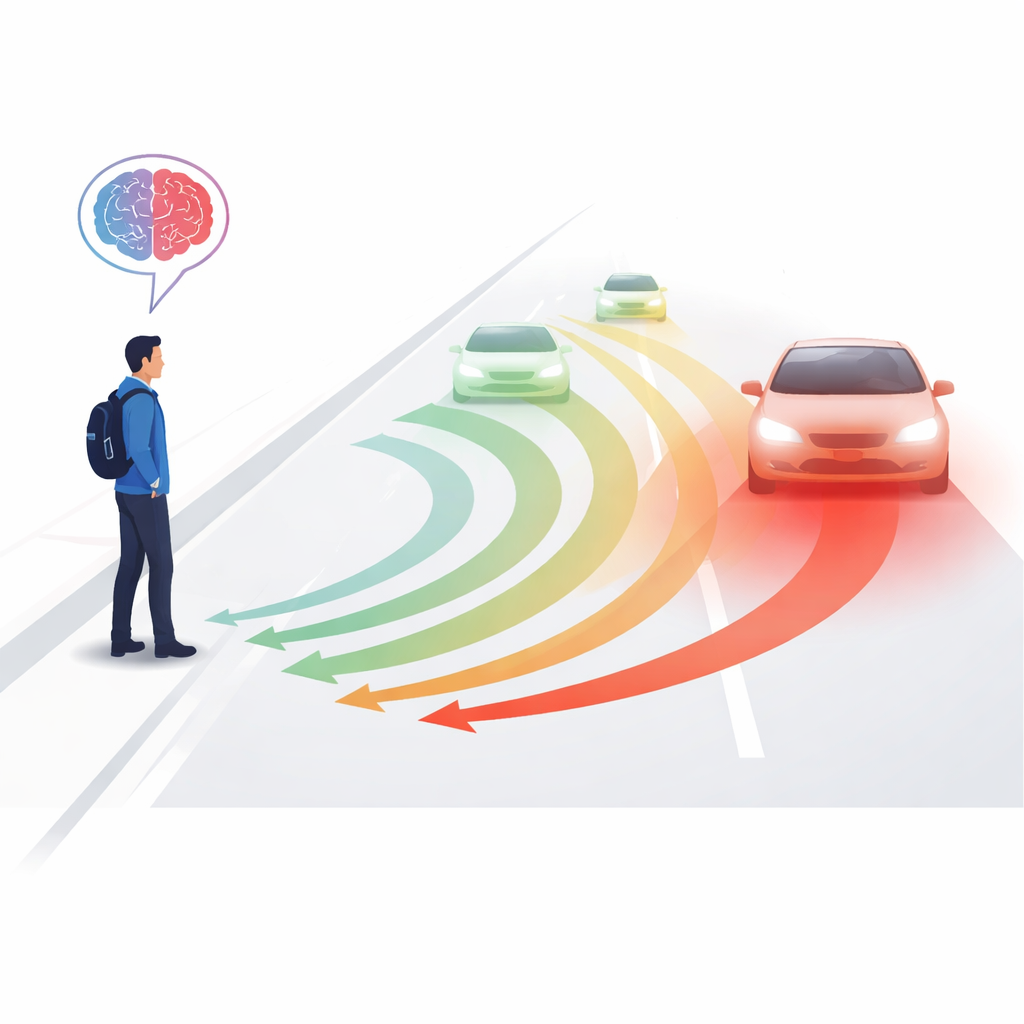
Self-driving cars at the highest automation levels may have no attentive driver for pedestrians to make eye contact with. To fill this communication gap, researchers have proposed "external" interfaces—lights on the outside of the vehicle that change color to show how risky it is to cross in front of the car. In this study, the lights turn green for low risk, yellow for medium risk, and red for high risk, based on how soon the car will arrive at the crossing. The team wanted to know how these signals affect the way people feel and think when judging gaps in traffic, especially when some cars have these lights and others do not.
Testing different mixes of cars on a busy road
To explore this, the researchers showed 24 volunteers realistic video scenes of a straight, two-lane road without traffic lights or crosswalks. From a fixed viewpoint on the curb, participants watched “platoons” of cars passing by and indicated whether they would cross in front of each one. The study compared three situations: no cars had warning lights, all cars had them, or only half of the cars had them, mixed randomly with regular cars. Vehicle speeds and the time gaps between cars were varied in a controlled way to mimic natural traffic. While choosing when to cross, participants also listened for rare high-pitched beeps in headphones and silently counted them, allowing the researchers to track how much mental effort the street-crossing task was using.
Looking inside the brain while people decide
Beyond asking people how demanding the task felt, the study used a brainwave method to get a more direct read on mental workload. Participants wore a cap with many electrodes that measured the brain’s electrical activity while they counted the beeps. A well-known brain signal called the P300 normally grows stronger when people have spare attention for a secondary task. If the crossing task is using up a lot of mental resources, the P300 signal in response to the beeps becomes smaller. After each traffic block, the volunteers also rated how clearly they understood what was happening on the road, how demanding the situation felt, and how much spare attention they still had—together forming a measure of their situation awareness.
When more signals help and when they hurt
The clearest pattern emerged when comparing the three levels of warning-light use across the vehicle platoons. When every autonomous car in the stream showed the risk-warning lights, people reported better understanding of the situation, felt less strained, and their brain signals indicated more spare attention. Importantly, they also used gaps in traffic more effectively: they were more likely to reject very small, risky gaps and more likely to take large, safe ones. This sharper sensitivity to gap size appeared without any measurable rise in mental workload compared with having no lights at all. In contrast, when only half of the cars carried warning lights and half did not, the picture worsened. Pedestrians crossed less often in front of the cars with lights, their brain signals showed higher mental workload, and their ratings revealed poorer awareness and fewer spare mental resources.
What this means for the future of city streets
To a non-specialist, the takeaway is straightforward: these new warning lights on self-driving cars can genuinely help pedestrians—if every such vehicle uses them in the same way. In a fully equipped traffic stream, the lights make it easier for people to judge which gaps are safe, without overloading their minds. But in a mixed world where some cars have the lights and others do not, the added information can actually make crossing decisions harder and more tiring. This suggests that careful planning, clear standards, and public education will be essential as cities roll out external signals on autonomous vehicles, so that these systems simplify rather than complicate everyday street crossing.
Citation: Yang, F., Sun, X., Ma, J. et al. Neuroergonomic evaluation of risk-warning eHMI penetration rates in vehicle platoons: effects on pedestrians’ mental workload, situation awareness, and gap acceptance. Sci Rep 16, 13582 (2026). https://doi.org/10.1038/s41598-026-42814-3
Keywords: autonomous vehicles, pedestrian safety, traffic signals, mental workload, human–machine interaction