Clear Sky Science · en
Optimization of hole quality in drilling of direct hot-pressed Al/SiC composites using Taguchi method
Why better holes matter in light metals
From aircraft wings to electric cars, engineers increasingly rely on lightweight aluminum parts that are bolted or riveted together. Every one of those fasteners needs a precisely drilled hole. If the hole is rough, oversized, or out of round, the joint can loosen, crack over time, or even fail. This study looks at a promising class of materials—aluminum reinforced with tiny ceramic particles—and asks a practical question: how can we drill clean, accurate holes in them reliably and efficiently?
Building tougher but lighter metal blocks
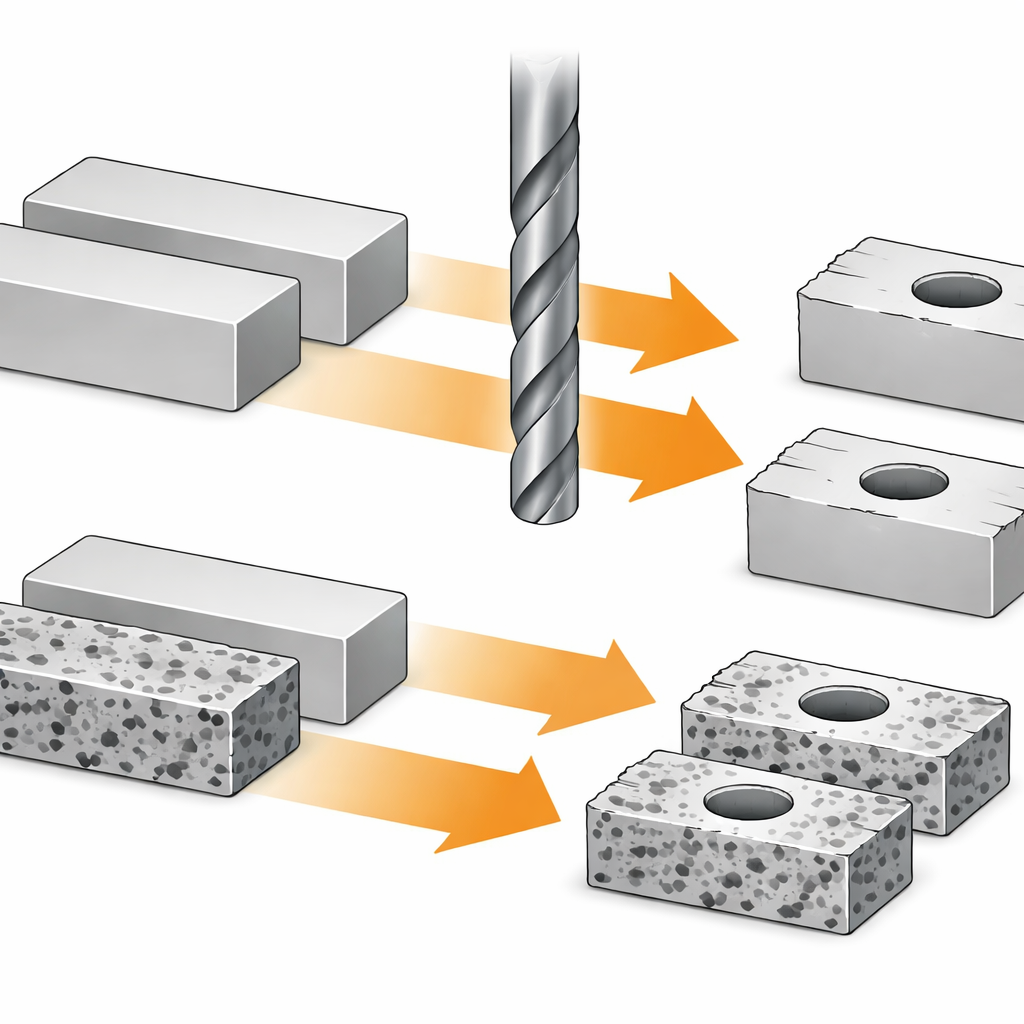
The researchers first manufactured aluminum blocks reinforced with different amounts of silicon carbide, a very hard ceramic also used in sandpaper. Using a solid-state technique called direct hot-pressing, they compacted aluminum and silicon carbide powders under heat and pressure to form dense composite slabs. Microscopy showed that the ceramic particles were spread fairly evenly through the metal, and X-ray analysis confirmed that no unwanted reaction compounds formed at the boundaries between the aluminum and the ceramic. Although adding more ceramic slightly increased internal pores and reduced overall density, it made the material significantly harder—by about one third at the highest particle content—because the hard grains block the tiny internal shifts that normally let metals deform.
Why drilling these materials is tricky
In real-world products, these composites must be drilled so bolts and rivets can pass through. But the same hard ceramic particles that strengthen the material are also abrasive, wearing out tools and roughening the hole. The team focused on four practical measures of hole quality: how much pushing force the drill needs, how smooth the inner surface is, how close the final diameter is to the intended value, and how round the hole remains. They drilled many test holes with ordinary high-speed steel drill bits while systematically varying cutting speed, how fast the drill advanced into the material, the tip angle of the bit, and how much ceramic was mixed into the aluminum.
Testing many conditions with fewer experiments
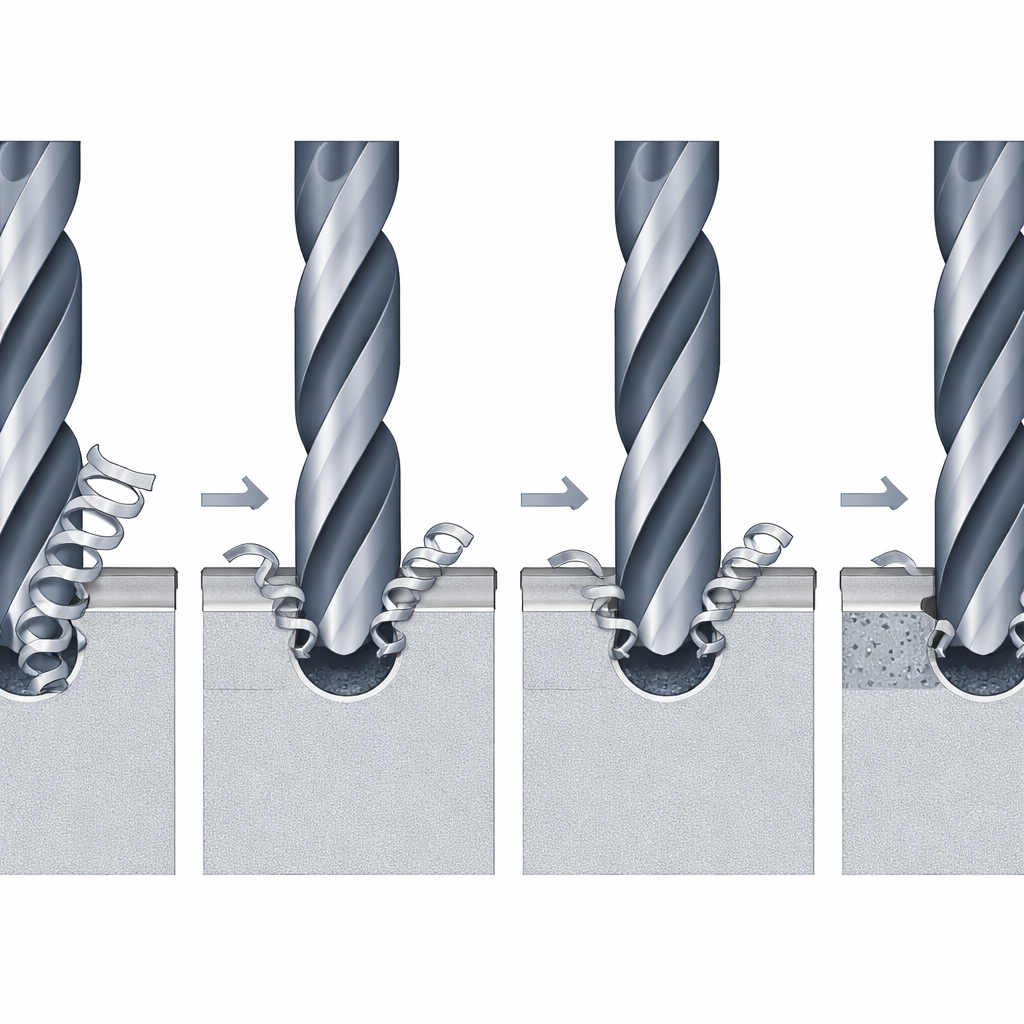
Rather than exhaustively testing every possible combination, the researchers used a statistical strategy called the Taguchi method. This approach arranges a carefully chosen subset of experiments so that the influence of each factor can still be teased apart. After each drilling test, they measured the pushing force with a force sensor, the surface smoothness with a profilometer, and the size and roundness with a precision coordinate measuring machine. They also inspected drill wear, the shape of the chips, and the burrs that formed where the drill exited the part. Then they used statistical tools to rank which settings mattered most and to build equations that could predict how a given drilling recipe would affect the four measures of hole quality.
What controls a good hole
The clearest message from the data is that the feed rate—the distance the drill advances per turn—is the dominant control knob. Higher feed rates dramatically increased the force on the drill, the roughness of the hole wall, and the errors in diameter and roundness. Cutting speed, drill tip angle, and ceramic content also played roles, but to a lesser extent and in different ways. Faster cutting tended to smooth the surface but slightly worsened geometric accuracy because of heat and vibration. A larger tip angle and more ceramic particles generally helped keep hole size and shape under control, and higher ceramic content also reduced burrs and long stringy chips by making the material behave less like soft, smear-prone aluminum and more like a brittle, easily fractured solid.
Finding the sweet spot for drilling settings
By combining their measurements with the Taguchi analysis, the team identified drilling conditions that jointly minimize force, roughness, diameter error, and out-of-roundness. The best overall recipes used a low feed rate with a steep drill tip and the highest ceramic content, with cutting speed adjusted depending on whether surface finish or dimensional precision was the main concern. When they tested these “optimal” settings in fresh experiments, the results matched the predictions within a narrow margin and showed substantial improvements in all four quality measures. For manufacturers, this means that high-performance aluminum–ceramic composites can be drilled to tight tolerances using conventional tools, provided that feed rate and drill geometry are chosen carefully. In practical terms, the work offers a roadmap for making lighter, stiffer components with drilled holes that last longer and fail less often in service.
Citation: Basar, G., Der, O., Kahraman, F. et al. Optimization of hole quality in drilling of direct hot-pressed Al/SiC composites using Taguchi method. Sci Rep 16, 13591 (2026). https://doi.org/10.1038/s41598-026-42714-6
Keywords: aluminium matrix composites, silicon carbide reinforcement, drilling optimization, hole quality, Taguchi design