Clear Sky Science · en
Electrical information flows across the sporocarps of two ectomycorrhizal fungi in the field
Mushrooms with Hidden Messages
On a walk in the woods, mushrooms can seem like simple decorations on the forest floor. This study suggests they may be more like the blinking lights on a buried circuit board. By listening to tiny voltage changes in wild mushrooms, the researchers found signs that fungi can send electrical information across underground networks, and that these signals change with shifts in moisture in surprisingly organized ways.
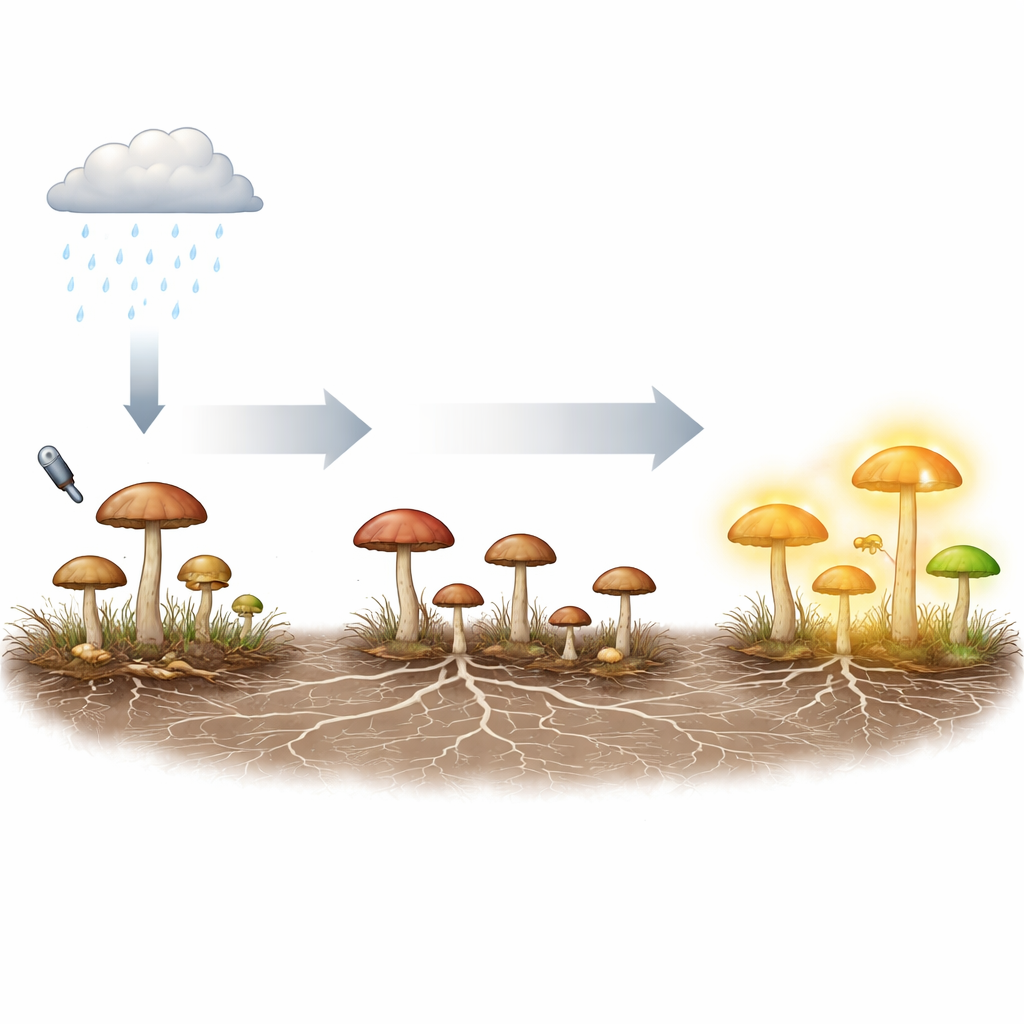
A Forest Floor Wired with Fungi
Many forest trees rely on fungi that wrap around their roots and spread out as fine threads through the soil. These threads move nutrients, water, and even chemical signals between partners. Earlier work in labs hinted that fungal networks might also carry electrical messages, but real-world evidence from natural forests was scarce. The team behind this paper set out to test whether mushrooms growing in the wild share electrical activity in a way that looks like information flow, and how that activity responds when the environment is nudged.
Turning the Woods into a Natural Laboratory
The researchers worked in an oak forest in northern Japan. Months before mushroom season, they added urea, a nitrogen-rich compound, to several patches of ground. This is known to encourage a group of species called ammonia-loving fungi to fruit later in the year. In autumn, the plan paid off: 37 mushroom bodies, or sporocarps, from two Hebeloma species popped up within a five-meter-square plot. Each mushroom was fitted with a pair of tiny medical electrodes, one in the cap and one in the stalk, to record the voltage difference every second for three and a half days without harming the forest floor.
Following Electrical Conversations Underground
The voltage in each mushroom rose and fell over time even when there was no visible disturbance, and these fluctuations were not random. Using a statistical approach borrowed from information theory, the team measured how much knowing the electrical pattern in one mushroom helped predict the pattern in another a few seconds later. This allowed them to map the direction and strength of “information flow” among all 37 sporocarps. Signals were not confined to mushrooms of the same genetic clone or even the same species, but they weakened with greater physical distance. Genetic differences within a species also mattered, hinting that related mushrooms may share more tightly coupled activity, possibly through a shared mycelial network beneath the soil.

Water Wakes Up the Network
To see how the network responds to change, the team carefully poured either tap water or human urine at the base of one chosen mushroom at several times, and once soaked all urea-treated areas with water. When a small amount of water was added locally, the strength of information flow between mushrooms spiked within about half an hour, suggesting that the network rapidly registered and spread the news of a wetter patch. In contrast, when the whole plot was watered, the coordination between mushrooms dropped: with everything suddenly moist, each fruit body appeared to react more independently. Urine, which slowly breaks down into ammonia, had little short-term effect on the shared electrical patterns during the few days of recording, likely because the chemical changes in the soil unfold much more slowly than the brief electrical spikes the electrodes captured.
What the Findings Mean for Forest Life
Taken together, the results support the idea that fungal mushrooms in a natural forest form a responsive electrical web that crosses both distance and species lines, and that this web becomes more or less coordinated depending on local conditions such as water availability. The study does not yet prove that these signals act like “language” with specific meanings, but it strongly suggests that underground fungal networks can rapidly sense and broadcast changes in their surroundings. Future work that connects these electrical shifts to concrete changes in growth, nutrient movement, or spore release may reveal that those quiet mushrooms at our feet are taking part in a dynamic, information-rich life hidden just below the surface.
Citation: Fukasawa, Y., Akai, D., Takehi, T. et al. Electrical information flows across the sporocarps of two ectomycorrhizal fungi in the field. Sci Rep 16, 12397 (2026). https://doi.org/10.1038/s41598-026-42673-y
Keywords: fungal networks, mushroom electricity, forest ecology, mycorrhiza, bioelectrical signaling