Clear Sky Science · en
Artificial intelligence-based intrusion detection and secure communication model for sustainable 6G-IoT networks
Why Smarter Networks Matter
Billions of everyday objects—from thermostats and traffic lights to medical devices and factory robots—are now online. As future 6G networks knit all these gadgets together, a single unnoticed digital break‑in could ripple into power outages, gridlock, or hospital disruptions. This paper introduces a new artificial‑intelligence system designed to spot and stop such attacks inside vast Internet‑of‑Things (IoT) networks before they cause real‑world damage.
Growing Risks in a Hyper-Connected World
Today’s wireless systems already support phones, sensors, and smart appliances, but 6G networks will go much further. They promise near‑instant response times, huge data speeds, and dense coverage for countless devices. That power comes with risk: more entry points for hackers, more traffic to analyze, and more complex patterns of normal and abnormal behavior. Traditional security tools that rely on fixed rules or simple statistics struggle to keep up with evolving threats, especially when attacks are subtle, rare, or disguised as ordinary traffic.
Teaching Machines to Spot Trouble
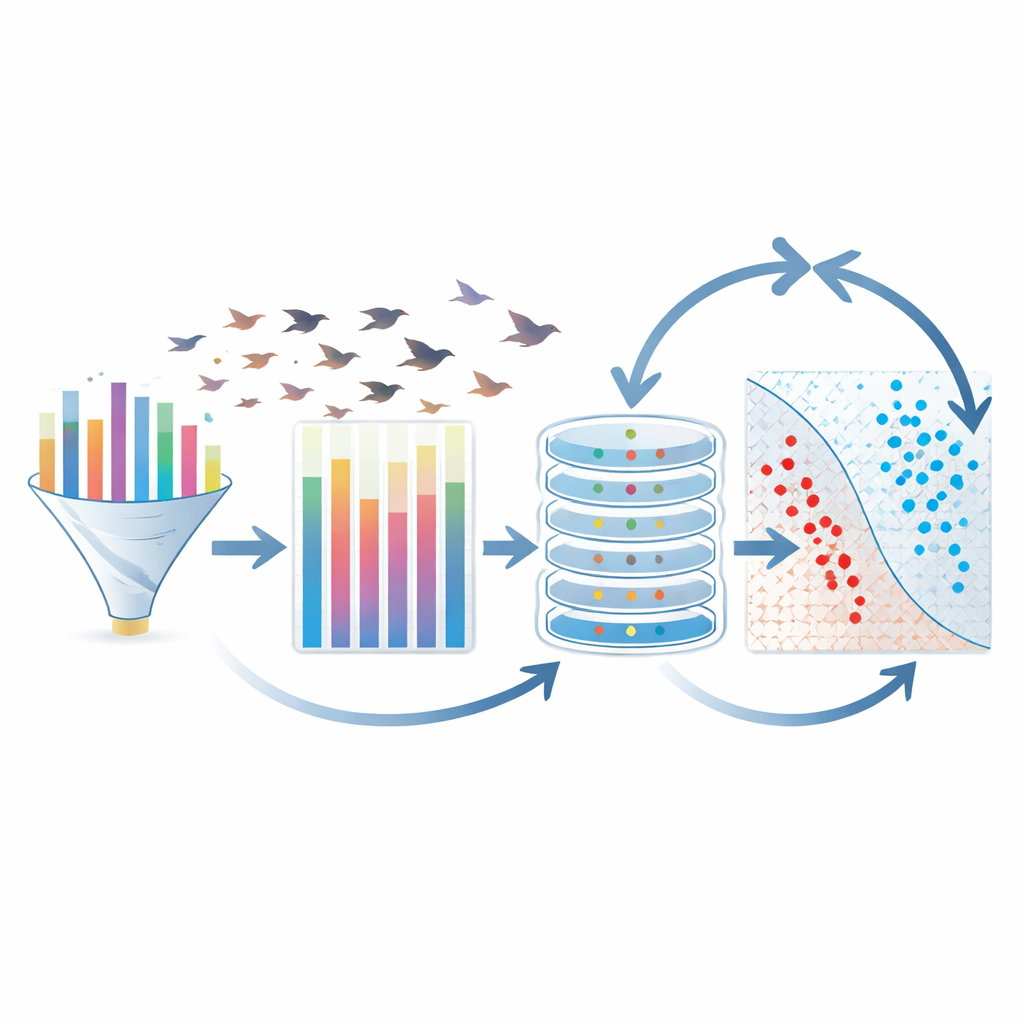
The authors propose an AI‑driven approach called AIBID‑SCSA to watch over 6G‑IoT traffic in real time. Instead of hand‑crafted rules, the system learns from data which patterns signal danger. It starts by putting all incoming measurements into a common numeric scale so that no single feature dominates just because it has larger values. Then it automatically chooses a compact set of the most informative signals from each connection—such as how often packets arrive or how they are routed—reducing noise and cutting the amount of computation needed. This focused view allows the AI engine to concentrate on the clues that matter most for distinguishing normal behavior from intrusions.

Following Digital Footprints Over Time
Attacks on modern networks often unfold as a sequence of steps rather than a single suspicious event. To capture this, AIBID‑SCSA uses a type of deep‑learning model that excels at understanding time‑ordered data, tracking how traffic evolves across many moments. This model effectively “remembers” what happened earlier while weighing new observations, allowing it to catch slow‑moving, multi‑stage intrusions and subtle anomalies that would escape snapshot‑based methods. By blending information that looks both backward and forward in a sequence, it can interpret the overall story of a connection instead of isolated frames.
Letting Algorithms Fine-Tune Themselves
Building such an intelligent guard requires many design choices: how large the model should be, how quickly it should learn, and how strongly it should be regularized to avoid overfitting. Rather than relying on trial‑and‑error by human experts, the researchers use a search strategy inspired by how animals explore their surroundings. This optimization layer automatically tests and adjusts the model’s internal settings, balancing broad exploration of possibilities with fine‑grained improvement around the best candidates. The result is a tuned detector that offers high accuracy without wasting computing resources—an important property for security components that may need to run on edge devices or busy gateways.
How Well Does It Work?
The team evaluated their system on several public intrusion‑detection datasets that simulate real 6G‑IoT conditions, including many types of attacks such as denial‑of‑service floods, password guessing, ransomware, and stealthy man‑in‑the‑middle behavior. Across these tests, AIBID‑SCSA consistently outperformed a wide range of existing machine‑learning and deep‑learning approaches, correctly classifying nearly all traffic with accuracy around 99% and keeping false alarms low. It also processed data faster than many competing models, suggesting that it can meet the low‑delay requirements of future high‑speed networks.
What This Means for Everyday Users
For non‑specialists, the key takeaway is that securing next‑generation networks will depend heavily on adaptive, learning‑based defenses rather than static firewalls alone. The AIBID‑SCSA framework shows that combining careful data preparation, smart feature selection, sequence‑aware deep learning, and automated tuning can yield an intrusion detector that is both precise and efficient. While the authors note that further testing on more diverse and adversarial data is needed before deployment, their work points toward future 6G‑IoT systems where embedded intelligence continuously watches over our connected devices—quietly blocking digital threats so that cities, homes, and hospitals can rely on their networks with greater confidence.
Citation: Assiri, M. Artificial intelligence-based intrusion detection and secure communication model for sustainable 6G-IoT networks. Sci Rep 16, 12662 (2026). https://doi.org/10.1038/s41598-026-42664-z
Keywords: 6G IoT security, intrusion detection, deep learning, network cybersecurity, smart devices