Clear Sky Science · en
Chronic high-altitude exposure and cognitive health in Chinese college students: a 4-year longitudinal neuroimaging study
Why Thin Air Matters for Young Minds
Each year, large numbers of students, soldiers, and workers move from low-lying cities to high mountain regions. While most people know that thin air can make you short of breath, far fewer realize it may also subtly change how the brain works and remembers. This study followed a group of Chinese college students for four years after they moved from near sea level to Tibet, asking a simple question with big implications: does long-term life at high altitude quietly chip away at young adults’ thinking speed and memory, and if so, what happens inside the brain?
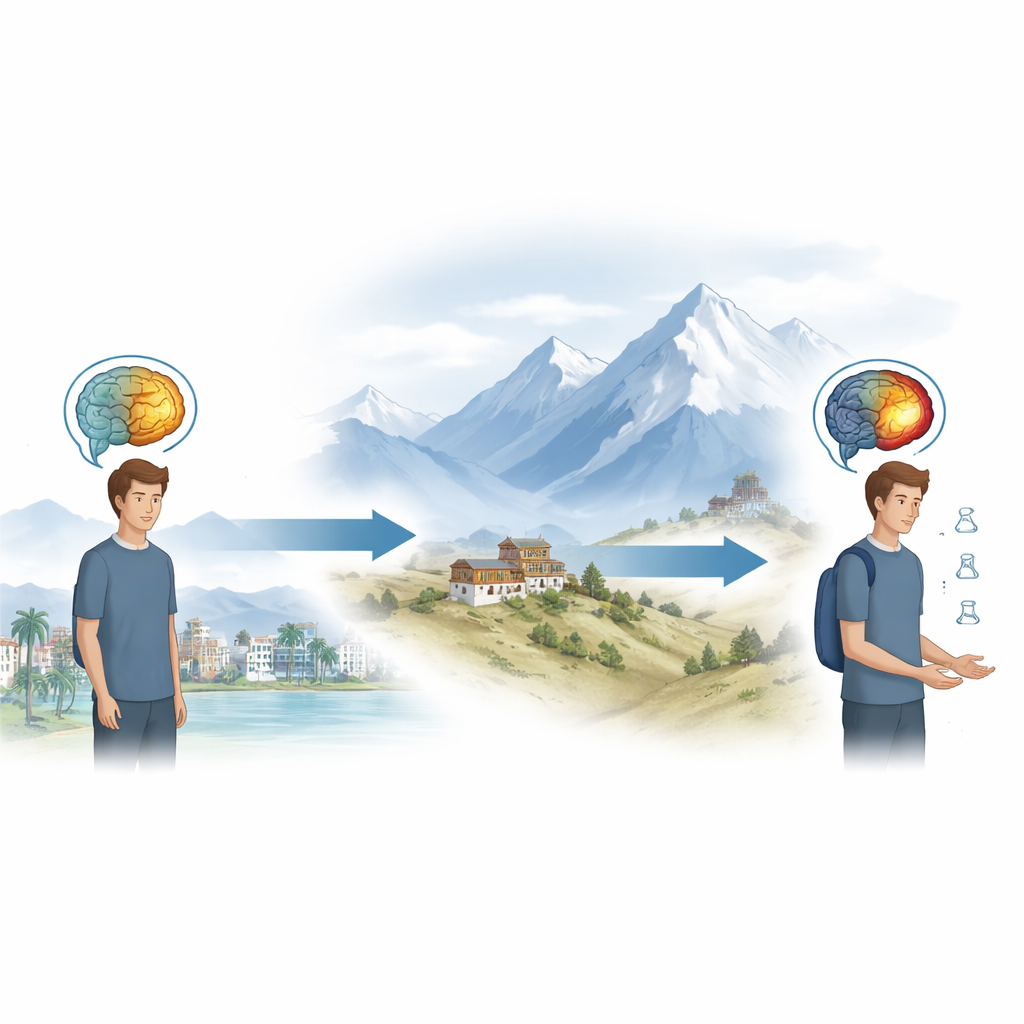
Following Students on Their Journey Upward
The researchers recruited 69 healthy high-school graduates from low-altitude regions who were about to start university in Lhasa, a city more than 3,600 meters above sea level. Before the move, the students completed detailed tests of memory and reaction speed and underwent brain scans using MRI. Over the next four years, the team checked in repeatedly: they repeated the thinking tests every year and performed follow-up brain scans at roughly two and four years after the move. To separate the effects of altitude from normal brain development in early adulthood, they also used existing MRI data from a matched group of students who stayed at low altitude.
Slower Thinking and Fading Scores
As the years at high altitude passed, the students’ mental performance showed a steady, worrisome drift. Scores on both verbal and visual memory tests declined compared with their own baseline before moving, and the drop appeared early and then persisted. At the same time, their reaction times—how quickly they could respond to simple sounds or images, or distinguish targets from distractors—grew longer year by year. Importantly, this pattern did not reverse with continued residence on the plateau, suggesting that the brain did not simply adapt back to its previous level of efficiency, at least within the four-year window of the study.
A Deep Brain Hub Under Strain
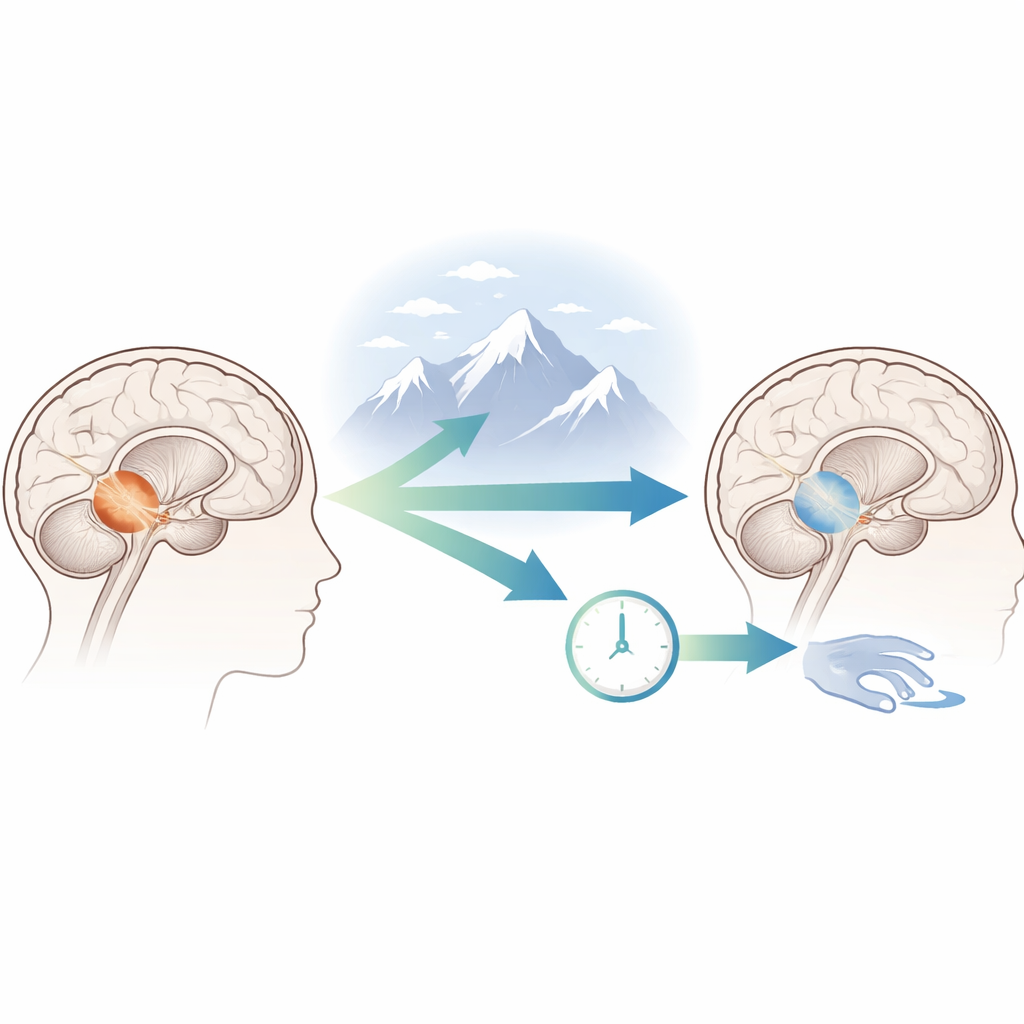
The MRI scans pointed to one deep structure as a common thread tying together these changes in memory and speed: the putamen, a small region buried near the center of the brain that helps link movement, learning, and cognitive control. While the outer layer of the brain did not show clear thickness changes, the volume of the putamen shrank over time in the students living at high altitude, especially on the left side. Students who lost more tissue in this area tended to show larger drops in immediate and delayed memory scores. Measures of the brain’s resting activity in the left putamen also shifted over the four years, first increasing, then decreasing, and these fluctuations tracked with changes in reaction time and memory performance.
Disrupted Brain Communication Networks
Beyond the size and baseline activity of the putamen, the study looked at how strongly this region communicated with other key areas while the brain was at rest. Connections between the left putamen and regions involved in attention and internal awareness—the anterior cingulate cortex and insula—grew weaker after two years at altitude, then partially strengthened by year four. These changing patterns of communication were linked to shifts in memory scores, suggesting that the brain may initially struggle and then attempt to rewire its networks in response to the long-term challenge of low oxygen. Statistical analyses further indicated that part of the impact of altitude on memory ran through changes in the left putamen: more time spent at high altitude was associated with smaller putamen volume, which in turn was associated with poorer verbal and visual memory.
What This Means for Life at the Top of the World
Taken together, the findings suggest that for otherwise healthy young adults, several years of living and studying at high altitude are not completely benign for the brain. The students showed persistent slowdowns in thinking speed and declines in memory that were mirrored by structural and functional changes in a key deep brain hub. While the study cannot prove permanent damage or rule out partial recovery after a return to lower elevations, it raises an important public-health message: when large numbers of students, workers, or service members move to high-altitude regions, their cognitive health deserves monitoring and support, just as much as their lungs and hearts. Simple screening and preventive strategies could help identify those most vulnerable and guide interventions to protect learning, safety, and long-term productivity in thin air.
Citation: Li, H., Zhang, Q., Zeng, S. et al. Chronic high-altitude exposure and cognitive health in Chinese college students: a 4-year longitudinal neuroimaging study. Sci Rep 16, 12539 (2026). https://doi.org/10.1038/s41598-026-42645-2
Keywords: high altitude, cognitive function, brain imaging, young adults, hypoxia