Clear Sky Science · en
Preventing chick culling in the poultry industry with a new biomarker for rapid in ovo gender screening
Why the fate of baby chicks matters
Every year, billions of male chicks from egg-laying breeds are killed shortly after hatching because they cannot lay eggs and are not profitable for meat. This practice is increasingly seen as unacceptable from an animal-welfare perspective. The study described here presents a way to tell whether a chick will be male or female while it is still developing inside the egg, early enough to avoid pain and to prevent hatching chicks that will later be culled. By discovering a new chemical signal and building an ultra-fast testing system around it, the researchers show how technology could transform how the poultry industry handles eggs.
A problem hidden in the breakfast aisle
Eggs are among the most widely eaten foods on Earth, with well over a trillion produced each year. To keep supermarket shelves full, hatcheries must constantly raise new laying hens. But the males of these specialized egg-laying breeds grow slowly and do not provide enough meat to be valuable. Today, eggs are incubated, chicks hatch, workers determine their sex by hand, and male chicks are killed using methods such as grinding or gas. Growing concern for animal welfare and new legislation in several countries are putting pressure on the industry to find humane, economically realistic alternatives.
Looking inside the egg without harming it
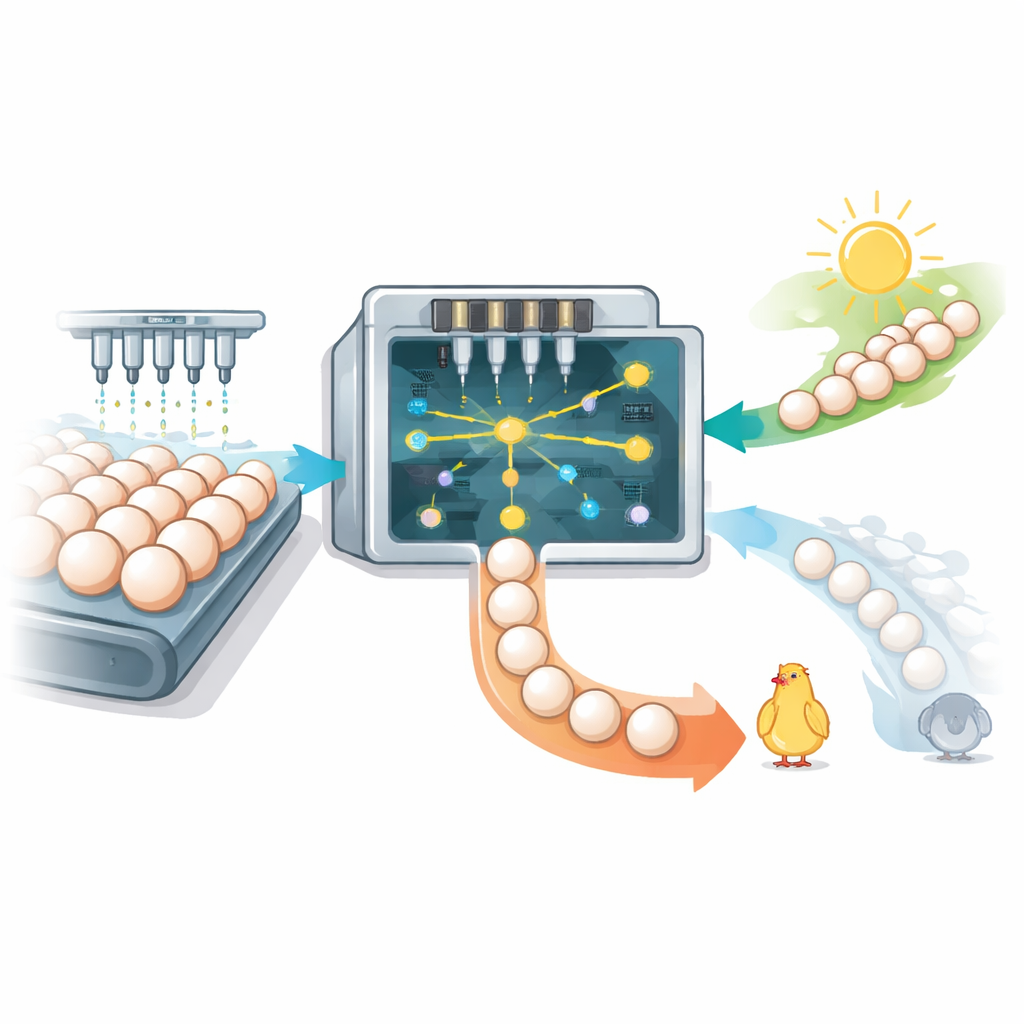
One promising idea is to determine the sex of the embryo while it is still in the egg and before its nervous system is developed enough to feel pain, roughly within the first 11 days of incubation. The authors focused on the allantoic fluid, a liquid-filled sac inside the egg that handles gas exchange and waste, and can be reached by a small puncture through the shell without harming the embryo. Using a broad, untargeted chemical survey with high-resolution mass spectrometry, they screened thousands of molecular signals in this fluid from eggs at several early days of development, searching for differences between male and female embryos.
Finding a chemical signature of sex
From nearly 2,000 detected signals, the team narrowed down one particularly strong candidate, a small molecule they eventually identified as 3-[(2-aminoethyl)sulfanyl]butanoic acid, or ASBA. Eggs carrying female embryos consistently had lower levels of ASBA than those with males, especially around day 9 of incubation, a time point that meets ethical guidelines. This difference held true across two different commercial chicken lines, brown and white egg layers, allowing the same cut-off level to be used regardless of breed. Statistical models based on ASBA levels correctly predicted sex for close to 9 out of 10 eggs in these early experiments, suggesting that this single molecule could serve as a reliable biological marker.
Turning a discovery into a factory-ready test
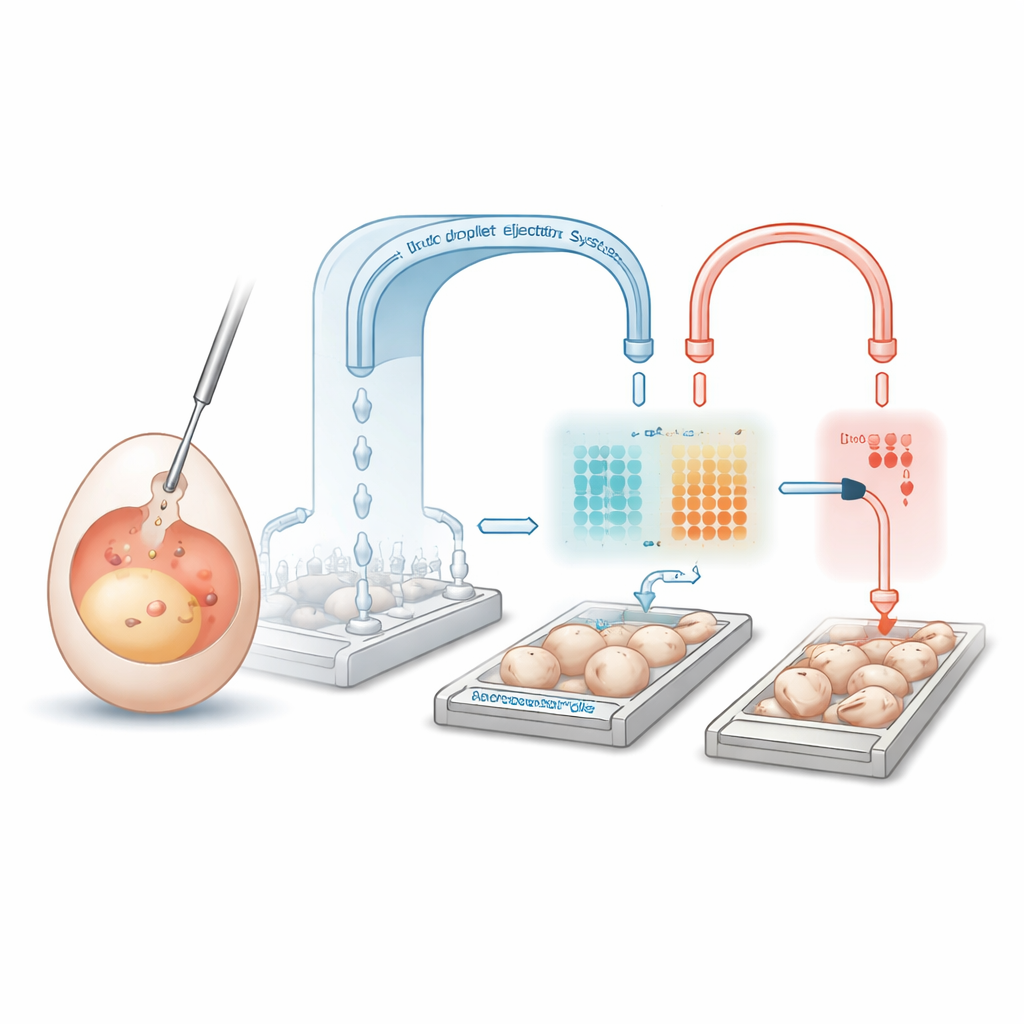
To be practical in real hatcheries, a test must be fast, cheap, and accurate at the scale of tens of millions of eggs per year. Conventional laboratory instruments would be far too slow, so the researchers optimized a technology called acoustic droplet ejection mass spectrometry (ADE-MS). In this setup, a sound pulse launches tiny droplets of allantoic fluid from microplates into a flowing stream that carries them directly into the mass spectrometer at several samples per second. The team refined every step: robotic sampling from eggs, automatic mixing with a stable reference compound, careful control of droplet formation, and custom software to separate the continuous data stream into individual egg results. They also developed a “dynamic” decision rule that adjusts the sex-determination threshold based on the distribution of ASBA levels in each plate, improving robustness to day-to-day variation.
What this means for animals and farms
With their optimized workflow, the authors could analyze more than 1,800 egg samples per hour on a prototype system and correctly predict the sex of day-9 embryos with about 95.5% accuracy. While this is slightly below the roughly 99% accuracy achieved by skilled human chick sexers, the method operates much earlier in development and completely avoids hatching unwanted male chicks. The researchers argue that further automation, parallel instruments, and possibly combining ASBA with additional markers could push both throughput and accuracy to levels suitable for routine use in large hatcheries. If widely adopted, such in-egg testing could dramatically reduce the number of male chicks that are culled, shifting an ethically troubling but largely invisible cost of egg production toward a more humane, technology-enabled solution.
Citation: Drouin, N., Elfrink, H.L., Bruins, W. et al. Preventing chick culling in the poultry industry with a new biomarker for rapid in ovo gender screening. Sci Rep 16, 11987 (2026). https://doi.org/10.1038/s41598-026-42524-w
Keywords: in-ovo sexing, poultry welfare, mass spectrometry, biomarker screening, egg hatchery technology