Clear Sky Science · en
Surface hardening of a mould steel by laser quenching
Stronger tools for everyday products
From car bumpers to phone cases, many plastic objects are born in steel moulds that must withstand millions of production cycles. When these moulds wear out, factories face costly downtime and replacement. This study explores how a focused laser beam can quickly harden just the outer skin of a commonly used mould steel, making it tougher against wear while keeping the interior tough and crack‑resistant. The work points toward faster, more precise treatments that could extend tool life and reduce waste in mass manufacturing.
A high-tech way to toughen steel
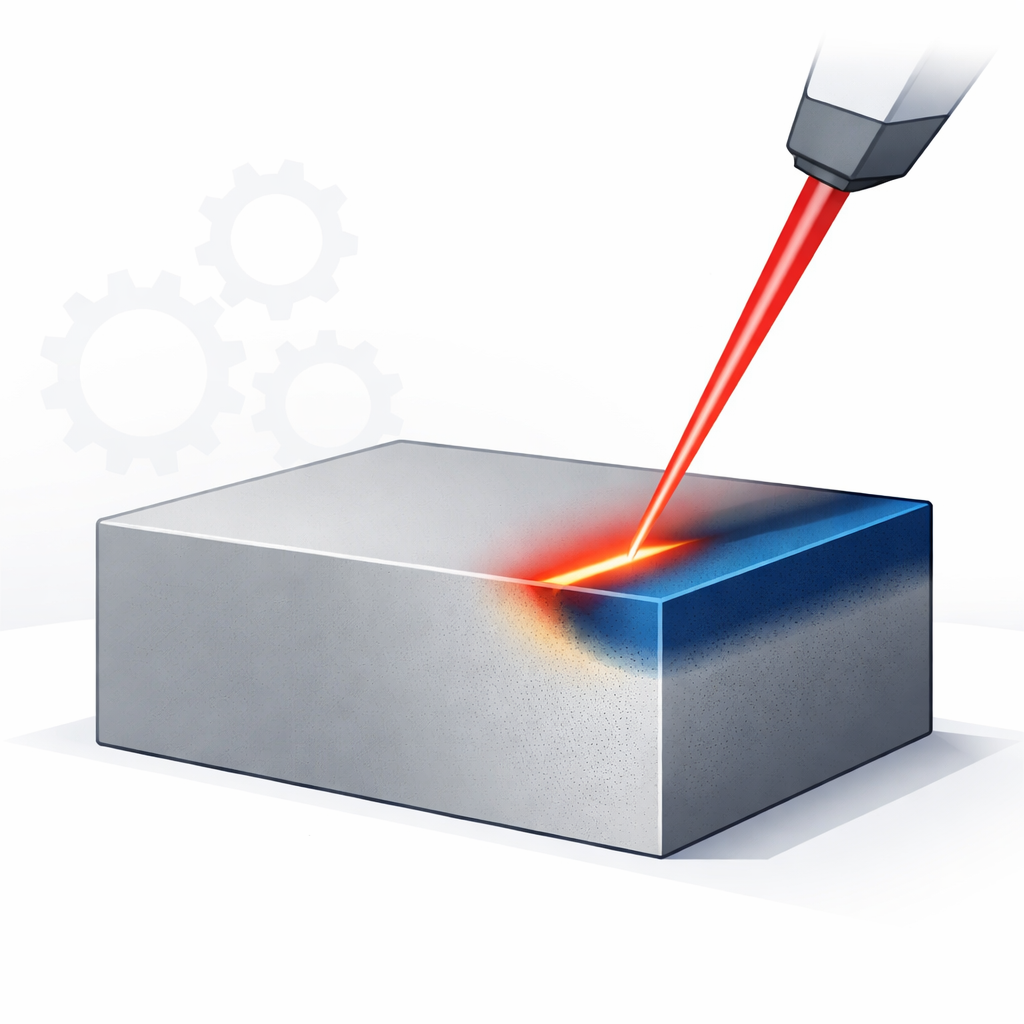
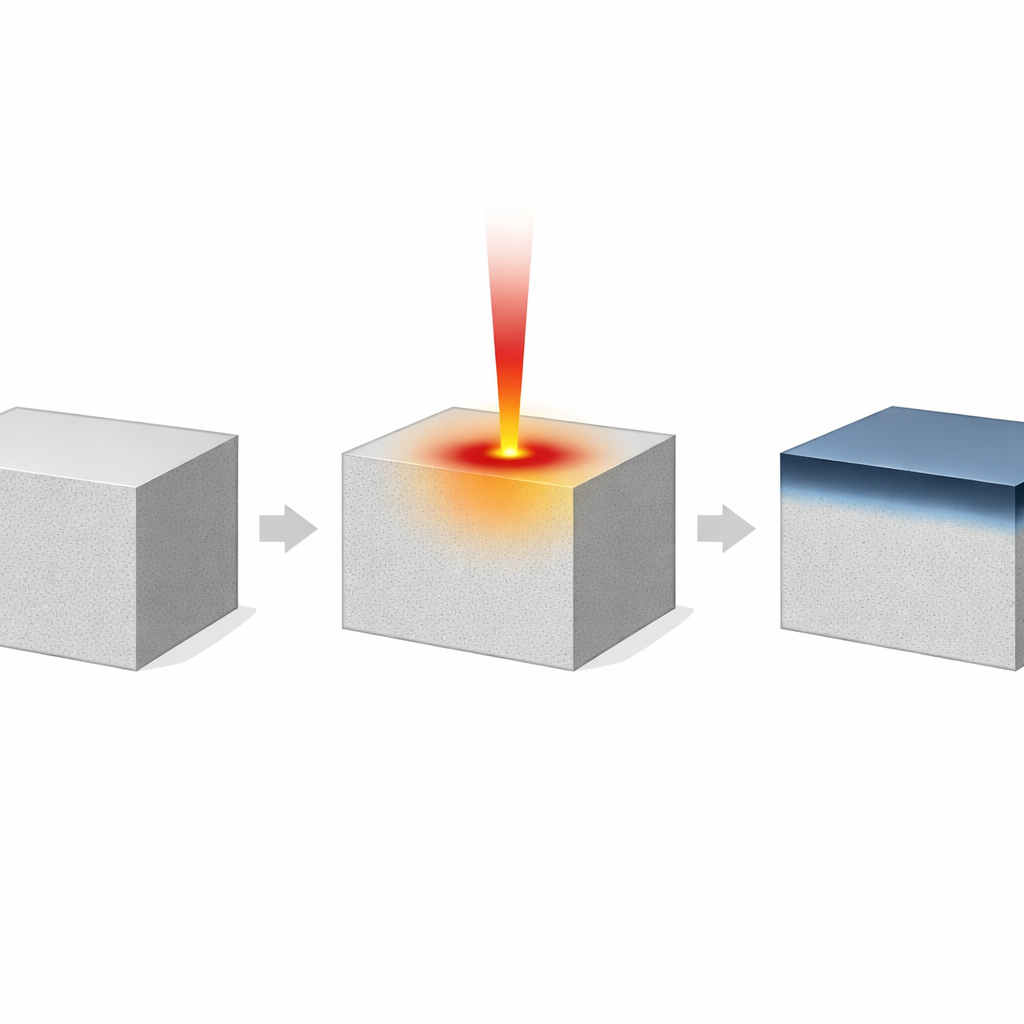
Traditional hardening of steel involves heating entire parts in a furnace and then cooling them rapidly. While effective, this can warp complex shapes and leave behind internal stresses that weaken components. The researchers instead tested “laser quenching,” in which a powerful diode laser sweeps over the surface of a P20+S mould steel block. The laser rapidly heats only a thin outer layer, which then cools quickly into a very hard structure, while the bulk of the steel stays relatively cool and ductile. This localized approach promises better control, less distortion and surfaces that often require no extra polishing.
How the tests were carried out
The team varied two main settings during laser treatment: the surface temperature (either about 1000 °C or 1200 °C) and how much neighbouring laser tracks overlapped (10% or 25%). They then examined cross‑sections of the treated zones under optical and electron microscopes and used X‑ray diffraction to identify crystal structures. To quantify how much harder the surface became, they performed nanoindentation, pressing a tiny diamond tip into the material at many points from the surface down into the interior. Finally, they tested wear resistance using a pin‑on‑disk setup, in which a ceramic ball slid thousands of times over the steel surface while the resulting grooves and friction were measured.
What happens inside the steel
Before treatment, the P20+S steel showed a typical mixture of softer ferrite and harder pearlite. After laser quenching, this microstructure disappeared at the surface, replaced by a much harder phase consistent with martensite, a needle‑like arrangement of atoms known for its high strength. Surface hardness more than doubled—from about 3.4 gigapascals in the untreated steel to roughly 8–9 gigapascals after laser quenching. At 1000 °C, this hardened layer reached depths just under 700 micrometres; at 1200 °C, it extended to nearly 1400 micrometres, creating a deep, hard shell over a softer, unchanged core. Changing the overlap between laser tracks mainly affected how wide the treated region was, not the hardness itself, and the overlap zones remained as hard as the rest of the treated surface.
Harder is not always more durable
Although higher temperature produced a deeper and slightly harder layer, it also encouraged the growth of a thicker oxide film on the surface. During wear tests, this brittle oxide repeatedly detached, exposing and damaging the hardened steel underneath. As a result, the sample treated at 1200 °C showed the highest wear volume and a more erratic friction signal, dominated by adhesive wear where bits of material stuck and tore away. In contrast, the steel treated at 1000 °C formed a much thinner oxide layer. When small patches of it broke off under sliding, the underlying martensitic layer continued to protect the surface, so overall wear stayed closer to that of the untreated steel despite the much higher hardness.
What this means for industry
The study demonstrates that laser quenching can rapidly create a hard, wear‑resistant shell on mould steels while keeping their cores tough and dimensionally stable. By tuning laser temperature and track overlap, manufacturers can control how deep this hardened layer extends, though excessively high temperatures may harm wear performance by building fragile oxide films. Overall, the results support laser quenching as a promising, industry‑ready alternative to conventional furnace treatments for tools and moulds, potentially extending their service life and improving the reliability of high‑volume plastic production.
Citation: Rodrigues, F.M., Gonçalves, F., Cavaleiro, D. et al. Surface hardening of a mould steel by laser quenching. Sci Rep 16, 12917 (2026). https://doi.org/10.1038/s41598-026-42194-8
Keywords: laser surface hardening, mould steel, wear resistance, heat treatment, industrial tooling