Clear Sky Science · en
Immediate effects of real time feedback and kinesiotaping on kinematics and muscle activity in athletes with dynamic knee valgus
Why this matters for active people
Jumping and cutting sports like basketball, volleyball, and handball are thrilling—but they put serious strain on the knees. One common problem is the knee collapsing inward when landing from a jump, a fault linked to painful ligament tears, especially of the anterior cruciate ligament (ACL). This study asks a practical question that matters to athletes, coaches, and therapists: can a simple combination of mirror-based feedback and stretchy tape on the knee immediately improve landing technique and muscle use in young athletes who already show this risky movement pattern?
The problem of the inward-dropping knee
When an athlete lands from a jump on one leg, the hip, knee, and ankle should bend and share the impact forces. If the hip muscles are not controlling the thigh well, the knee can drop inward toward the other leg, a pattern called dynamic knee valgus. This inward collapse increases twisting and side-to-side forces on the knee and can overload the ACL. Past research shows that athletes who land with straighter legs, limited hip and knee bend, and a pronounced inward knee motion are at higher risk of ligament injury. Because many ACL tears happen during single-leg landings, spotting and correcting this pattern in training is a priority.
Two simple tools: mirrors and stretchy tape
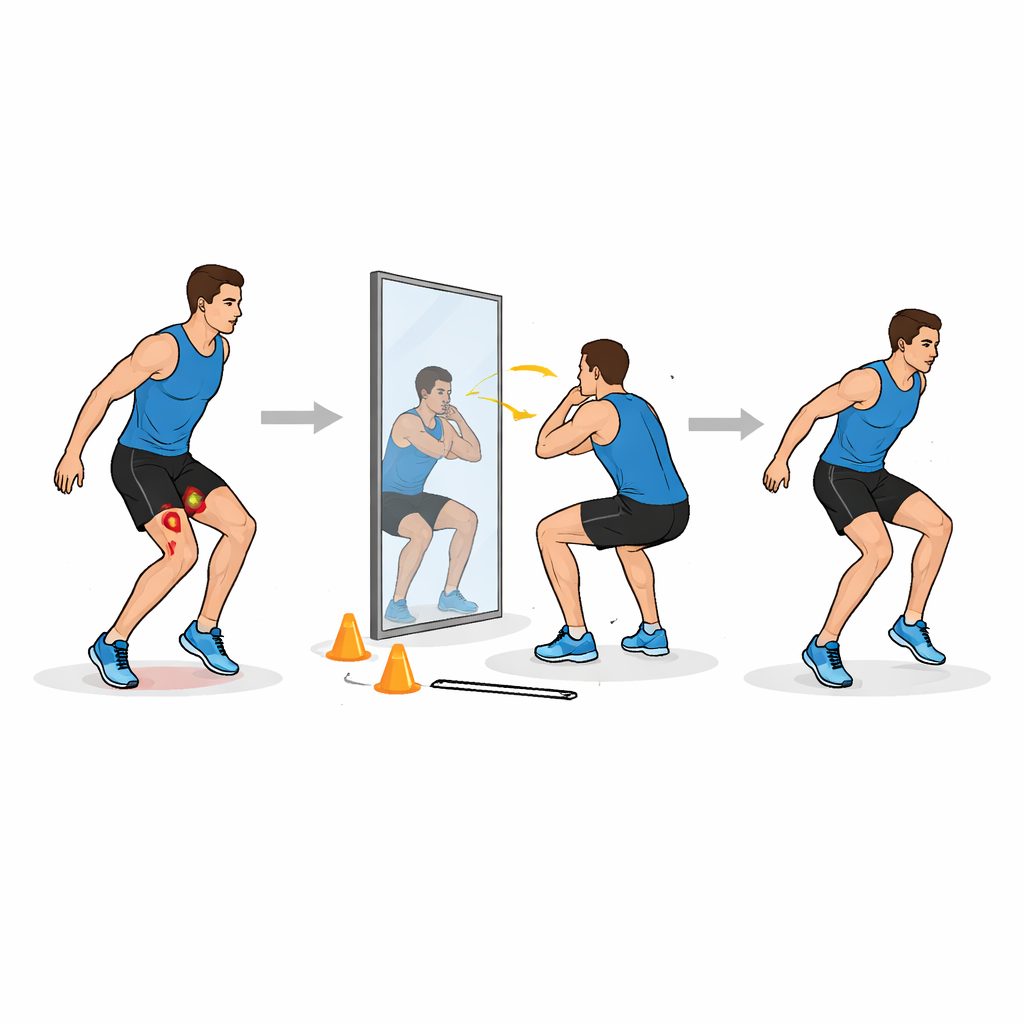
The researchers tested two widely used tools: real-time visual feedback and Kinesio taping. Real-time feedback meant athletes performed squats and step-downs in front of a full-length mirror with a vertical center line. A specialist gave them verbal cues to keep the working knee from crossing the body’s midline. Kinesio tape is an elastic strip applied along the front and sides of the knee, designed to gently guide motion and heighten skin sensation, which may help muscles switch on more effectively. Thirty-four young male athletes who played jumping sports and already showed more than ten degrees of inward knee movement during landing were randomly assigned either to mirror-feedback alone or to mirror-feedback plus taping.
How the study was done
Before training, each athlete completed a single-leg vertical drop jump: stepping off a small box, landing on one leg, jumping up, and landing again. Tiny motion sensors on the pelvis, thigh, shin, and foot measured hip, knee, and ankle angles. Sticky electrodes recorded muscle activity from key hip and thigh muscles, including the side-hip muscles that lift the leg outward and the inner portion of the front-thigh muscle that helps guide the kneecap. After this pre-test, both groups performed a short series of four exercises—bilateral squats, single-leg squats, forward step-downs, and lateral step-downs—using the mirror and verbal cues. Only the combined group had their knee taped before these drills. Then everyone repeated the jump test so the team could see how joint angles and pre-landing muscle activity changed right away.
What changed in joint motion and muscles
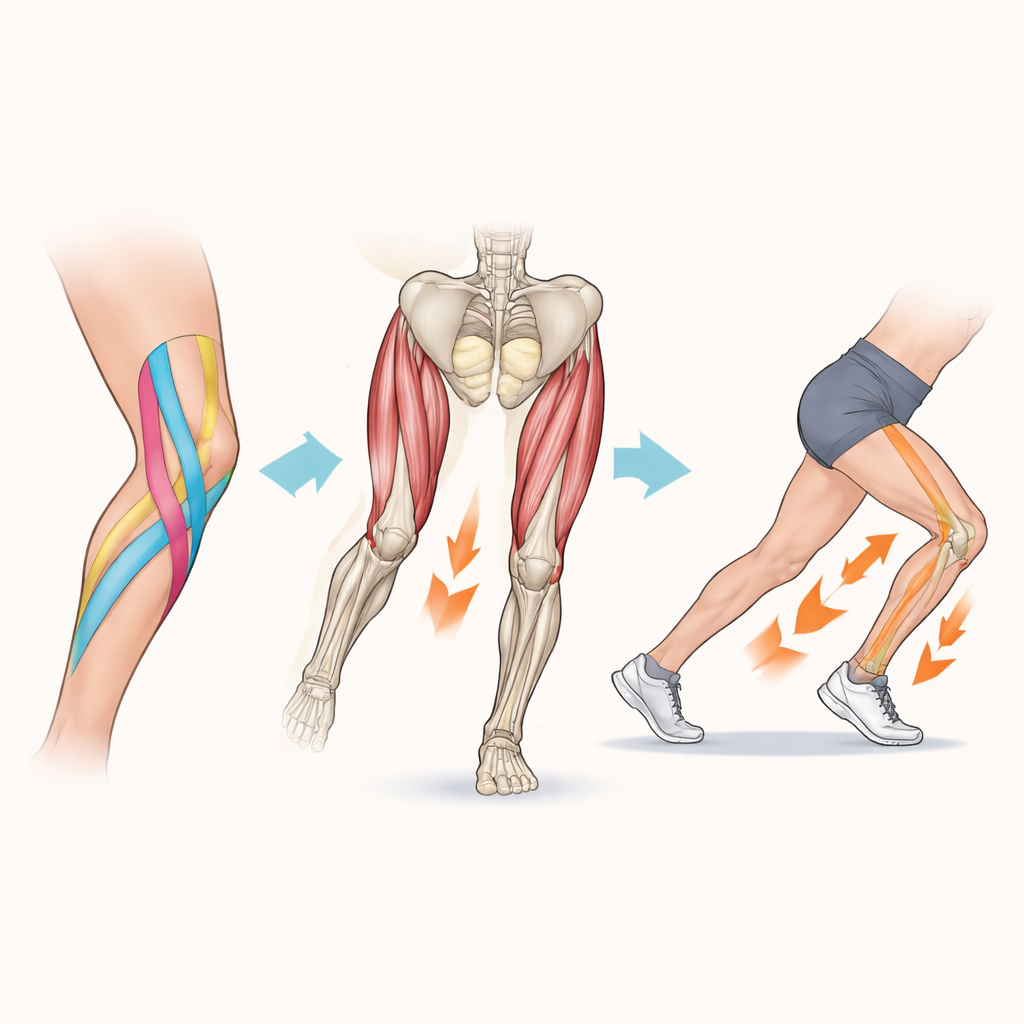
Both groups showed immediate improvements after this brief training session. Athletes bent more at the hip and knee and allowed more ankle bend when landing, all of which help absorb impact and reduce strain on the ACL. The inward knee angle dropped sharply in both groups, meaning the landing position grew safer. Muscle recordings showed stronger preparatory activation in the big hip extensor, the hamstrings at the back of the thigh, and both sides of the front-thigh muscles. These changes suggest the body was better “bracing” for impact before the foot hit the ground, a sign of improved neuromuscular control that can shield the knee from sudden forces.
The extra boost from adding tape
Although mirror feedback alone was beneficial, adding Kinesio tape provided an extra push in some key areas. The taped group increased their peak knee bend during landing more than the untaped group, adopting a softer, more flexed position known to reduce ACL loading. They also showed larger gains in pre-landing activity of the side-hip muscle and the inner portion of the front-thigh muscle, both important for keeping the knee aligned over the foot. In contrast, improvements in inward knee position, hip bend, ankle bend, and activation of other muscles were similar with or without tape, suggesting that the basic mirror-feedback program was doing much of the work.
What this means for protecting knees
For athletes with an inward-dropping knee pattern, a simple session of mirror-based landing exercises can immediately shift them toward safer mechanics and better muscle preparation during a demanding single-leg jump. Adding elastic tape around the knee appears to fine-tune this effect by encouraging deeper knee bend and stronger activation of specific stabilizing muscles. In practical terms, real-time visual feedback is a solid, low-cost core strategy for refining movement, and pairing it with Kinesio taping may offer additional, targeted benefits for athletes at risk of ACL injury.
Citation: Gheibi, T., Firouzjah, E.M.A.N., Ghanati, H.A. et al. Immediate effects of real time feedback and kinesiotaping on kinematics and muscle activity in athletes with dynamic knee valgus. Sci Rep 16, 11468 (2026). https://doi.org/10.1038/s41598-026-41823-6
Keywords: ACL injury prevention, jump-landing mechanics, kinesio taping, real-time feedback, dynamic knee valgus