Clear Sky Science · en
A damage constitutive model of carbonaceous shale containing a single crack under drying-weting cycles and triaxial compression
Why Cracked Rock on Slopes Matters
Many highways, rail lines, and dams in mountainous regions are cut into slopes made of a dark, brittle rock called carbonaceous shale. When this rock is crisscrossed by cracks and repeatedly exposed to drying and wetting—such as during seasonal rains—it gradually weakens. That hidden weakening can set the stage for collapses and landslides. This study develops a mathematical way to describe how such cracked shale gradually loses strength under changing moisture and underground pressure, helping engineers better predict long‑term slope stability.
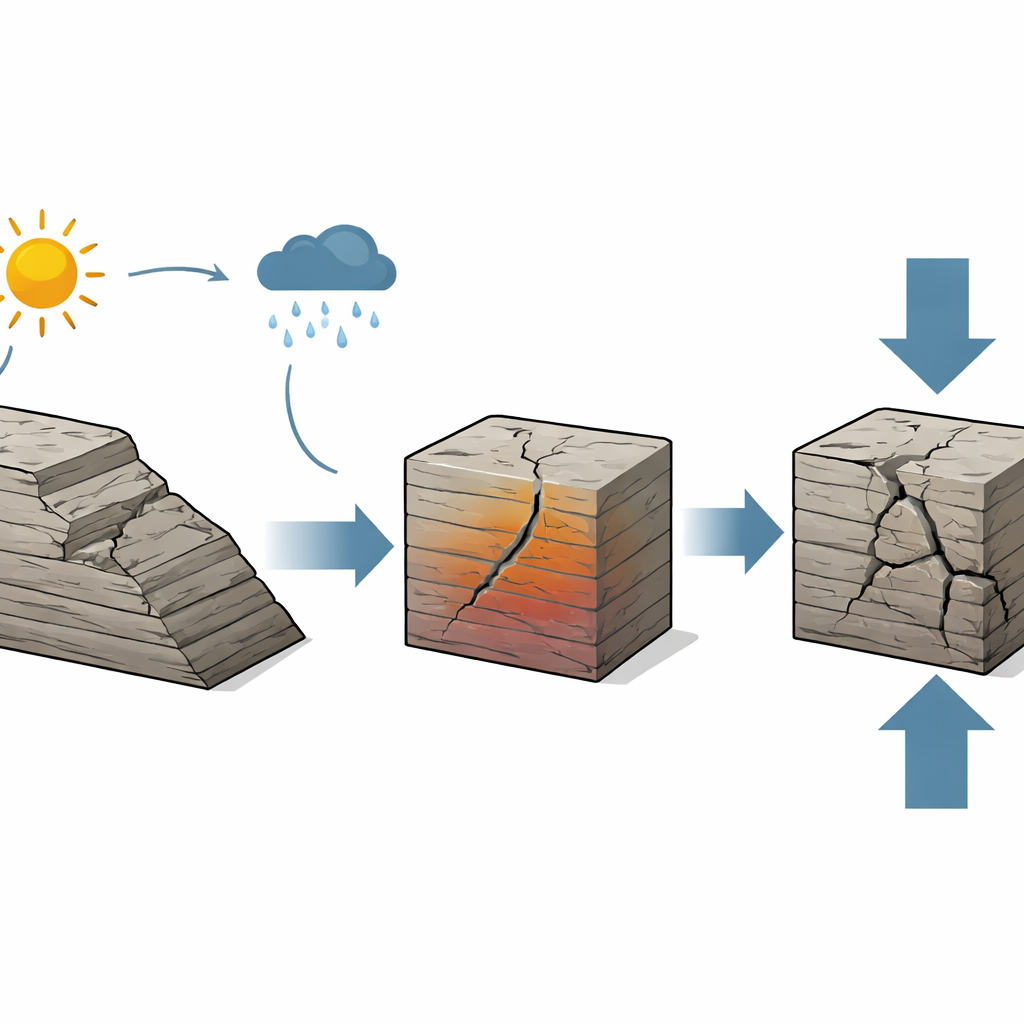
Rock That Breathes Water In and Out
Carbonaceous shale is common in engineering projects and is notorious for its sensitivity to water. As it repeatedly dries out and then soaks up moisture again, its internal pores expand and connect, and existing cracks can grow. The authors note that this cycling steadily reduces the rock’s strength and stiffness, which in turn lowers the safety margin of slopes and underground works. Earlier research had explored how wet–dry cycles damage rocks and how cracks or joints weaken them, but no single description captured all the key influences at once: moisture cycling, crack orientation, and the confining pressure from surrounding rock.
Testing Cracked Shale Under Realistic Conditions
To tackle this gap, the researchers first carried out a series of laboratory tests on blocks of carbonaceous shale, some intact and some containing a single artificial crack cut at different angles. These samples were subjected to different numbers of drying–wetting cycles, then compressed under various confining pressures that mimic the weight of overlying rock. From the resulting stress–strain curves—graphs that show how much the samples deform as the load increases—they observed clear patterns. More drying–wetting cycles shifted the curves downward, indicating weaker rock, while higher confining pressure shifted them upward, revealing a strengthening, ductile effect. The angle of the crack controlled how easily the sample failed, with a 45‑degree crack causing the greatest weakening.
Building a Damage Roadmap Inside the Rock
Using these experimental observations, the team constructed a step‑by‑step damage model that separates three contributions: microscopic damage from drying–wetting, macroscopic damage from the pre‑existing crack, and additional damage that develops as the rock is loaded. They express each type of damage through changes in the rock’s stiffness and combine them into a single “coupled” damage measure. Crucially, they split the rock’s response into two stages. The first is a compaction stage, where tiny pores and microcracks close and the rock stiffens. The second is a damage‑propagation stage, where new microcracks form and link up, leading ultimately to failure. This segmented approach allows the model to follow the full stress–strain curve, including the initial nonlinear compaction that earlier models ignored.
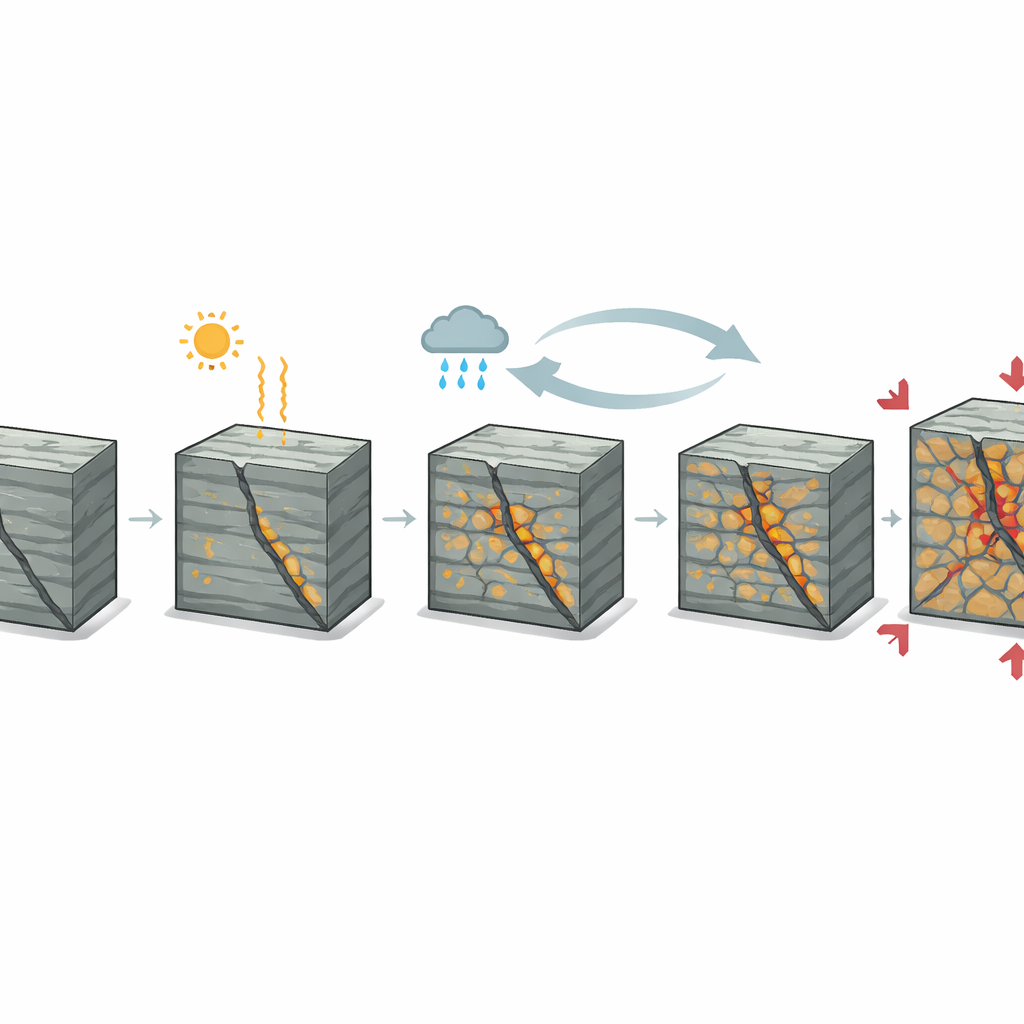
Five Steps on the Road to Failure
When they applied their model to the test data, the predicted curves matched the measurements closely, especially in how damage evolves. The model shows that rock damage progresses through five stages, forming an S‑shaped path: an initial stable phase, a gentle onset of damage, a rapid acceleration phase, a slowing phase as the rock approaches its strength limit, and finally a termination phase where the rock has largely failed. Increasing the number of drying–wetting cycles pushes this S‑curve to the left, meaning the rock reaches serious damage at smaller strains. Higher confining pressure shifts it to the right, delaying failure and allowing more deformation before collapse. The crack angle controls how much initial damage the rock starts with and how directionally the damage spreads, peaking in severity when the crack is inclined at about 45 degrees.
What This Means for Slopes and Tunnels
In everyday terms, the study provides a quantitative “weathering and breaking” rule for cracked shale: repeated wetting and drying act like a hidden accelerator for damage, confining pressure plays the role of a restraining belt, and the orientation of a major crack sets the preferred path for failure. By capturing all three influences in one model that mirrors real stress–strain behavior, engineers gain a tool for forecasting how shale slopes and underground excavations will deteriorate over years of changing seasons and loads. This can guide safer designs, better monitoring, and timely reinforcement before small, invisible changes inside the rock turn into large, visible disasters.
Citation: Li, Y., Wang, Y., Wang, R. et al. A damage constitutive model of carbonaceous shale containing a single crack under drying-weting cycles and triaxial compression. Sci Rep 16, 12427 (2026). https://doi.org/10.1038/s41598-026-41783-x
Keywords: rock slope stability, drying–wetting cycles, cracked shale, rock damage modeling, triaxial compression