Clear Sky Science · en
Bio-optimized complex valued spatiotemporal GNN for herbal species classification
Why smart herb ID matters
From kitchen remedies to modern drugs, many treatments start with the humble leaf. Yet telling one medicinal plant from another is tricky, even for experts, and mistakes can affect research, farming, and health care. This study introduces a computer system that automatically identifies herb species from photos of their leaves, aiming to make plant recognition faster, more accurate, and easier to use outside specialist labs. 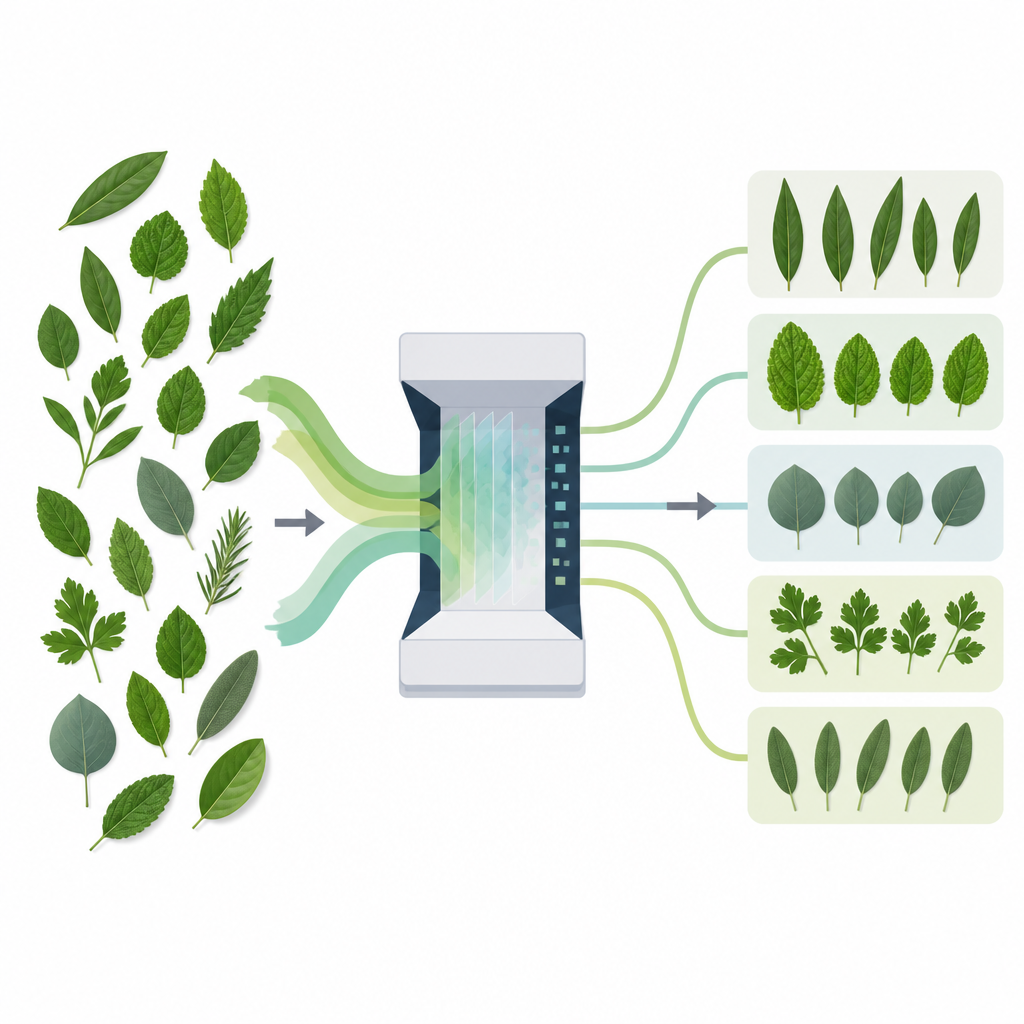
Turning leaf photos into reliable clues
The researchers focus on the idea that a single leaf carries a rich fingerprint of its species. Shape, edge pattern, color shades, and vein texture all encode useful clues. But real photos are messy: backgrounds are noisy, leaves overlap, lighting changes, and many species look deceptively similar. Existing tools often rely on a few handcrafted features or simple deep learning, which can stumble when leaves are damaged, partly hidden, or mixed with soil and other objects. The new system is designed to handle this complexity by cleaning the images carefully and then learning subtle visual patterns more deeply than past approaches.
Cleaning up the picture before making a call
The first stage of the system tackles messy images. A method called Multiple Local Particle Filter scans each photo in small regions and estimates what the true leaf pixels should look like. In practice, this step removes specks, shadows, and background clutter while preserving fine details such as vein lines and leaf edges. Once the image is cleaned, a technique named Revised Tunable Q-Factor Wavelet Transform breaks the leaf into many small patches of color and texture at different scales. This extract not only the outline but also surface patterns and color blends, so the system does not depend on shape alone or texture alone when comparing species. 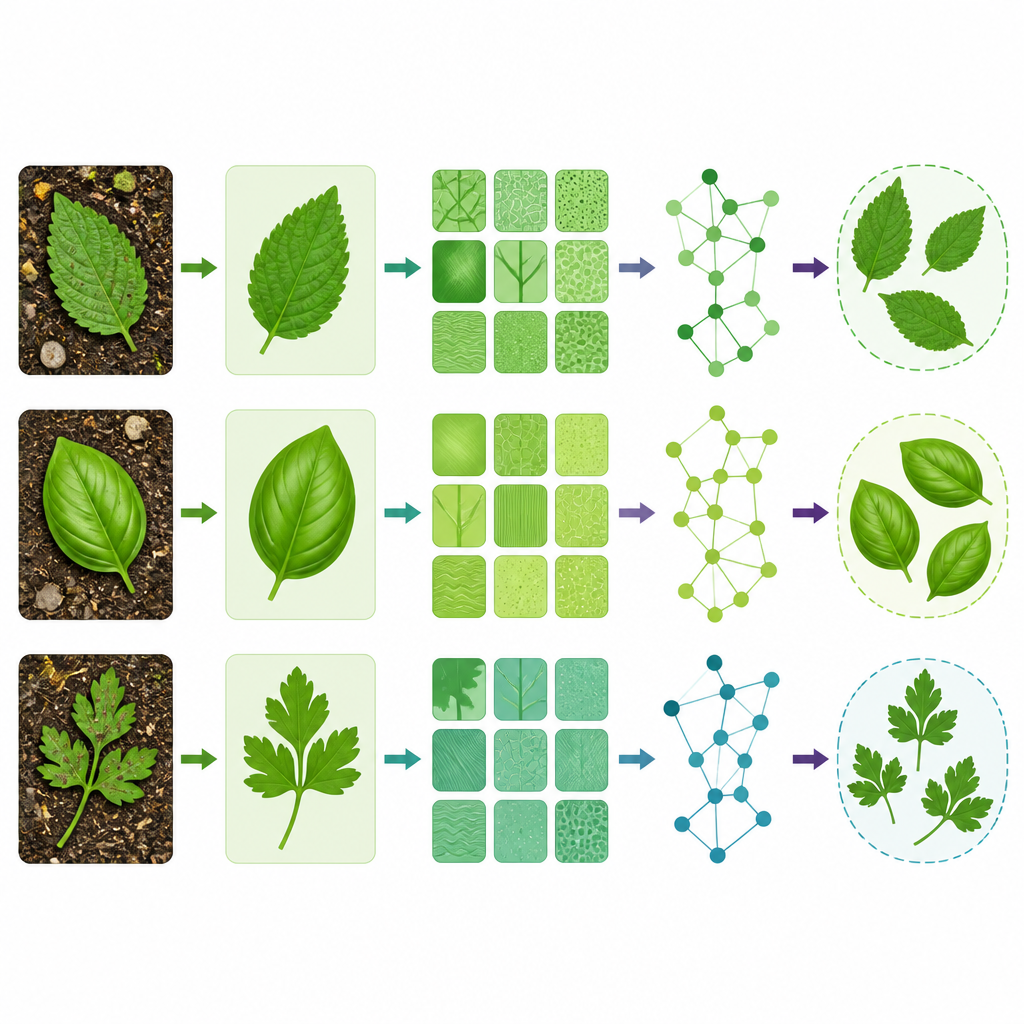
Reading leaves as a network of connected parts
After feature extraction, the system treats each leaf as a network of related regions rather than a flat picture. This is done with a complex valued spatiotemporal graph neural network, which can represent both how strong a visual pattern is and how it is oriented across the leaf surface. Vein directions, for example, become structured relationships between regions rather than isolated pixels. By learning on this graph, the model distinguishes species that share a rough outline but differ in finer structure, such as how veins fan out or how texture changes from center to edge. Tests were carried out on two public datasets of medicinal leaves, including the well known FLAVIA collection and a mobile phone medical leaf set that reflects more realistic image conditions.
Letting a nature inspired search tune the model
To squeeze the best performance out of this graph based learner, the authors use an optimization method inspired by the foraging behavior of manta rays. In this step, many candidate settings for the network are explored, with the algorithm balancing wide search and fine adjustment, much like animals sweeping and narrowing their search for food. This process tunes the network weights to reduce both false alarms and missed detections. As a result, the system achieves about 99.4 percent accuracy, with similarly high precision and recall, and maintains low error rates across many different herb species and datasets.
What this means for everyday use
In simple terms, the study shows that combining smarter image cleanup, richer feature extraction, and a network that treats each leaf as a linked structure can make automatic herb identification extremely reliable. While the method still needs testing on more wild, real world photos and new species, it points toward tools that could help farmers, herbalists, and researchers quickly confirm plant identity using only leaf images. If further developed, such systems could support safer medicinal plant use, better biodiversity tracking, and more efficient agricultural monitoring.
Citation: Vats, P., Vats, S., Sharma, A. et al. Bio-optimized complex valued spatiotemporal GNN for herbal species classification. Sci Rep 16, 15329 (2026). https://doi.org/10.1038/s41598-026-41760-4
Keywords: herbal species classification, leaf image recognition, graph neural network, computer vision in botany, medicinal plants